Chapter 7
Dasha Mahavidya: The 10 Wisdom Goddesses Explained
दश महाविद्या — The Ten Great Wisdoms
The Dasha Mahavidya (दश महाविद्या, "Ten Great Wisdoms"), usually called simply the Mahavidyas, are a group of ten Hindu Tantric goddesses: Kali, Tara, Tripurasundari, Bhuvaneshwari, Bhairavi, Chhinnamasta, Dhumavati, Bagalamukhi, Matangi and Kamala. Shakta tradition regards them as ten forms of one Great Goddess, together covering every side of reality, from terror and loss to beauty and abundance.
The group brings together some of the gentlest and some of the most unsettling images in Hindu religious art. A goddess who cuts off her own head stands beside one who sits on a lotus while elephants pour water over her. That is deliberate. Tradition teaches that the Goddess cannot be known by accepting only her pleasant forms. This page is the hub for our series on the ten Mahavidyas. It gives you a quick summary table, a short profile of each goddess with a link to her full page, the origin myth, and the main ways the tradition groups and interprets them.
What Are the 10 Mahavidyas? Names, Meanings and Symbols
The table below gives the most widely used order, which follows texts such as the Mahabhagavata Purana and the Todala Tantra. Meanings are literal translations or common epithets. The symbolism column gives the usual interpretation, not the only one.
| # | Goddess | Meaning / Epithet | Key Symbolism | Full Profile |
|---|---|---|---|---|
| 1 | Kali काली | "The Black One"; she who is Time (kala) | Time, death, dissolution of the ego | Read more about Kali |
| 2 | Tara तारा | "Star"; "she who carries across" | Rescue, guidance, the power of speech | Read more about Tara |
| 3 | Tripurasundari त्रिपुरसुन्दरी | "Beauty of the three worlds"; also Shodashi, Lalita | Beauty, desire made divine, the Sri Yantra | Read more about Tripurasundari |
| 4 | Bhuvaneshwari भुवनेश्वरी | "Queen of the worlds" | Space, the cosmos as her body | Read more about Bhuvaneshwari |
| 5 | Bhairavi भैरवी | "The fierce / terrifying one" | Tapas (spiritual heat), destruction of impurity | Read more about Bhairavi |
| 6 | Chhinnamasta छिन्नमस्ता | "She whose head is severed" | Self-sacrifice, life feeding on life, going beyond the ego | Read more about Chhinnamasta |
| 7 | Dhumavati धूमावती | "The smoky one"; the widow | Loss, old age, emptiness, detachment | Read more about Dhumavati |
| 8 | Bagalamukhi बगलामुखी | Often read as "she who paralyses" or "crane-faced" | Stillness, silencing speech, stambhana (immobilising) | Read more about Bagalamukhi |
| 9 | Matangi मातङ्गी | "She of the Matanga" (an outcaste community in the myths) | Speech, music, learning, the "leftover" and marginal | Read more about Matangi |
| 10 | Kamala कमला | "She of the lotus"; also Kamalatmika | Prosperity, good fortune, grace; the tantric Lakshmi | Read more about Kamala |
Some texts and regional traditions list the goddesses in a different order or swap in other names. Some lists, for example, include forms of Durga or name Tripurasundari as Shodashi or Shri. Across most sources, though, the ten above are the standard set. They are usually shown together in painted panels and temple niches.
The Origin of the Mahavidyas: Sati and Daksha
The best-known origin story comes from the Mahabhagavata Purana, a medieval Shakta text from eastern India, and a similar version appears in the Brihaddharma Purana. It draws on the older myth of Daksha's sacrifice. Sati's father, Daksha, holds a great fire sacrifice and deliberately leaves out her husband, Shiva. Sati wants to go anyway. Shiva forbids it.
In the Mahabhagavata version, Sati grows furious at being refused. She takes on a terrifying, dark form, and Shiva is alarmed and tries to leave. Wherever he turns, a different goddess blocks his way. Sati has become ten forms, one standing in each of the ten directions (the eight compass points, above and below). When Shiva asks who they are, Sati names them as her own forms, the ten Mahavidyas. Shiva gives way, and Sati goes to the sacrifice. There she ends her own life after Daksha insults Shiva. That event is linked to the origin of the Shakti Peethas, the goddess seats set out one by one in our list of the 51 Shakti Peethas.
The myth carries a clear theological message. The Goddess is not a subordinate consort. She fills every direction of space and is greater than even Shiva can escape. Scholars such as David Kinsley note that the story also shows the Goddess asserting her will against male authority, a theme that runs through Shakta literature. Other texts explain the ten differently. Some treat them as emanations of Kali or Durga, and some later texts match them with the ten avatars of Vishnu. The Sati story, however, is the one most often told today.
How Old Is the Mahavidya Tradition?
Several of the goddesses, such as Kali and Lakshmi (Kamala), are much older than the group itself, and Tara and Chhinnamasta have close counterparts in Buddhist Tantra. As a fixed set of ten, however, the Mahavidyas appear mainly in medieval and later Tantric and Puranic texts. Their worship is especially strong in Bengal, Assam, Odisha and Nepal. Historians therefore treat the group as a medieval Shakta synthesis rather than an ancient Vedic grouping. For the wider historical background, see our chapter on the origins of Tantra.
The Ten Mahavidyas: Short Profiles
Each profile gives the essentials. Follow the links for the full iconography, myths, mantras and temples of each goddess.
1. Kali — Goddess of Time and Transformation
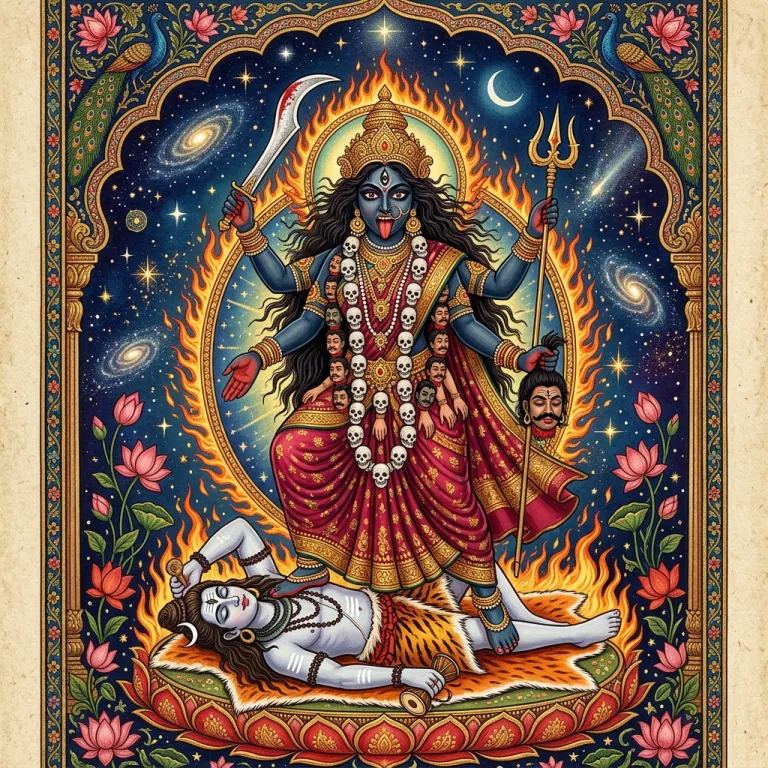
Kali (काली) comes first in almost every list and is often called the adya, or primordial, Mahavidya. Her name is linked to kala, time, which eventually consumes all things. In the popular Dakshina Kali image she is dark or black, naked or clothed in space, and wears a garland of severed heads and a skirt of severed arms. She holds a sword and a severed head, while her other two hands make gestures of fearlessness and blessing. She stands on Shiva, who lies beneath her.
Her devotees interpret the fearsome images symbolically. The heads stand for the ego, and her nakedness means she is beyond all concealment. The poet-saints of Bengal, and Ramakrishna at Dakshineswar, addressed her above all as a loving Mother. Major centres include Kalighat and Dakshineswar in Kolkata. Read the full Kali profile →
2. Tara — The Goddess Who Carries Across
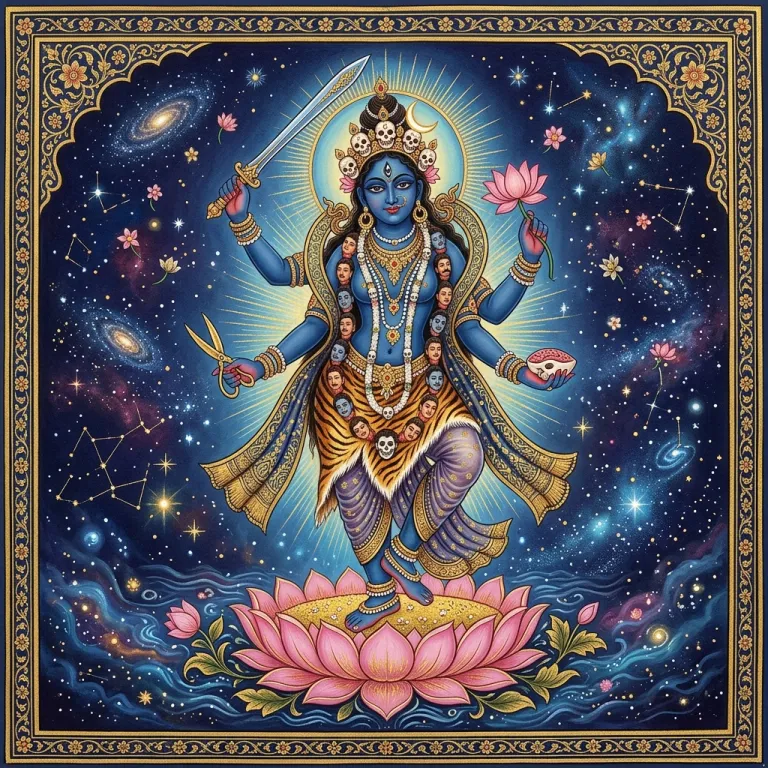
Tara (तारा) means "star" and "she who carries across," that is, across the ocean of worldly suffering. She looks much like Kali, but she is usually blue, short and pot-bellied. She wears a tiger skin and holds a sword, scissors, a skull cup and a blue lotus, and she stands on a corpse or on Shiva. Her forms include Ugra Tara, the fierce Tara, and Nila Sarasvati, which links her to speech and learning.
A well-known Bengali tradition says Tara nursed Shiva after he swallowed the poison churned from the cosmic ocean. Her chief temple is at Tarapith in West Bengal, which has long been associated with cremation-ground practice. The goddess Tara is also central to Tibetan Buddhism, and scholars continue to discuss how the Hindu and Buddhist Taras are related. Read the full Tara profile →
3. Tripurasundari (Shodashi) — Beauty of the Three Worlds
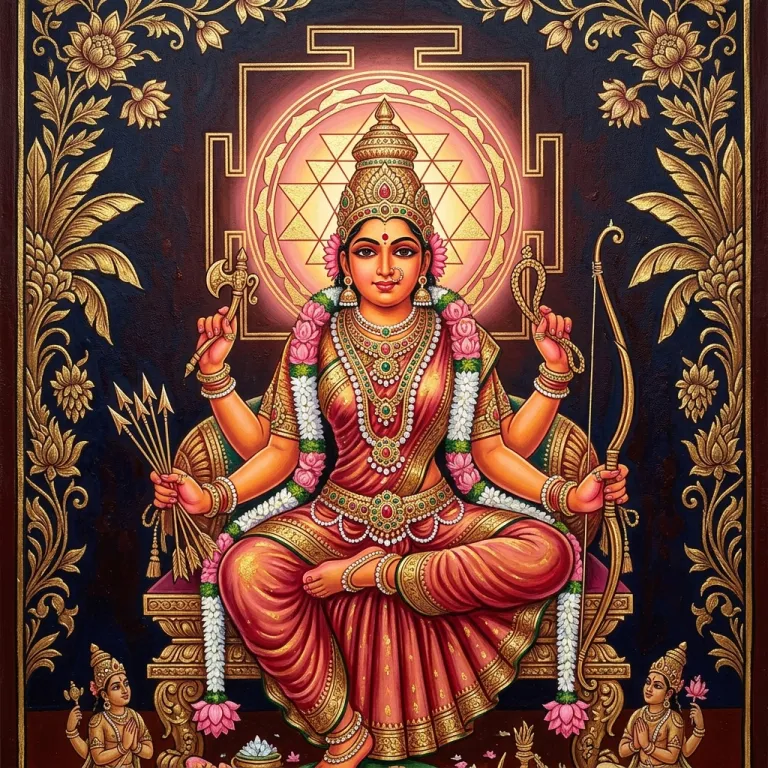
Tripurasundari (त्रिपुरसुन्दरी) is "the beautiful one of the three worlds," or of the three cities. She is also called Shodashi, "the sixteen-year-old," and Lalita, "she who plays." She is shown red-complexioned and radiant, holding a noose, an elephant goad, a sugarcane bow and five flower arrows. In many depictions she sits on a throne whose legs are the gods Brahma, Vishnu, Rudra and Ishvara.
She is the central deity of Sri Vidya, the tradition that worships her through the Sri Yantra and the fifteen-syllable Panchadashi mantra, and through hymns such as the Lalita Sahasranama and Saundarya Lahari. For many Sri Vidya practitioners she is the highest form of the Goddess, not just one of ten. Read the full Tripurasundari profile →
4. Bhuvaneshwari — Queen of the Worlds
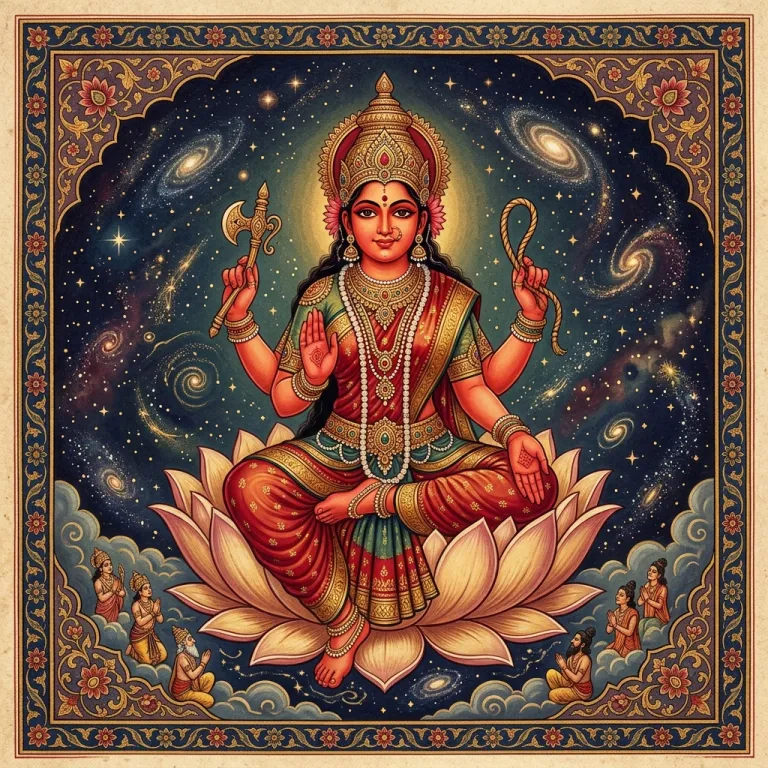
Bhuvaneshwari (भुवनेश्वरी) means "mistress of the worlds." She is a calm, benevolent figure with a bright complexion and a crescent moon on her crown. She usually holds a noose and a goad and makes gestures of blessing and fearlessness. Her seed syllable, hrim, is one of the best-known bija mantras in Shakta practice.
Her main association is with space, the room in which the universe unfolds. In this reading the created world is not an illusion to run from but the Goddess's own body and domain. Her name implies both sovereignty and nurture: she creates the worlds, fills them and governs them. She is closely related to Tripurasundari and shares some of her imagery. Read the full Bhuvaneshwari profile →
5. Bhairavi — The Fierce Goddess of Tapas
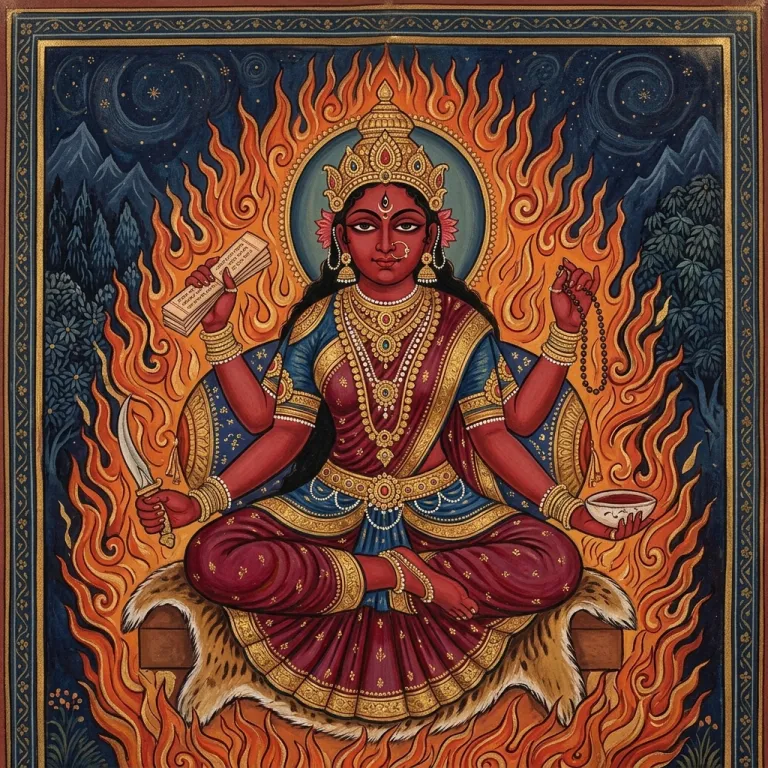
Bhairavi (भैरवी) is the feminine counterpart of Bhairava, the terrifying form of Shiva. Her name means "fierce" or "terrifying." Her meditation verses describe her as red, like thousands of rising suns, wearing a garland of heads and smeared with blood. She holds a rosary and a book, or weapons, and her other hands make gestures of fearlessness and blessing. She has several named forms, including Tripura Bhairavi.
She is commonly linked with destruction and with tapas, the burning heat of spiritual discipline. In this sense she is the fire that consumes impurities and complacency. The title bhairavi is also used for accomplished female Tantric practitioners. Ramakrishna's Tantric teacher, for example, is remembered as the Bhairavi Brahmani (see notable masters). Read the full Bhairavi profile →
6. Chhinnamasta — The Self-Decapitated Goddess
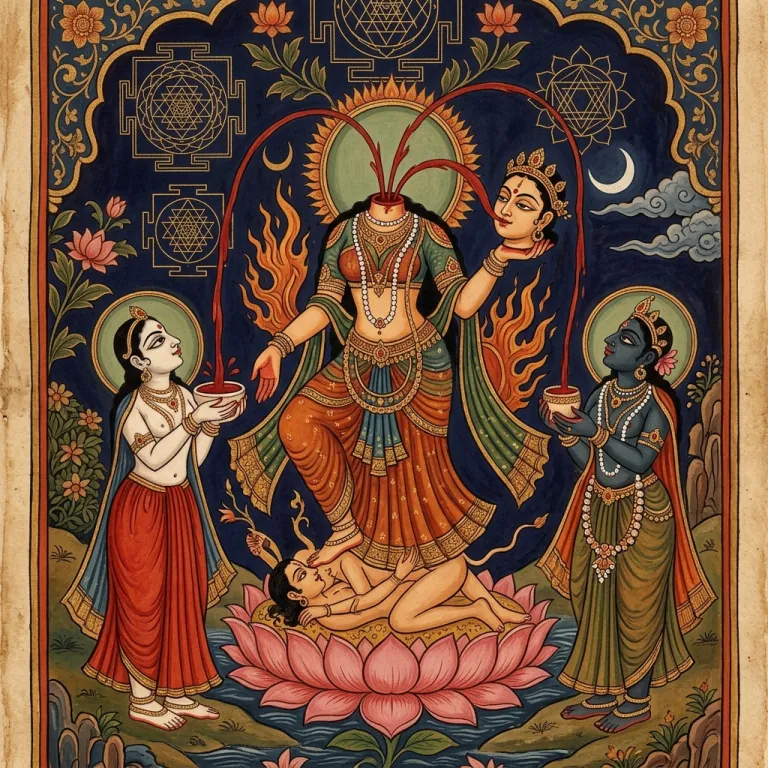
Chhinnamasta (छिन्नमस्ता), "she whose head is severed," holds her own cut-off head in one hand and a blade in the other. Three streams of blood spring from her neck. One flows into her own mouth, and the other two flow into the mouths of her attendants, often named Dakini and Varnini. She usually stands on a couple making love, commonly identified as Kama and Rati, the god of desire and his wife.
Interpretations include self-sacrifice that nourishes others, the cycle of life feeding on life, and control over, or transformation of, desire. Elisabeth Benard's study shows her close relationship with the Buddhist Chinnamunda, a form of Vajrayogini. Her best-known temple is at Rajrappa in Jharkhand. Read the full Chhinnamasta profile →
7. Dhumavati — The Widow Goddess
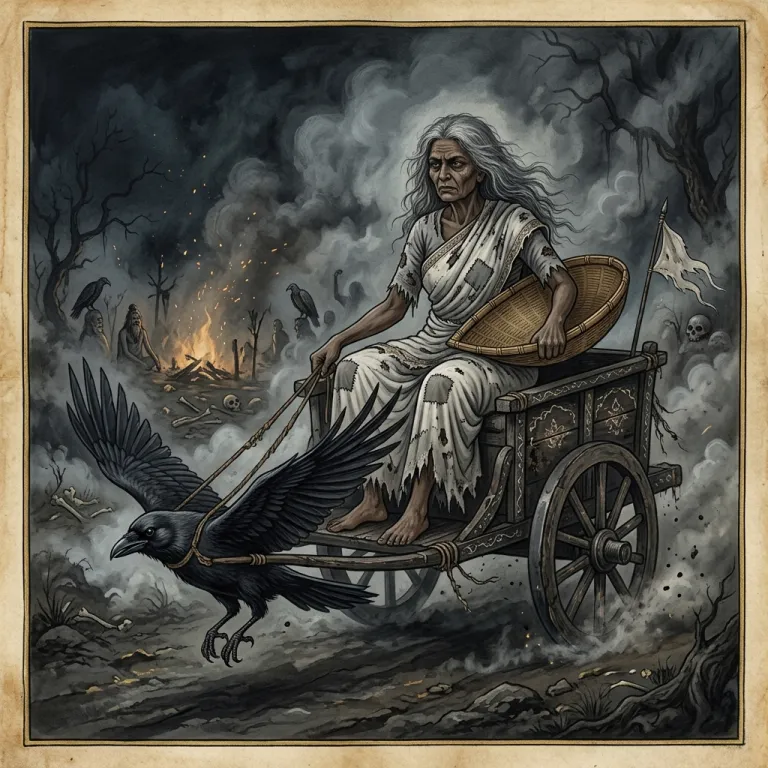
Dhumavati (धूमावती), "the smoky one," is an old, gaunt widow in pale, dirty clothes. She carries a winnowing basket and rides a crow or sits in a chariot with a crow banner. She is associated with hunger, poverty, quarrels, misfortune and inauspicious times. One well-known story says Sati, overcome by hunger, swallowed Shiva. He persuaded her to release him and then cursed her to live as a widow.
She is rarely approached for worldly favours. Her religious meaning lies in facing what people fear most, including ageing, loss and disappointment, and in the detachment that follows. Some practitioners value her especially for renunciation. Dhumavati temples are rare. A well-known one is in Varanasi, and there is a shrine within the Pitambara Peeth complex at Datia. Read the full Dhumavati profile →
8. Bagalamukhi — The Goddess Who Stuns
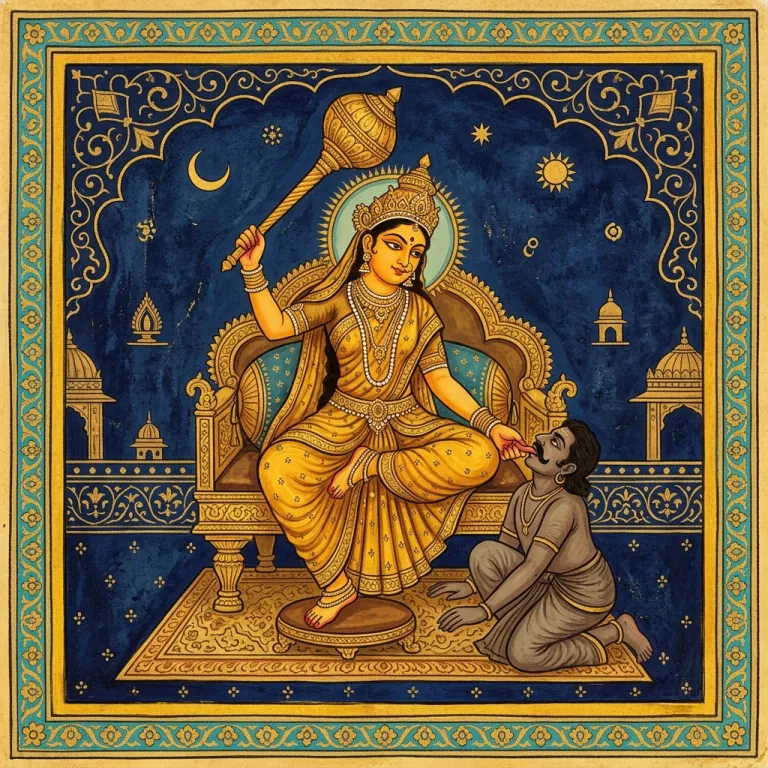
Bagalamukhi (बगलामुखी) is dressed and garlanded in yellow, and she is also called Pitambara. She grasps a demon by the tongue with one hand and raises a club with the other. Her name is often read as "crane-faced." Some scholars instead derive it from valga, a bridle or restraint. Her defining power is stambhana, bringing things to a standstill.
Traditional texts say her worship can silence opponents, win disputes and lawsuits, and immobilise enemies. These are traditional claims made in ritual manuals. They are not demonstrated effects, and this site does not endorse using ritual against others. Contemplative readings take her "stilling" inward, as the power to stop restless thought and useless speech. Pitambara Peeth in Datia and the temple at Nalkheda, both in Madhya Pradesh, are well-known shrines. Read the full Bagalamukhi profile →
9. Matangi — The Outcaste Goddess of Speech and Music
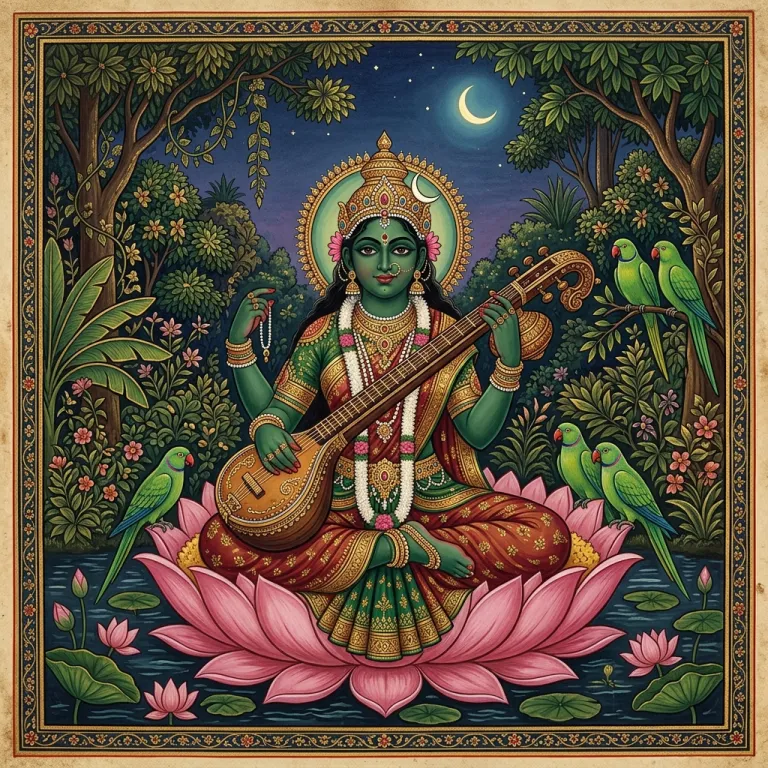
Matangi (मातङ्गी) is dark or emerald-green. She plays a veena, and a parrot is often shown with her. She governs speech, music, learning and the arts, which is why she is often called a tantric counterpart of Saraswati. Unlike Saraswati, she is linked with the Matanga, an outcaste community in the myths, and with ucchishta, leftover food that orthodox purity rules treat as polluted. Some of her rites prescribe offering such leftovers.
Scholars read her as a deliberate challenge to purity and caste boundaries: in this view, wisdom is found even in what society rejects. In Sri Vidya, a form of Matangi called Shyamala or Raja Matangi serves as the chief minister of Lalita Tripurasundari. Read the full Matangi profile →
10. Kamala — The Lotus Goddess
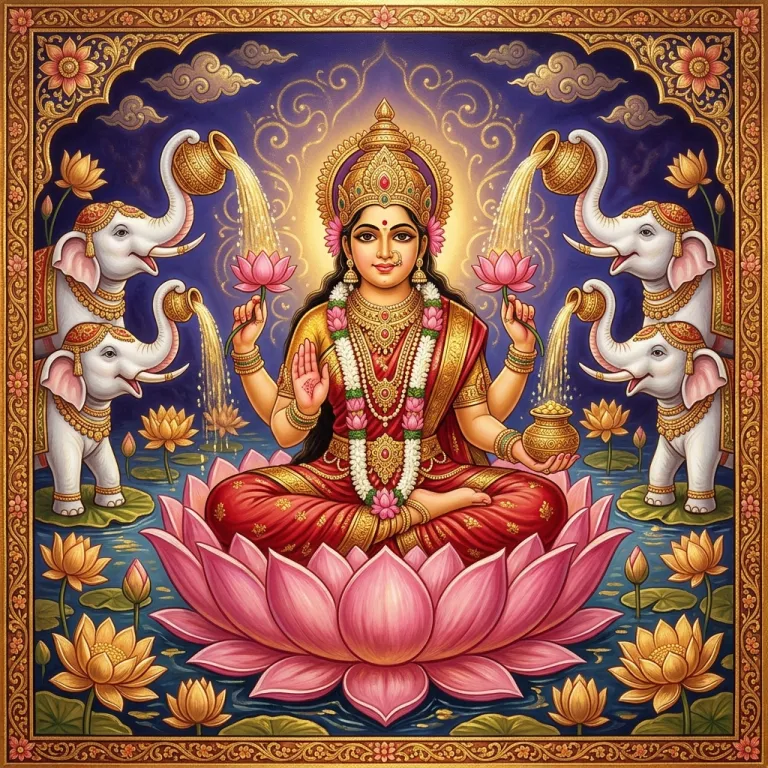
Kamala (कमला), also called Kamalatmika, is "she of the lotus." She is golden, sits on a lotus and holds lotuses in two hands. Her other hands make gestures of blessing and fearlessness, and elephants pour water over her from pots. The image is closely modelled on Gaja Lakshmi, and Kamala is widely understood as the tantric form of Lakshmi, goddess of prosperity and good fortune.
She comes last in the usual order, and many interpreters treat that position as meaningful. After the dissolution, loss and austerity of the fierce goddesses, the list ends with abundance, harmony and grace. Worldly well-being is thus affirmed as part of the divine, not opposed to it. Unlike the Lakshmi of mainstream worship, Kamala is approached through tantric ritual and yantra. Read the full Kamala profile →
Kali-kula and Sri-kula: How the Mahavidyas Are Grouped
Shakta Tantra is often divided into two broad "families" (kula). The Kali-kula centres on Kali and related fierce goddesses such as Tara. It has historically been strongest in Bengal, Assam, Odisha and Nepal. The Sri-kula centres on Tripurasundari, the Sri Yantra and the Sri Vidya lineages, and it is especially strong in South India. The Mahavidya set cuts across both families: Kali and Tara lead the list, while Tripurasundari, Bhuvaneshwari, Matangi and Kamala have a special place in Sri-kula worship. See the three Tantric traditions for how these streams relate to Kaula and Samaya approaches.
| Feature | Kali-kula | Sri-kula |
|---|---|---|
| Central goddess | Kali (with Tara) | Lalita Tripurasundari |
| Main regions | Bengal, Assam, Odisha, Nepal | South India (historically also Kashmir) |
| Key symbol | Cremation ground, Kali yantra | Sri Yantra (Sri Chakra) |
| Mahavidyas most emphasised | Kali, Tara, Chhinnamasta, Dhumavati | Tripurasundari, Bhuvaneshwari, Matangi, Kamala |
Many modern writers also sort the ten informally by temperament. The fierce (ugra) goddesses are Kali, Tara, Chhinnamasta, Dhumavati and Bagalamukhi, and the gentle (saumya) ones are Tripurasundari, Bhuvaneshwari, Matangi and Kamala. Bhairavi is placed in either group depending on the text. These are helpful study aids, not rigid classifications found in every source. Other schemes map the ten onto the nine planets, the ten avatars of Vishnu, the Bhairavas and the chakras; our guide to Mahavidya correspondences explains which of those lists have a textual basis and which do not.
What Do the Mahavidyas Mean? A Complete Spiritual Path
Many modern teachers read the ten as stages of one spiritual journey. This is an interpretive framework, not a teaching fixed in the classical texts. In this reading, Kali dissolves illusion, Tara guides the seeker through darkness, Tripurasundari reveals beauty as consciousness, and Bhuvaneshwari shows the world as sacred space. Bhairavi supplies the fire of discipline, and Chhinnamasta demands self-sacrifice. Dhumavati teaches acceptance of loss, Bagalamukhi stills the mind, and Matangi finds wisdom at the margins. Kamala completes the path with grace and abundance.
A second recurring theme is that the Mahavidyas overturn convention. Several of them embody things orthodox Brahmanical society avoided: widowhood, pollution, blood, the cremation ground and female autonomy. Kinsley argues that this is central to their meaning. By treating the forbidden as sacred, they push the worshipper past ordinary ideas of pure and impure, auspicious and inauspicious. For the philosophical background, see our chapter on Tantric philosophy.
How Are the Mahavidyas Worshipped?
Each Mahavidya has her own meditation verse (dhyana), seed mantra, yantra, and hymns such as the kavacha ("armour") and the hundred- or thousand-name litanies. Ritual manuals also pair each goddess with a consort form of Shiva known as her Bhairava. Worship follows the general pattern of Tantric sadhana: purification, nyasa (ritually placing mantras on the body), meditation on the goddess's form, mantra repetition and offerings. Some goddesses, such as Kamala and Bhuvaneshwari, are also worshipped in ordinary devotional ways at home and in temples. Others, especially Chhinnamasta and Dhumavati, are mostly approached by initiates.
Shakta lineages often concentrate Mahavidya worship in Gupt Navratri, the two “hidden” Navratris of Magha and Ashadha, when the ten goddesses are commonly honoured one per day. Household worship during Sharad Navratri, by contrast, usually follows the nine Navadurga instead — see Mahavidya vs Navadurga for how the two groups differ. In both settings the text most often recited is the Durga Saptashati, the Puranic work that first presented the Goddess as supreme reality and supplied much of the fierce imagery the Mahavidyas inherit. Temples dedicated to all ten are uncommon. The Kamakhya temple complex in Assam has shrines to the ten Mahavidyas on and around Nilachal Hill, and several newer temples in north and east India display the full set.
A note on practice
The Mahavidya traditions consistently say their mantras and rites should be received from a qualified teacher through initiation (diksha). This page is educational. It does not give ritual instructions, and it makes no claim that any practice will bring particular results. If you are dealing with distress, illness or conflict, please seek appropriate medical, psychological or legal help.
Which Mahavidya Should One Worship?
This is among the most common questions asked about the Mahavidyas, and the honest answer is that the tradition does not treat it as a personal choice. In Shakta and Tantric lineages the goddess a practitioner takes as their ishta-devata (chosen deity) is settled by the lineage: she comes with the family's kula-devata, or she is given by a teacher at initiation (diksha) together with the mantra that belongs to her. It is the teacher's judgement, not a list, that matches a practitioner to a Mahavidya.
Lineages differ in how they arrive at that decision, and the procedures are not public. Some ritual compendia and later astrological manuals contain schemes based on the letters of a name, on the syllables of a mantra, or on a horoscope; the schemes disagree with one another, and where they are used at all they are applied by a teacher rather than by the seeker. Our page on Mahavidya correspondences sets out the main systems and explains why they should not be read as a transactional "worship this goddess to fix that problem" table.
So no page, this one included, should assign a Mahavidya to a reader. Anyone offering to select your goddess from your birth details for a fee is selling a service the tradition does not recognise. What is open to everyone is study, reverence and ordinary devotion: reading the myths, visiting temples, and reciting widely published hymns such as the Durga Saptashati. The gentler forms, especially Kamala, Bhuvaneshwari and Tripurasundari, are also honoured in plain householder fashion with lamp, flowers and a hymn, which is a different thing from taking up their tantric sadhana.
The Mahavidyas and the Shakti Peethas
The ten Mahavidyas and the Shakti Peethas are two different systems that people often look up together, and they are joined at the root rather than item by item. Both grow out of the same Sati narrative. In the Mahavidya origin story Sati takes ten forms when Shiva refuses to let her attend her father Daksha's sacrifice; in the Peetha story she dies at that sacrifice, and the places where parts of her body fell as Shiva carried her became the Peethas. One myth yields a set of goddesses, the other a map of places.
The two systems share a structural habit as well. Each Peetha is traditionally listed with a goddess and her Bhairava, and each Mahavidya is likewise paired with a Bhairava in ritual manuals. A few sites sit inside both frames at once: Tarapith in Birbhum is a famous seat of Tara, who is also the second Mahavidya, and the Kamakhya complex in Assam, the best known of the Peethas, has separate shrines for all ten Mahavidyas on and around Nilachal Hill.
Where the two do not line up is in the counting. The Peetha lists run to 51 or 52 in the common enumerations and to 108 in others, and the goddess named at each site is usually a local or regional form rather than one of the ten. Identifications between a Peetha goddess and a Mahavidya do exist, but they vary by source and by region, so they are better read as local theology than as a fixed table. Our chapter on sacred geography covers how the Peetha map was assembled.
Are the Mahavidyas Dangerous? The "Ugra Devata" Question
Several Mahavidyas carry a reputation as ugra devatas, fierce deities. Ritual texts do sort goddesses loosely into ugra (fierce) and saumya (gentle) types, and Kali, Bhairavi, Chhinnamasta, Dhumavati and Bagalamukhi are normally placed on the fierce side, with Tripurasundari, Bhuvaneshwari and Kamala on the gentle one. That classification describes how a goddess is approached in ritual. It is not a warning that she harms her devotees.
What the tradition actually cautions about is narrower than the internet suggests. Its standing positions are that the mantras and rites of the fierce forms are received from a qualified teacher rather than picked up from a book or a video; that some lineages restrict particular goddesses to particular practitioners, so that Dhumavati, the widow goddess, is in many places kept away from household and marriage rites; and that rites aimed at harming or controlling another person are condemned within the tradition itself, whatever the manuals describe. Intensive practice of any kind, including long fasting, prolonged retreat and forceful breathwork, carries the ordinary risks that intensive practice always carries. That is an argument for having a teacher, not for being afraid of a goddess.
Why do such forms exist at all? Shakta theology answers that a Goddess who is reality itself must also contain what people would rather not look at: time, death, hunger, loss and disgust. Chhinnamasta severing her own head, Dhumavati's smoke and widowhood, Kali standing in the cremation ground — these are teaching images about the end of a self-image, not portraits of malice. Tantra's method has been to face what is feared rather than avoid it, which is precisely why these goddesses are depicted as they are. David Kinsley's study of the group reads the fierce Mahavidyas in exactly this way.
It is worth saying plainly that most of the fear content about these goddesses is commercial. Pages and videos warning about the "side effects" of a particular mantra, or about what a fierce goddess will do to someone who makes a mistake, usually exist to create alarm and then sell the remedy, consultation or puja that removes it. We describe that pattern, and how to recognise it, in our page on fear, black magic and the remedy industry. Reading about the Mahavidyas, visiting their temples and honouring them devotionally is not a hazardous act.
Frequently Asked Questions
What are the 10 Mahavidya names?
The ten Mahavidyas, in their usual order, are Kali, Tara, Tripurasundari (also called Shodashi or Lalita), Bhuvaneshwari, Bhairavi, Chhinnamasta, Dhumavati, Bagalamukhi, Matangi and Kamala (Kamalatmika). Some texts vary the order or substitute a name, but this list is the standard one found in most Shakta sources and temple art.
What does Mahavidya mean?
Mahavidya is Sanskrit for "great wisdom" or "great knowledge." In Tantric usage, vidya also refers to a goddess's mantra, so a Mahavidya is both a goddess and the liberating knowledge she embodies. Dasha simply means "ten," so Dasha Mahavidya means "the ten great wisdoms."
Who is the most powerful Mahavidya?
Traditions do not agree. Kali-kula practitioners usually treat Kali as the first and highest Mahavidya, while Sri Vidya practitioners regard Tripurasundari as supreme. Shakta theology generally holds that all ten are forms of one Goddess, so ranking them is a question of lineage and personal devotion rather than doctrine.
How did the ten Mahavidyas originate?
In the best-known account, from the Mahabhagavata Purana, Shiva forbade Sati to attend her father Daksha's sacrifice. Angered, she took ten forms that surrounded Shiva in all ten directions. She identified them as the Mahavidyas, and Shiva relented. Other texts give different origin stories.
Is Tripurasundari the same as Lalita?
Yes. Tripurasundari, Lalita, Lalita Tripurasundari, Shodashi and Rajarajeshwari are names for the same goddess, the central deity of Sri Vidya. The Lalita Sahasranama praises her thousand names, and she is worshipped through the Sri Yantra. As a Mahavidya she is usually listed third.
Can anyone worship the Mahavidyas?
Anyone can learn about the Mahavidyas, read their hymns and honour them devotionally, and gentler forms such as Kamala are widely worshipped at home. However, tradition holds that their specific mantras and tantric rites require initiation from a qualified guru, especially for fierce goddesses like Chhinnamasta, Dhumavati and Bagalamukhi.
What is the difference between the Mahavidyas and the Navadurga?
The Navadurga are nine forms of Durga, worshipped one per night during Navaratri, from Shailaputri to Siddhidatri. The Mahavidyas are ten tantric goddesses associated especially with esoteric Shakta practice. The two sets overlap in spirit, since both are forms of the Great Goddess, but they have different names, myths and ritual contexts.
Which Mahavidya should I worship?
Tradition treats this as a question for a teacher rather than a personal choice. The goddess a practitioner takes up normally comes with the family or lineage deity, or is given by a guru at initiation along with her mantra. No article can assign you a Mahavidya, and anyone selecting one from your birth details for a fee is offering something the tradition does not recognise.
Are the Mahavidyas dangerous?
Not to someone reading about them or honouring them devotionally. Several are classed as ugra, fierce, and the tradition is firm that their mantras and rites should come from a qualified teacher rather than a book or a video. The real risks are ordinary ones: intensive practice without guidance, and people who manufacture fear about a goddess in order to sell the remedy.
Which Mahavidya can be worshipped at home?
The gentler forms are the ones usually kept in household shrines, above all Kamala, Bhuvaneshwari and Tripurasundari, along with Kali in her domestic Bengali forms. That means ordinary devotion, a lamp, flowers and a published hymn, rather than tantric sadhana, which the tradition reserves for initiates. Fierce forms such as Chhinnamasta and Dhumavati are generally approached only within a lineage.
Are the Mahavidyas connected to the Shakti Peethas?
They share the Sati myth rather than a one-to-one mapping. The Mahavidyas appear when Sati takes ten forms before Daksha's sacrifice; the Shakti Peethas mark where parts of her body fell afterwards. A few places belong to both frames, such as Tarapith for Tara and Kamakhya, which has shrines for all ten. Identifications between a Peetha goddess and a Mahavidya vary by region and source.
Sources & Further Reading
- David Kinsley, Tantric Visions of the Divine Feminine: The Ten Mahāvidyās. University of California Press, 1997.
- David Kinsley, Hindu Goddesses: Visions of the Divine Feminine in the Hindu Religious Tradition. University of California Press, 1986.
- Elisabeth Anne Benard, Chinnamastā: The Aweful Buddhist and Hindu Tantric Goddess. Motilal Banarsidass, 1994.
- Rachel Fell McDermott and Jeffrey J. Kripal (eds.), Encountering Kālī: In the Margins, at the Center, in the West. University of California Press, 2003.
- Douglas Renfrew Brooks, Auspicious Wisdom: The Texts and Traditions of Śrīvidyā Śākta Tantrism in South India. SUNY Press, 1992.
- S. Shankaranarayanan, The Ten Great Cosmic Powers: Dasa Mahavidyas. 1972.
- Hugh B. Urban, The Power of Tantra: Religion, Sexuality and the Politics of South Asian Studies. I.B. Tauris, 2010.
- Primary texts referred to: Mahabhagavata Purana, Brihaddharma Purana, Todala Tantra.