Chapter 07
Dasha Mahavidya
दश महाविद्या — The Ten Wisdom Goddesses
Overview
The Dasha Mahavidya (दश महाविद्या) — literally "Ten Great Wisdoms" — are ten Tantric goddesses who represent the totality of the Divine Feminine (Shakti). Together, they encompass every aspect of existence — creation and destruction, beauty and terror, abundance and void.
Core Teaching: Reality includes both light and dark. The Dasha Mahavidya are the Tantric response to a spirituality that only embraces beauty — they say: "If you want to know the Whole, you must embrace ALL of it."
The Origin Myth
According to the Shakta Maha-Bhagavata Purana: When Lord Shiva refused to permit his consort Sati to attend her father Daksha's fire sacrifice, Sati became furious. In her anger, she manifested into ten terrifying forms filling all ten directions, demonstrating to Shiva that she IS the entire universe — there is nowhere she is not present.
1. Kali (काली) — The Goddess of Time
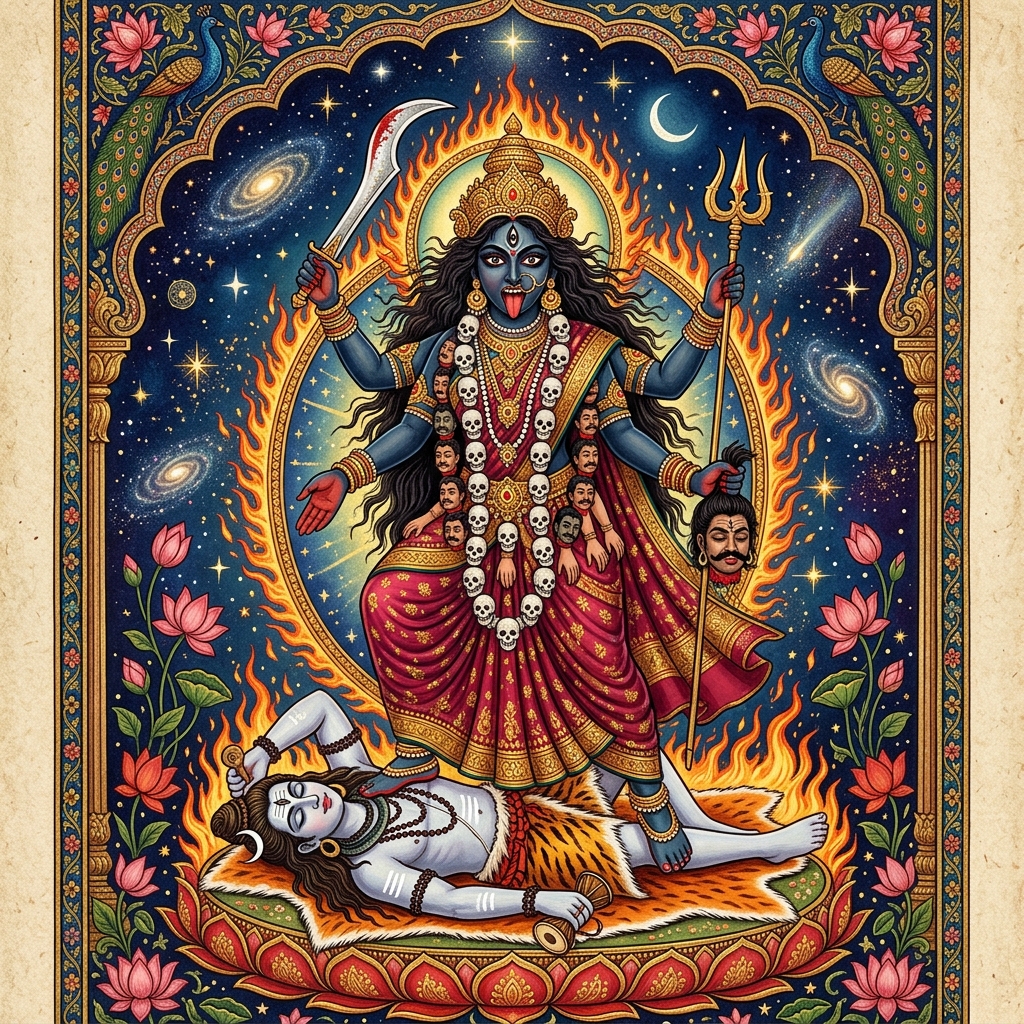
Kali Maa — The compassionate mother who destroys the ego-demon to liberate her children
| Meaning | "The Black One" / "She Who is Time" (काल) |
| Function | Dissolution, time, death, transformation |
| Appearance | Dark-skinned, garland of skulls, tongue protruding, standing on Shiva |
| Teaching | The ego must die for the true Self to be realized |
| Worship Centers | Kalighat, Kolkata; Kamakhya, Assam; Dakshineswar |
Kali is not "evil" or "destructive" in a negative sense. She is Kala (Time) itself — the force that swallows everything temporal to reveal the timeless. She is the compassionate mother who kills the ego-demon to liberate her children.
2. Tara (तारा) — The Savior Goddess
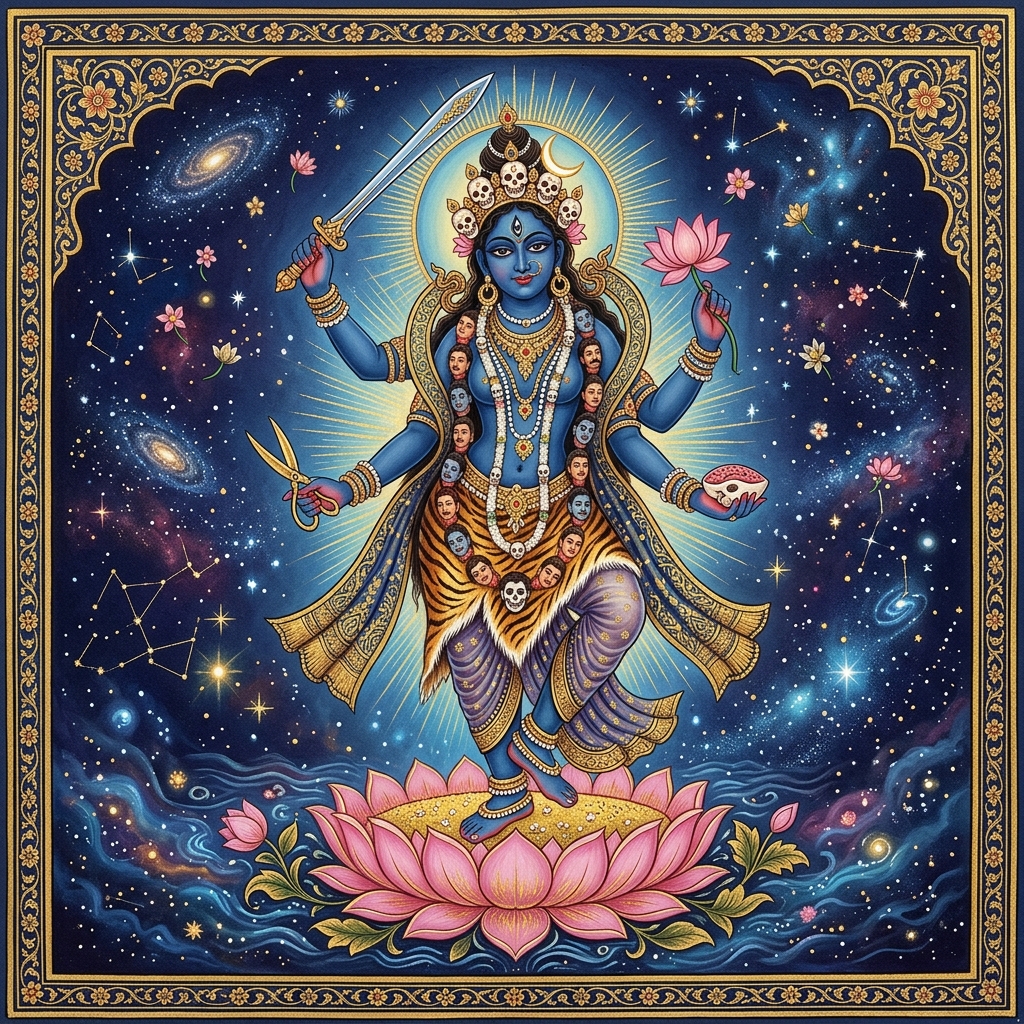
Tara — She Who Carries Across the ocean of worldly existence
| Meaning | "She Who Carries Across" / "The Star" |
| Function | Salvation, protection, guidance through dangers |
| Teaching | Sound (Shabda) is the primal creative power |
| Worship Center | Tarapith, West Bengal |
| Connection | Also found in Buddhism as the goddess Tara |
Tara represents the power of primordial sound (Nada) that carries the practitioner across the ocean of worldly existence. She is the bridge between the known and unknown.
3. Tripura Sundari (त्रिपुरसुन्दरी) — Beauty of the Three Worlds
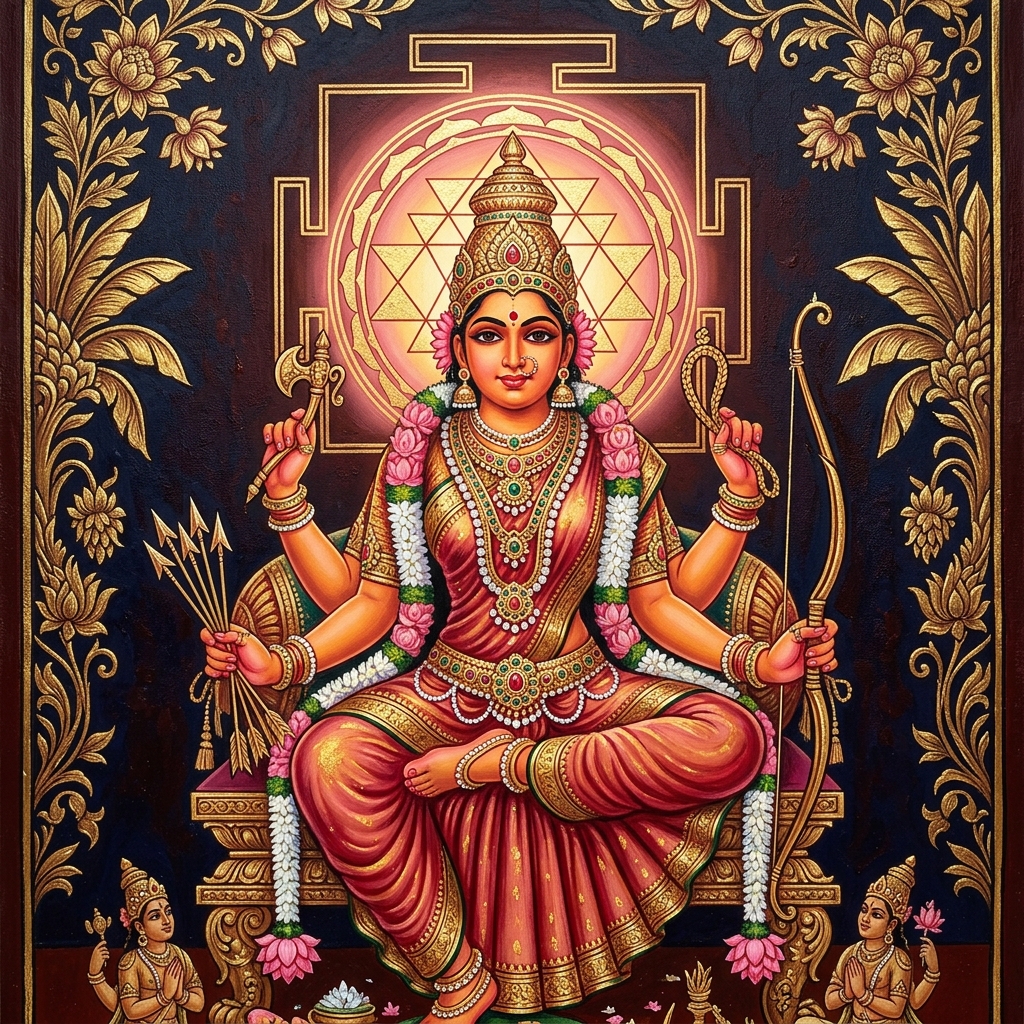
Lalita Tripurasundari — The supreme Goddess of the Sri Vidya tradition
| Meaning | "Beauty of the Three Cities" / "The Sixteen-Year-Old" |
| Function | Beauty, harmony, desire, supreme knowledge |
| Teaching | The universe is an expression of divine beauty and desire |
| Practice | Sri Chakra/Sri Yantra worship, Panchadashi mantra |
She is considered the highest form of the Goddess — more subtle than Kali. She teaches that Iccha (desire/will) at its deepest level is divine. She is worshipped through the Sri Yantra.
4. Bhuvaneshwari (भुवनेश्वरी) — Queen of the World
Meaning: "Ruler of the Worlds" · Function: Space, cosmic order, the stage of creation · Element: Akasha (Space/Ether)
Bhuvaneshwari is Maya in its positive sense — the mother who creates the "world-stage" on which the cosmic drama plays out. Without her, there would be no space for existence.
5. Bhairavi (भैरवी) — The Fierce Goddess
Meaning: "The Terrifying One" · Function: Tapas (spiritual heat), austerity, transformative fire
Bhairavi is the tapas itself — the heat of spiritual discipline that burns away impurities. She represents fierce compassion that refuses to let the aspirant remain complacent.
6. Chhinnamasta (छिन्नमस्ता) — The Self-Decapitated Goddess
Meaning: "She Whose Head is Severed" · Function: Self-sacrifice, ego-transcendence
Perhaps the most iconographically shocking of the Mahavidyas. She represents the courage to "cut off" the mind's tyranny — to sacrifice the thinking process itself for direct perception.
7. Dhumavati (धूमावती) — The Widow Goddess
Meaning: "The Smoky One" · Function: Void, disappointment, the space after destruction
The most challenging Mahavidya. She represents everything we avoid — old age, ugliness, poverty. Yet she teaches that running from these leads to suffering; embracing them leads to freedom. She is the Shakti present even in the absence of Shiva.
8. Bagalamukhi (बगलामुखी) — The Goddess Who Paralyzes
Meaning: "She Who Seizes the Tongue" · Function: Stambhana (paralysis), silencing enemies
At the deeper level, Bagalamukhi paralyzes the internal enemy — the restless mind and its endless commentary. She represents the power of stillness that freezes all mental activity, revealing the silence beyond thought.
9. Matangi (मातंगी) — The Outcast Goddess of Knowledge
Meaning: "She of the Matanga clan" · Function: Inner knowledge, speech, music, art
The Tantric form of Saraswati who goes where Saraswati won't. She dwells among the "polluted" — leftovers, outcasts — teaching that the divine makes no distinction between pure and impure. True wisdom comes from the margins.
10. Kamala (कमलात्मिका) — The Lotus Goddess
Meaning: "She of the Lotus" · Function: Material and spiritual abundance, grace
Kamala concludes the cycle by affirming that the world itself — with all its beauty, wealth, and blessings — is divine. After traversing the terrifying forms, the practitioner arrives at Kamala with understanding: worldly blessings are not obstacles but expressions of Shakti's grace.
The Mahavidyas as a Complete Path
| # | Goddess | Stage |
|---|---|---|
| 1 | Kali | Destroys illusions |
| 2 | Tara | Guides through darkness |
| 3 | Tripura Sundari | Reveals beauty in all creation |
| 4 | Bhuvaneshwari | Shows cosmic order |
| 5 | Bhairavi | Ignites transformative fire |
| 6 | Chhinnamasta | Demands ego-sacrifice |
| 7 | Dhumavati | Teaches embrace of void |
| 8 | Bagalamukhi | Stops the mind |
| 9 | Matangi | Reveals hidden wisdom |
| 10 | Kamala | Bestows grace and fulfillment |
📜 Sources & References
Todala Tantra; Shakta Maha-Bhagavata Purana; David Kinsley "Tantric Visions of the Divine Feminine"; Devi Bhagavatam; Traditional Shakta teachings