Chapter 9
Shakti Peethas & Tantric Sacred Sites of India
शक्ति पीठ · तीर्थ क्षेत्र
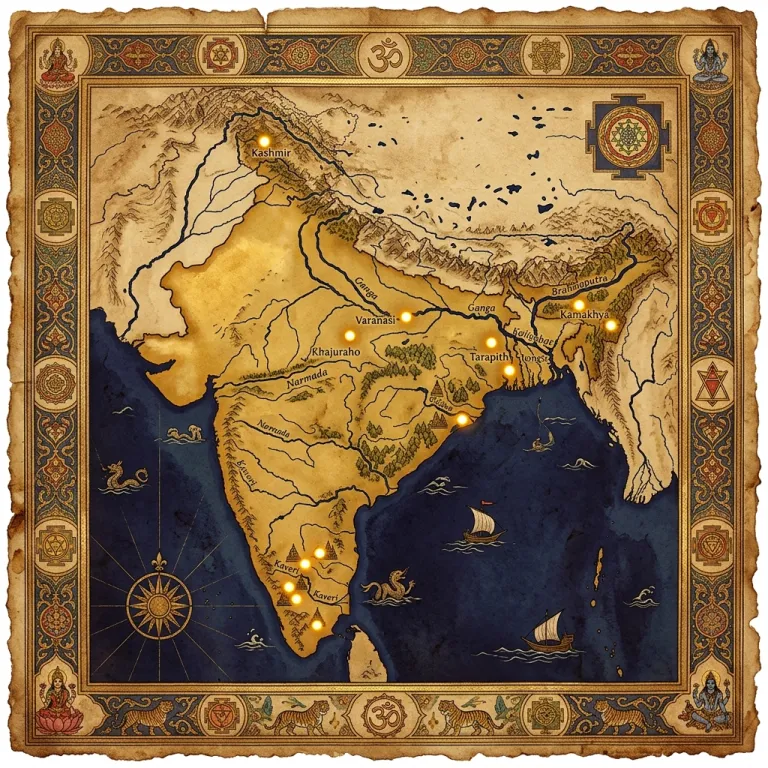
The Shakti Peethas (शक्ति पीठ, "seats of the Goddess") are shrines where, according to Hindu tradition, parts of the goddess Sati's body fell to earth. The most popular list counts 51, though texts give anywhere from 4 to 108. Major sites include Kamakhya in Assam, Kalighat in Kolkata, Jwalamukhi and Hinglaj.
Tantra has always been tied to place. Alongside the Shakti Peethas, cremation grounds, circular Yogini temples, and centres of learning such as medieval Kashmir have shaped how the tradition developed and is practised. This chapter explains the Shakti Peetha legend and why the lists disagree, provides a table of widely recognised Peethas, and profiles the most important Tantric sites, including Kamakhya and Tarapith.
The Shakti Peetha Legend: Sati and Daksha
The story begins with Daksha's sacrifice. Daksha holds a great fire ritual and pointedly leaves out his son-in-law, Shiva. His daughter Sati, Shiva's wife, attends anyway. The Mahabhagavata Purana says she first overcomes Shiva's objection by revealing her ten Mahavidya forms. Humiliated by her father's insults to her husband, Sati gives up her body.
In the later versions that underlie the Peetha tradition, a grief-stricken Shiva carries Sati's corpse across the world in a destructive dance. To restore balance, Vishnu cuts the body apart with his discus (Sudarshana chakra), or in some tellings the body falls apart as Shiva wanders. Wherever a part fell, a Peetha arose. At each site the Goddess is worshipped under a local name, together with a guardian form of Shiva called a Bhairava.
Historians note that the self-sacrifice of Sati is old, but the dismemberment story and the numbered lists of Peethas developed gradually in medieval Puranic and Tantric literature. Many of the sites were probably sacred to local goddesses long before they were written into the Sati myth. The classic scholarly study is D.C. Sircar's The Śākta Pīṭhas.
How Many Shakti Peethas Are There? 4, 18, 51, 52 or 108
"51 Shakti Peethas" is the best-known figure, but different texts count differently:
| Count | Where it comes from | Notes |
|---|---|---|
| 4 | Early Tantric texts, both Hindu and Buddhist | A set of four great pithas: Oddiyana, Jalandhara, Purnagiri and Kamarupa |
| 18 | The Ashtadasha Shakti Peetha hymn, popularly attributed to Adi Shankaracharya | Widely followed in South India; includes Kamakhya, Kolhapur Mahalakshmi, Srisailam, Kanchi Kamakshi and Varanasi Vishalakshi |
| 51 | The Pithanirnaya list (associated with the Tantrachudamani) and popular Bengali tradition | Linked to the 51 letters of the Sanskrit alphabet; the most widely quoted number |
| 52 | Variant lists, common in Bengal | Adds one site to the 51 |
| 64 | Some Tantric lists | A number that also appears in the 64 Yoginis and 64 Tantras |
| 108 | Devi Bhagavata Purana and related lists | 108 places and names of the Goddess; a broader list of sacred seats, not all tied to body parts |
Because the lists disagree, several temples may claim the same body part, and some famous goddess temples appear in one list but not another. Treat any "complete list of 51" with care.
Shakti Peetha List: Widely Recognised Sites
The table below is a selection of Shakti Peethas that appear widely in popular and textual lists. It is not a canonical or complete list of 51. Body-part associations follow the most commonly cited tradition, and other lists may differ. For all fifty-one entries, with Shakti and Bhairava names and disputed sites flagged, see our full 51 Shakti Peetha list. If you are looking for the Peethas of one region, that page groups the same fifty-one rows by state and country under Shakti Peethas by state, and answers the common comparison question in Shakti Peeth vs Jyotirlinga.
| Peetha (Goddess) | Location | State / Country | Body part (per tradition) |
|---|---|---|---|
| Kamakhya | Nilachal Hill, Guwahati | Assam, India | Yoni (genitals / womb) |
| Kalighat (Kalika) | Kolkata | West Bengal, India | Toes of the right foot |
| Kiriteshwari | Murshidabad district | West Bengal, India | Crown (diadem) |
| Bahula | Ketugram, near Katwa | West Bengal, India | Left arm |
| Jwalamukhi (Siddhida / Ambika) | Kangra district | Himachal Pradesh, India | Tongue |
| Naina Devi | Bilaspur district | Himachal Pradesh, India | Eyes |
| Tripuramalini (Devi Talab) | Jalandhar | Punjab, India | Left breast |
| Vishalakshi | Varanasi (near Manikarnika) | Uttar Pradesh, India | Earring(s) |
| Lalita / Alopi | Prayagraj | Uttar Pradesh, India | Fingers |
| Katyayani (Uma) | Vrindavan | Uttar Pradesh, India | Locks of hair |
| Bhadrakali (Savitri) | Kurukshetra | Haryana, India | Ankle |
| Jaya Durga | Baidyanath Dham, Deoghar | Jharkhand, India | Heart (Ambaji in Gujarat also claims this) |
| Biraja | Jajpur | Odisha, India | Navel |
| Tara Tarini | Ganjam district | Odisha, India | Breasts |
| Jayanti | Nartiang, Jaintia Hills | Meghalaya, India | Left thigh |
| Guhyeshwari | Near Pashupatinath, Kathmandu | Nepal | Knees (some lists: hips) |
| Hinglaj | Lasbela district, Balochistan | Pakistan | Crown of the head (brahmarandhra) |
| Jessoreshwari | Ishwaripur, Satkhira | Bangladesh | Palms and soles |
| Chandranath (Bhavani) | Sitakunda, Chittagong | Bangladesh | Right arm |
| Manasa | Lake Manasarovar | Tibet (China) | Right hand |
Several much-visited goddess temples fall outside the 51-list tradition or appear only in some versions. Examples include Vaishno Devi in Jammu, Tarapith in West Bengal (local tradition links it to Sati's eye), and the "18 Peetha" temples of South India. Their religious importance does not depend on being in any particular list.
In the western Himalaya, five foothill shrines — Jwalamukhi, Brajeshwari Devi at Kangra, Chintpurni, Naina Devi and Chamunda Devi — are travelled together as a single route even though the lists count them differently; our guide to the Shakti Peethas in Himachal Pradesh sets out what each of them actually claims.
Kamakhya Temple: The Foremost Tantric Peetha
Kamakhya, on Nilachal Hill above Guwahati, is widely regarded as the most important Tantric Shakti Peetha. It was the centre of ancient Kamarupa, a region praised in texts such as the Kalika Purana and the Yogini Tantra. The inner sanctum has no image. Worship is offered to a natural cleft in the rock, kept moist by a spring, which is venerated as the yoni (womb and genitals) of the Goddess, the source of creation. The present temple was rebuilt in the sixteenth century under the Koch kings after an earlier structure was destroyed. Our full Kamakhya Temple guide covers the Sati story, the sanctum, Ambubachi Mela and practical visiting advice.
- Ambubachi Mela: Each June, during the monsoon, the temple closes for about three days while the Goddess is believed to menstruate. When it reopens, large crowds of pilgrims and ascetics gather, and pieces of red cloth are distributed as blessed objects. Popular belief holds that the spring's water turns red, and interpretations of this vary.
- The ten Mahavidyas: The Nilachal complex includes shrines to the Dasha Mahavidya, which makes it a major centre for their worship. Individual Mahavidyas also have their own pilgrimage centres elsewhere, such as the Bagalamukhi temples of Madhya Pradesh and Himachal Pradesh.
- Ritual life: Kamakhya combines mainstream devotion with Tantric rites. Animal sacrifice is still performed there, a practice that remains both traditional and debated.
Hugh Urban's The Power of Tantra examines Kamakhya's history as a site where Tantra, kingship and goddess worship met.
Tarapith: The Seat of Goddess Tara
Tarapith, near Rampurhat in Birbhum district, West Bengal, is the leading shrine of the goddess Tara, second of the Mahavidyas. Local tradition counts it as a Peetha where Sati's eye (or third eye) fell, and it also tells that the sage Vashistha won success in Tara worship here. The temple image shows Tara nursing Shiva, recalling the story that she soothed him after he drank the cosmic poison.
Tarapith is famous for its cremation ground (mahashmashana) beside the Dwarka river, long used by Tantric practitioners for night-time sadhana. Its best-known figure is Bamakhepa (traditional dates c. 1837–1911), the “mad saint” whose unconventional devotion to Tara made him one of Bengal's most loved holy men. June McDaniel's work on Bengali goddess worship describes Tarapith as a living centre of Shakta practice. Our full Tarapith temple guide covers the shrine and its image, Kaushiki Amavasya and the festival calendar, and practical guidance for visitors.
Kalighat and Dakshineswar: Kali in Kolkata
Kalighat is counted among the 51 Peethas as the place where the toes of Sati's right foot fell. Its striking image of Kali, with a long gold tongue and large eyes, draws huge crowds. Some people derive the city's former name "Calcutta" from Kalighat, though historians consider that derivation uncertain. The Kalighat painting style, which developed near the temple in the nineteenth century, is now a recognised art tradition.
Dakshineswar Kali Temple, built by Rani Rashmoni and opened in 1855, is not a Peetha. It is famous as the place where Sri Ramakrishna served as priest and practised a wide range of disciplines, including Tantric sadhana under the teacher remembered as the Bhairavi Brahmani.
Both temples are at their most crowded on Kali Puja night, the new moon of Kartik, when Bengal keeps its great night festival of the Goddess on the same date as Diwali.
Yogini Temples of Odisha and Central India
The Yogini temples are among the most distinctive Tantric monuments in India. They are dedicated to groups of goddesses, usually 64, who were central to early Kaula worship. Most are circular and open to the sky (hypaethral), with a Yogini image in each niche around the inner wall. The Khajuraho example, however, is rectangular. See our site-by-site guide to the 64 Yogini temples of India.
| Site | Location | Notes |
|---|---|---|
| Hirapur Chausath Yogini | Near Bhubaneswar, Odisha | A small circular open-air temple, usually dated to around the 9th century |
| Ranipur-Jharial | Balangir district, Odisha | A large circular Yogini temple within a temple complex |
| Chausath Yogini, Bheraghat | Near Jabalpur, Madhya Pradesh | A circular temple with more than 64 niches |
| Mitawali | Morena district, Madhya Pradesh | A circular temple with many small shrines |
| Chausath Yogini, Khajuraho | Khajuraho, Madhya Pradesh | A rectangular plan; among the earliest structures at the site |
Also in Bhubaneswar, the 8th-century Vaital Deul houses the fierce goddess Chamunda and shows clear Tantric influence. Vidya Dehejia's study Yogini Cult and Temples remains the standard survey.
Khajuraho: Temples, Sculpture and Tantra
The Chandela-era temples of Khajuraho (roughly 10th–11th century CE) in Madhya Pradesh are a UNESCO World Heritage Site. Only about two dozen of a much larger original group survive. They are famous for their erotic sculptures, although these make up a small share of the carvings, which mostly show deities, celestial figures, animals and scenes of everyday life. Scholars disagree about how far the erotic imagery reflects Tantric ideas and how far it reflects auspicious convention, royal culture and artistic tradition. The "Tantric explanation" is one interpretation, not a settled fact. See myths vs reality for more on common misreadings.
Kashmir: The Philosophical Heartland
Between roughly the 9th and 12th centuries, Kashmir produced the most sophisticated philosophy of non-dual Shaiva Tantra, including the Pratyabhijna ("recognition"), Spanda, Krama and Trika schools. The towering figure is Abhinavagupta (c. 10th–11th century), whose Tantraloka is one of the great summaries of Tantric thought (see sacred texts). The valley's goddess shrines are still important to Kashmiri Hindus. They include Kheer Bhawani (Ragnya Devi) at Tulmul and Sharika Devi on Hari Parbat in Srinagar, where the goddess is worshipped in the form of a rock regarded as a Sri Chakra.
South Indian Goddess Centres
The South has its own Shakta emphases — Sri Vidya, Kerala's Bhagavathy worship and the Tamil Amman temples — which our dedicated guide to South India's Shakti temples sets out in full.
| Temple | Location | Significance |
|---|---|---|
| Kamakshi Amman | Kanchipuram, Tamil Nadu | A leading Sri Vidya shrine with a Sri Chakra before the goddess |
| Meenakshi Amman | Madurai, Tamil Nadu | One of India's great goddess temples |
| Sringeri Sharada Peetham | Sringeri, Karnataka | A monastery of the Shankara tradition, devoted to Sharada |
| Kollur Mookambika | Udupi district, Karnataka | A swayambhu linga with a golden line, linked in tradition with Adi Shankaracharya |
| Kodungallur Bhagavathy | Thrissur district, Kerala | An ancient Bhadrakali temple known for its Bharani festival |
| Chottanikkara Bhagavathy | Ernakulam district, Kerala | Worshipped in three forms through the day; traditionally visited for relief from mental affliction |
Visiting Tantric Sites Respectfully
Most of these places are active temples, not museums. Dress modestly, follow local rules about photography and entry, and treat rituals you do not understand with respect. Cremation grounds are places of mourning for local families, not tourist attractions. Be wary of anyone at a pilgrimage site who offers to perform "tantric" rituals for money, promising specific results.
Frequently Asked Questions
What are the 51 Shakti Peethas?
The 51 Shakti Peethas are goddess shrines where, according to tradition, parts of Sati's body fell after Vishnu's discus cut apart her corpse. The number 51 comes mainly from the Pithanirnaya list and Bengali tradition and matches the letters of the Sanskrit alphabet. Other texts give 18, 52, 64 or 108.
Which is the most powerful Shakti Peetha?
Devotees hold every Peetha sacred, so there is no official ranking. In Tantric tradition, however, Kamakhya in Assam is usually regarded as the foremost Peetha, because the yoni of the Goddess is believed to have fallen there and texts such as the Kalika Purana and Yogini Tantra glorify it.
Why is Kamakhya temple important in Tantra?
Kamakhya worships the Goddess as a natural rock yoni, the source of creation, rather than as an image. It was the heart of ancient Kamarupa, praised in Tantric texts, and it has shrines to the ten Mahavidyas. Its Ambubachi Mela, marking the Goddess's menstruation, draws Tantric practitioners from across India.
Is Tarapith a Shakti Peetha?
Local tradition holds that Sati's eye fell at Tarapith, and many devotees count it as a Peetha, but it does not appear in every standard list. Its fame rests mainly on the goddess Tara, its cremation ground used for Tantric practice, and the saint Bamakhepa.
Are there Shakti Peethas outside India?
Yes. Traditional lists include sites in present-day Pakistan (Hinglaj in Balochistan), Bangladesh (such as Jessoreshwari and Chandranath), Nepal (Guhyeshwari in Kathmandu), Tibet (Manasa at Lake Manasarovar) and, in some lists, Sri Lanka. Access to some of these sites depends on current travel conditions.
What is a Bhairava at a Shakti Peetha?
Each Shakti Peetha traditionally pairs the Goddess with a form of Shiva called a Bhairava, who guards the shrine. Lists give a specific name for the Goddess and the Bhairava at each site. Pilgrims often visit the Bhairava shrine as well to complete the pilgrimage.
Sources & Further Reading
- D.C. Sircar, The Śākta Pīṭhas. Motilal Banarsidass, revised edition 1973.
- Diana L. Eck, India: A Sacred Geography. Harmony Books, 2012.
- Hugh B. Urban, The Power of Tantra: Religion, Sexuality and the Politics of South Asian Studies. I.B. Tauris, 2010.
- Vidya Dehejia, Yogini Cult and Temples: A Tantric Tradition. National Museum, New Delhi, 1986.
- June McDaniel, Offering Flowers, Feeding Skulls: Popular Goddess Worship in West Bengal. Oxford University Press, 2004.
- David Kinsley, Hindu Goddesses: Visions of the Divine Feminine in the Hindu Religious Tradition. University of California Press, 1986.
- Primary texts referred to: Kalika Purana, Yogini Tantra, Devi Bhagavata Purana, Mahabhagavata Purana, the Pithanirnaya list.