Chapter 8
Sri Yantra Meaning: Structure, Nine Avaranas & Sri Vidya
श्री यन्त्र · श्री चक्र · श्री विद्या
The Sri Yantra (श्री यन्त्र), also called the Sri Chakra, is a sacred diagram of nine interlocking triangles around a central point (bindu), enclosed by two lotus rings and a square gateway. In the Sri Vidya tradition it is the geometric form of the goddess Lalita Tripurasundari and a map of creation returning to its source.
Of all yantras used in Tantric worship, the Sri Yantra is the most elaborate and the most famous. It is used in temples and homes and in the detailed nine-stage ritual called the Navavarana Puja, and it is now also a popular design motif around the world. This chapter explains what each part of the yantra means, sets out the nine avaranas (enclosures), gives an overview of the Sri Vidya tradition behind it, and separates traditional beliefs about its "benefits" from what can actually be shown.
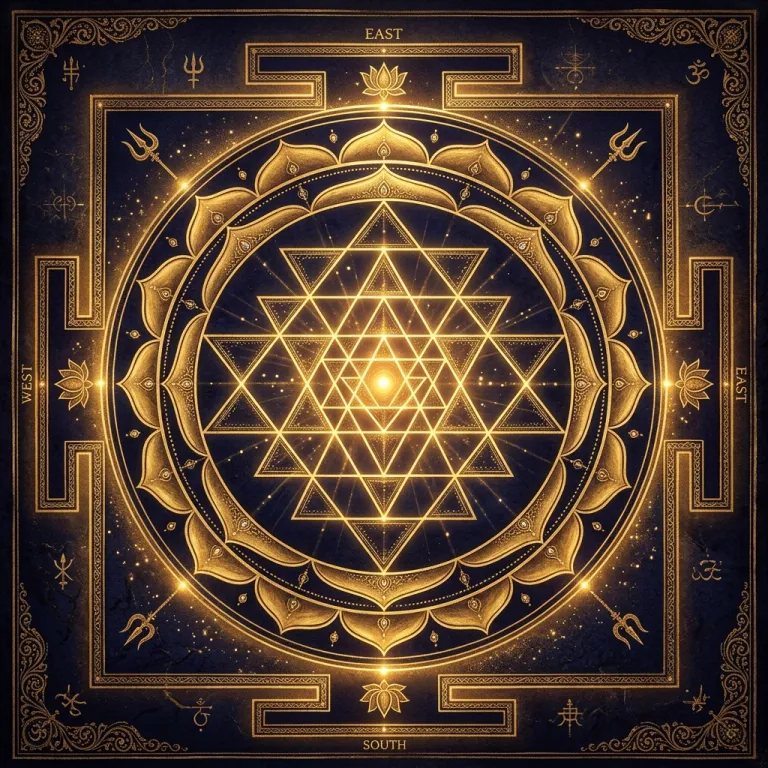
What Does the Sri Yantra Mean?
Sri means auspiciousness, radiance and prosperity, and it is also a name of the Goddess. Yantra means an instrument or device, here a tool for holding the mind and for worship — see our guide to tantra, mantra and yantra for how the three terms differ. The Sri Yantra is therefore "the instrument of Sri." Sri Vidya texts treat it as the body of the Goddess in visual form, just as her mantra, the Panchadashi, is her body in sound.
The diagram can be read in two directions. Read from the centre outward, it shows creation: the single bindu divides into the polarity of Shiva and Shakti and then multiplies into the many triangles, petals and walls of the manifest world. Read from the outside inward, it shows return: the practitioner passes through layer after layer of experience back to undivided unity. This non-dual vision, in which the world is the Goddess's own self-expression, is rooted in the Tantric philosophy of Shiva and Shakti.
Sri Yantra Structure: Parts and Symbolism
From the centre outward, a standard Sri Yantra has the following parts. The table gives the most common Sri Vidya interpretations, and commentators differ in the details.
| Component | Number | Traditional meaning |
|---|---|---|
| Bindu (central point) | 1 | The source: undivided consciousness, the union of Shiva and Shakti; the seat of Lalita Tripurasundari |
| Downward triangles | 5 | Shakti: the feminine, creative power |
| Upward triangles | 4 | Shiva: the masculine principle of consciousness |
| Smaller triangles formed | 43 | The differentiated powers of the manifest universe, arranged in five rings |
| Eight-petal lotus | 8 | Eight goddesses (the Ananga shaktis) of the third enclosure |
| Sixteen-petal lotus | 16 | Sixteen "attracting" powers, often linked with the sixteen Sanskrit vowels and the phases of the moon |
| Three circles | 3 | Boundary girdles between the lotuses and the square |
| Bhupura (square with gates) | 3 lines, 4 gates | The earth plane and the entrance into sacred space |
The Sri Yantra can be drawn flat (bhu-prastara) or built as a three-dimensional pyramid called the Meru, in which the layers rise towards the bindu at the top. Both forms are used in worship. Drawing the triangles so that their lines meet exactly is notoriously difficult, and this has made the figure a favourite puzzle for geometers.
The Nine Avaranas of the Sri Chakra
Sri Vidya divides the yantra into nine avaranas (नवावरण, "nine enclosures"), each called a chakra with its own name, its own group of attendant goddesses and a presiding yogini. Worship passes through them in order, from the outermost (1) to the bindu (9). The names below follow the standard Sri Vidya liturgy, as found in the Khadgamala hymn and the Navavarana rituals.
| # | Chakra name & meaning | Part of yantra | Attendant deities | Presiding yogini |
|---|---|---|---|---|
| 1 | Trailokya Mohana: "enchanter of the three worlds" | Bhupura (outer square) | 28 deities: ten Siddhis, eight Matrikas, ten Mudra shaktis | Prakata |
| 2 | Sarvasha Paripuraka: "fulfiller of all desires" | 16-petal lotus | 16 attraction shaktis (Kamakarshini and others) | Gupta |
| 3 | Sarva Sankshobhana: "agitator of all" | 8-petal lotus | 8 Ananga shaktis | Guptatara |
| 4 | Sarva Saubhagyadayaka: "giver of all good fortune" | 14 triangles | 14 shaktis | Sampradaya |
| 5 | Sarvartha Sadhaka: "accomplisher of all aims" | Outer 10 triangles | 10 shaktis | Kulottirna |
| 6 | Sarva Rakshakara: "protector of all" | Inner 10 triangles | 10 shaktis | Nigarbha |
| 7 | Sarva Rogahara: "remover of all ills" | 8 triangles | 8 Vashini (Vagdevata) goddesses of speech | Rahasya |
| 8 | Sarva Siddhiprada: "bestower of all attainments" | Central triangle | Kameshvari, Vajreshvari, Bhagamalini, and the Goddess's weapons | Atirahasya |
| 9 | Sarvanandamaya: "full of all bliss" | Bindu | Lalita Tripurasundari with Kameshvara | Parapararahasya |
The chakra names describe what each layer grants, but the tradition generally understands them as stages of inner transformation rather than material rewards. The seventh chakra's "removal of ills," for example, is read as the removal of the basic affliction of ignorance. The eight Vashini goddesses of that enclosure are traditionally credited with composing the Lalita Sahasranama. Some commentators also group the nine avaranas into three sets of three, corresponding to creation, preservation and dissolution.
What Is Sri Vidya?
Sri Vidya (श्री विद्या, "auspicious wisdom") is the Shakta Tantric tradition centred on the goddess Lalita Tripurasundari, who is third among the ten Mahavidyas. It worships her in three linked forms: the Sri Yantra, which is her visual form; the Sri Vidya mantra, her sound form; and meditation on her anthropomorphic image. Historically it developed within the Kaula milieu of medieval Tantra, drew heavily on Kashmiri Shaiva thought, and later became firmly established in South India, where it is still strong. Our dedicated guide to the Sri Vidya tradition covers its texts, its Kadi and Hadi streams, and what initiation involves.
Key Sri Vidya texts
- Vamakeshvara Tantra, including the Nityashodashikarnava, and the Yogini Hridaya. These are core tantras on the yantra, the mantra and their inner meaning.
- Tantraraja Tantra, a major ritual text of the tradition.
- Lalita Sahasranama, the "thousand names of Lalita," found in the Brahmanda Purana's Lalitopakhyana section. It is recited widely today.
- Saundarya Lahari, a celebrated hymn traditionally attributed to Adi Shankaracharya. Scholars debate the attribution.
- Commentaries by Bhaskararaya (18th century), including the Setubandha, the Varivasya Rahasya and the Saubhagya Bhaskara on the Lalita Sahasranama. Read more about him among our notable masters and in Tantric sacred texts.
The Panchadashi mantra
The root mantra of Sri Vidya is the Panchadashi (पञ्चदशी), a fifteen-syllable mantra in three groups (kutas): the Vagbhava kuta, linked with speech and knowledge; the Kamaraja kuta, linked with desire and will; and the Shakti kuta, linked with power and action. There are two main versions, the Kadi vidya and the Hadi vidya, named after their first syllables. Tradition associates the first with Kamadeva (Manmatha) and the second with the sage Lopamudra. A sixteen-syllable extension, the Shodashi, is reserved for advanced initiates. Sri Vidya lineages hold that these mantras should be received only through initiation (diksha), so this page does not reproduce them.
Samaya and Kaula approaches
Sri Vidya practitioners disagree about external ritual. The Kaula approach uses outer worship of a physical yantra and may include classic Kaula elements. The Samaya approach, championed by commentators such as Lakshmidhara in his commentary on the Saundarya Lahari, emphasises purely internal worship, locating the Sri Chakra in the practitioner's own body. A mixed (mishra) path combines the two. See the three Tantric traditions for more.
Sri Yantra Benefits: What Tradition Says
Searches for "Sri Yantra benefits" usually lead to confident promises of wealth, success and healing. It is more accurate to separate three kinds of claim.
| Claim | What it is | How to read it |
|---|---|---|
| Brings prosperity and good fortune (Sri) | Traditional belief | Rooted in the yantra's link to the goddess of auspiciousness; not a guaranteed outcome |
| Harmonises a home or workplace | Traditional and modern popular belief (often linked with Vastu) | A devotional and cultural practice; no measurable effect has been established |
| Protects and removes obstacles | Traditional belief, reflected in the avarana names | Understood within the tradition mainly as inner protection and the removal of ignorance |
| Supports concentration and contemplation | Reasonable, experience-based description | Any detailed visual focus can steady attention; the yantra is designed for this use |
| Leads to spiritual realisation | The central religious claim of Sri Vidya | A matter of faith and practice within the tradition, guided by a teacher |
A Sri Yantra bought as an object is, in traditional terms, only a diagram until it is ritually consecrated and worshipped. Its purpose in Sri Vidya is to support worship and meditation, not to work as a charm. Be cautious with sellers who promise specific financial or medical results — see our guide to keeping a Sri Yantra at home for placement customs, consecration and how to spot inflated claims.
How to Meditate on the Sri Yantra
Full Sri Chakra worship, the Navavarana Puja, is an elaborate ritual that invokes and honours the deities of each enclosure with mantras, mudras and offerings. Traditionally it is learned from a teacher. For general readers, a simple and widely taught contemplative approach looks like this:
- Settle. Sit comfortably with a clear, well-drawn image of the Sri Yantra at eye level, in soft, steady light.
- Gaze gently. Look at the whole figure with relaxed eyes. Let the breath be natural. Do not strain or force it.
- Move inward. Let your attention travel slowly from the outer square, through the sixteen and eight petals, through the rings of triangles, to the central triangle.
- Rest at the bindu. Hold your attention lightly on the central point, and let thoughts settle.
- Close and reflect. Close your eyes and keep the image in mind for a few moments, then end the session calmly.
This inward movement follows the traditional direction of worship, from the outer world towards the centre. Traditional practice is much richer and includes mantra, nyasa and visualisation of the deities, but the basic gesture of moving from the periphery to the centre is the heart of it. For related techniques, see Tantric practices and the subtle body.
Practice safely
Gentle visual meditation is generally considered low-risk, but long or intensive practice is best undertaken with a qualified teacher. Meditation is not a substitute for medical or mental-health care. If you experience distress, stop and seek appropriate help.
Is the Sri Yantra Mathematically Special?
The Sri Yantra is a difficult figure to construct precisely. In a well-drawn yantra, several sets of lines must pass through common points, and small errors quickly show. Mathematicians and enthusiasts have published various construction methods. Stronger claims are common online: that the yantra "encodes" the golden ratio or pi, or that scientific experiments have validated its power. These are not established. Proportions vary between traditional drawings, and the resemblances people report depend on which measurements they choose. The yantra's importance comes from its religious meaning, not from hidden mathematical constants. For a balanced look at such claims, see Tantra and science.
Where to See the Sri Yantra in India
| Site | Location | Connection |
|---|---|---|
| Kamakshi Amman Temple | Kanchipuram, Tamil Nadu | A Sri Chakra before the goddess, which tradition says Adi Shankaracharya installed |
| Sringeri Sharada Peetham | Sringeri, Karnataka | A monastery of the Shankara tradition; tradition says Shankara installed a Sri Chakra here |
| Kollur Mookambika | Udupi district, Karnataka | A goddess temple associated in tradition with Shankara and Sri Chakra worship |
| Devipuram | Near Visakhapatnam, Andhra Pradesh | A modern Sri Vidya centre with a temple built in the form of a Meru |
For goddess temples more broadly, including the Shakti Peethas, see our guide to Tantric sacred geography.
Frequently Asked Questions
What is the meaning of the Sri Yantra?
The Sri Yantra is a sacred diagram representing the goddess Lalita Tripurasundari and the whole cosmos. Its nine interlocking triangles show Shiva and Shakti in union. Read from the centre outward, it depicts creation unfolding from the bindu, and read inward, it maps the practitioner's return to unified consciousness.
What are the benefits of the Sri Yantra?
Tradition associates the Sri Yantra with prosperity, harmony, protection and spiritual progress. These are religious beliefs, not proven effects, and no yantra guarantees wealth or health. What can reasonably be said is that the yantra is designed as a focus for worship and contemplation, which many practitioners find steadying.
What are the nine avaranas of the Sri Chakra?
From outside in, they are Trailokya Mohana (outer square), Sarvasha Paripuraka (16-petal lotus), Sarva Sankshobhana (8-petal lotus), Sarva Saubhagyadayaka (14 triangles), Sarvartha Sadhaka (outer 10), Sarva Rakshakara (inner 10), Sarva Rogahara (8 triangles), Sarva Siddhiprada (central triangle) and Sarvanandamaya (the bindu).
How many triangles are in the Sri Yantra?
The Sri Yantra is built from nine large interlocking triangles, four pointing upward and five pointing downward. Their intersections create 43 smaller triangles arranged in rings around the central bindu. Some counts add the bindu or central triangle differently, but 9 and 43 are the standard figures.
Where should a Sri Yantra be placed at home?
Popular practice, often influenced by Vastu, favours a clean, respected place such as a home shrine, commonly facing east or north-east, with the yantra's tip pointing up. These are customs rather than fixed rules, and a consecrated yantra is traditionally worshipped regularly, not merely displayed.
What is the difference between Sri Yantra and Sri Chakra?
There is no real difference: Sri Yantra and Sri Chakra are two names for the same diagram. "Chakra" (wheel) is often preferred in Sri Vidya ritual contexts, especially when referring to its nine enclosures, each of which is itself called a chakra.
Can I practise Sri Vidya without a guru?
You can study Sri Vidya, recite widely published hymns such as the Lalita Sahasranama, and meditate on the yantra. Sri Vidya lineages, however, hold that its core mantras, such as the Panchadashi, and the full Navavarana Puja should be learned only after initiation from a qualified teacher.
Sources & Further Reading
- Douglas Renfrew Brooks, Auspicious Wisdom: The Texts and Traditions of Śrīvidyā Śākta Tantrism in South India. SUNY Press, 1992.
- Douglas Renfrew Brooks, The Secret of the Three Cities: An Introduction to Hindu Śākta Tantrism. University of Chicago Press, 1990.
- Madhu Khanna, Yantra: The Tantric Symbol of Cosmic Unity. Thames & Hudson, 1979.
- David Kinsley, Tantric Visions of the Divine Feminine: The Ten Mahāvidyās. University of California Press, 1997.
- Primary texts referred to: Vamakeshvara Tantra (Nityashodashikarnava), Yogini Hridaya, Tantraraja Tantra, Lalita Sahasranama, Saundarya Lahari; Bhaskararaya's Setubandha and Varivasya Rahasya.