Chapter 6
The Subtle Body: 7 Chakras, Nadis & Kundalini Explained
चक्र · नाडी · कुण्डलिनी
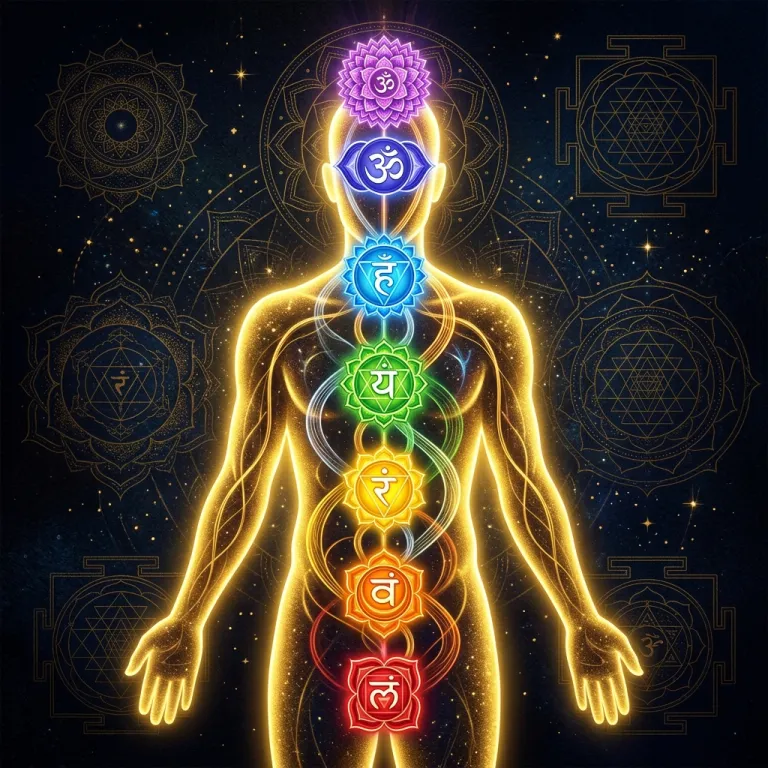
The chakra system is the Tantric map of the subtle body: a series of energy centres (chakras) strung along a central channel (sushumna) from the base of the spine to the crown. The best-known version has seven chakras — Muladhara, Svadhishthana, Manipura, Anahata, Vishuddha, Ajna and Sahasrara — linked by 72,000 channels (nadis) that carry prana.
In Tantra and Hatha Yoga, this subtle anatomy is the field in which meditation, breathwork and mantra work. Its goal is the awakening of kundalini, a divine power said to lie coiled at the base of the spine, and its ascent to the crown. This page explains the seven chakras in a single table, the main nadis, how kundalini awakening is described, and where traditional teaching ends and modern interpretation begins. It builds on the practices described in Tantric sadhana.
What Is the Subtle Body in Tantra?
The subtle body (sukshma sharira) is the meditative body that Tantra works with: a model of channels (nadis), centres (chakras) and life-force (prana) laid over the physical frame. It is a map of inner experience rather than a description of physical anatomy, and nothing in it corresponds one-to-one with an organ or a nerve.
Indian thought commonly speaks of three bodies: the gross physical body (sthula sharira, स्थूल शरीर), the subtle body (sukshma sharira, सूक्ष्म शरीर) and the causal body (karana sharira). A related scheme from the Taittiriya Upanishad describes five “sheaths” (koshas), of which the sheath of vital energy (pranamaya kosha) is where nadis and chakras are usually placed.
Prana, the life-force, is said to move in five main currents (vayus): prana (inward, in the chest), apana (downward and outward, in the pelvis), samana (balancing, at the navel), udana (upward, in the throat) and vyana (pervading the whole body). Tantric practice aims to gather and direct these currents into the central channel. Scholars such as Geoffrey Samuel describe the subtle body as a practical map for meditation — a way of organising inner experience — rather than a rival to physical anatomy. For how this fits Tantric metaphysics, see the philosophy of Tantra.
The 7 Chakras: Names, Locations, Elements and Bija Mantras
The seven chakras, from the base of the spine upward, are Muladhara (root), Svadhishthana (sacral), Manipura (navel), Anahata (heart), Vishuddha (throat), Ajna (brow) and Sahasrara (crown). The classical scheme gives them 4, 6, 10, 12, 16, 2 and 1,000 petals, and assigns the first five to earth, water, fire, air and space.
Chakra (चक्र) means “wheel”. In the texts, chakras are usually pictured as lotuses (padmas) with a set number of petals, each petal carrying a letter of the Sanskrit alphabet. The table below follows the classical scheme found in the Sat-Chakra-Nirupana; the last column gives common modern interpretations, which are not part of the classical description. For how the seed syllables in the Bija column are built and where the scheme comes from, see our guide to bija mantras and the main seed sounds.
| # | Chakra (Sanskrit) | Location | Element | Bija | Petals | Associated qualities (common modern reading) |
|---|---|---|---|---|---|---|
| 1 | Muladhara मूलाधार Root | Base of the spine / perineum | Earth (prithvi) | Lam (लं) | 4 | Stability, grounding, security |
| 2 | Svadhishthana स्वाधिष्ठान Sacral | Base of the genitals / lower abdomen | Water (apas) | Vam (वं) | 6 | Desire, creativity, emotion |
| 3 | Manipura मणिपूर Navel | Navel region | Fire (agni) | Ram (रं) | 10 | Will, vitality, digestion (“digestive fire”) |
| 4 | Anahata अनाहत Heart | Centre of the chest | Air (vayu) | Yam (यं) | 12 | Love, devotion, balance |
| 5 | Vishuddha विशुद्ध Throat | Throat | Space / ether (akasha) | Ham (हं) | 16 | Speech, expression, purification |
| 6 | Ajna आज्ञा Brow / “third eye” | Between the eyebrows | Mind (manas) | Om (ॐ) | 2 | Insight, intuition, concentration |
| 7 | Sahasrara सहस्रार Crown | Crown of the head (or just above) | Beyond the elements | None fixed (often described as silence) | 1,000 | Transcendence, union, liberation |
Each Chakra in the Classical Texts
The Sat-Chakra-Nirupana (“Description of the Six Centres”), composed by Purnananda in 1577 as part of a larger work and translated by Sir John Woodroffe in The Serpent Power, gives a detailed meditative picture of each centre. The summaries below follow that tradition; other texts differ in details.
1. Muladhara — the Root Chakra
A four-petalled crimson lotus at the base of the spine containing the yellow square of earth, the seed syllable Lam, the god Brahma and the goddess Dakini, with the elephant Airavata as the element’s vehicle. Inside it lies the self-born linga (svayambhu linga) around which kundalini sleeps, coiled three and a half times.
2. Svadhishthana — the Sacral Chakra
A six-petalled vermilion lotus containing the white crescent of water, the syllable Vam, Vishnu and the goddess Rakini, with the makara (a mythical water creature). Modern teachers often associate it with desire and deep-seated habits (samskaras).
3. Manipura — the Navel Chakra
A ten-petalled lotus, described as the colour of rain-clouds, holding the red triangle of fire, the syllable Ram, Rudra and the goddess Lakini, with a ram as vehicle. Its name means “city of jewels”. Many teachers link it to the “digestive fire” and to will-power.
4. Anahata — the Heart Chakra
A twelve-petalled vermilion lotus containing the smoke-coloured six-pointed figure of air, the syllable Yam, the deity Isha and the goddess Kakini, with a black antelope as vehicle. Anahata means “unstruck”, referring to the inner sound (nada) heard in deep meditation. Devotional traditions often treat the heart as the principal seat of the deity.
5. Vishuddha — the Throat Chakra
A sixteen-petalled lotus of smoky purple containing the circular region of space, the syllable Ham, Sadashiva and the goddess Shakini, with a white elephant. Its sixteen petals carry the sixteen Sanskrit vowels, which is one reason it is associated with speech.
6. Ajna — the Third-Eye Chakra
A white, two-petalled lotus between the eyebrows, the seat of the mind, of the goddess Hakini and of a linga called Itara, with Om as its syllable. Many schemes treat it as the place where the three principal nadis meet. Hatha Yoga practices such as shambhavi mudra direct attention here.
7. Sahasrara — the Crown Chakra
The “thousand-petalled” lotus at the top of the head is not usually counted among the six chakras proper but lies above them. It is the abode of Shiva, pure consciousness. When kundalini reaches it, Shakti is said to unite with Shiva, and the practitioner realises the non-dual state described in Tantric philosophy. Some lineages, such as the Samaya school of Sri Vidya, place special emphasis on inner worship here; see the three traditions.
Is the Chakra System Always Seven? Traditional vs Modern Views
No — the chakra system is not always seven. The seven-chakra model is the most widely known today, but earlier and parallel texts describe other arrangements — five, six, nine, twelve or more centres, sometimes located differently. Buddhist Tantras, discussed in Buddhist Tantra, typically describe four or five principal wheels, at the navel, heart, throat and crown (sometimes also the genital region). The seven-centre scheme became standard largely through the Sat-Chakra-Nirupana and Woodroffe’s 1919 English translation.
Chakras and Glands: A Modern Correlation
The chakra—gland pairings found in popular books are modern, not traditional. Those books pair each chakra with an endocrine gland — adrenals, gonads, pancreas, thymus, thyroid, pineal and pituitary — but the pairing does not appear in the classical Sanskrit texts; it developed in 20th-century Western esoteric and New Age writing. Likewise, the rainbow colour scheme (red at the root through to violet at the crown) and many of the psychological meanings given to each chakra are modern, as historian Kurt Leland has documented. These interpretations may be meaningful to some practitioners, but they should not be presented as traditional teaching or as scientific fact. There is no scientific evidence that chakras are physical structures. For a wider discussion, see Tantra and modern science.
What Are Nadis? The 72,000 Channels of Prana
Nadis (नाडी) are the channels through which prana flows. Many yoga texts, including the Goraksha Shataka tradition, state that the body contains 72,000 nadis; the Shiva Samhita gives a much larger figure. Of these, ten or fourteen are usually named as principal — lists include Sushumna, Gandhari, Hastijihva, Pusha, Alambusha, Kuhu and Shankhini — and three are of central importance.
Although nadis are sometimes compared with nerves or meridians, they belong to a different, meditative model of the body. Looking for a one-to-one match with anatomy misunderstands what the texts are describing.
The 14 Principal Nadis
Out of the 72,000, the texts single out a small group as principal. The number given is usually ten or fourteen, and the names vary from source to source, so no list should be treated as definitive. The set of fourteen most often repeated in hatha yoga literature, including the Shiva Samhita, runs: Sushumna, Ida, Pingala, Gandhari, Hastijihva, Kuhu, Sarasvati, Pusha, Shankhini, Payasvini, Varuni, Alambusha, Vishvodhara and Yashasvini. Lists of ten simply drop four of these.
The texts locate the minor nadis at the openings and organs of the body — the eyes, ears, tongue, and the lower openings — but they differ on which nadi goes where, and translators disagree further. The structural point survives the disagreement: a central channel, two channels flanking it, and a web of lesser channels distributing prana. Only the first three carry real weight in practice.
Sushumna, Ida and Pingala
Three of the 72,000 nadis carry almost all the practical weight: Sushumna in the centre, Ida on the left and Pingala on the right. The table gives the position, symbolism and traditional qualities of each.
| Nadi | Position | Symbolism | Traditional qualities |
|---|---|---|---|
| Sushumna सुषुम्ना | Central, along the spine from the base to the crown | Fire; the river Sarasvati | The path of kundalini; beyond the pairs of opposites |
| Ida इडा | Left; associated with the left nostril | Moon (Chandra); the Ganga | Cooling, receptive, calming |
| Pingala पिङ्गला | Right; associated with the right nostril | Sun (Surya); the Yamuna | Heating, active, energising |
Yoga texts describe prana as normally flowing through Ida or Pingala, alternating during the day, while Sushumna remains largely closed. When the two side channels are balanced, prana is said to enter the central channel, making deep meditation possible. The practice of observing the breath in each nostril is developed in svara yoga, taught in texts such as the Shiva Svarodaya.
Physiologists have documented a “nasal cycle” in which airflow alternates between the nostrils, with a period that varies from person to person. Some researchers have explored links between nostril dominance and brain or nervous-system activity, but the evidence is limited and does not confirm the traditional model. It is best read as an interesting parallel, not a proof.
Nadi Shodhana: Purifying the Channels
Nadi shodhana (alternate-nostril breathing) is the classic preparatory practice. In its simplest form, the practitioner sits upright, breathes in slowly through the left nostril while closing the right, then breathes out through the right; next breathes in through the right and out through the left. That is one round. Hatha texts add breath retention (kumbhaka) and set ratios, but these are introduced only gradually under a teacher.
Kundalini Shakti: What Is Kundalini Awakening?
Kundalini (कुण्डलिनी, “the coiled one”) is described as the power of the Goddess within the individual, and kundalini awakening is the rousing of that power from the base of the spine and its ascent through the chakras to the crown. In the Sat-Chakra-Nirupana she sleeps in Muladhara, coiled three and a half times around the svayambhu linga, her mouth closing the entrance to the Sushumna. In Kashmir Shaiva thought, kundalini is understood more broadly as the universal creative energy of consciousness, present in every experience.
Traditions describe several ways she may be roused: sustained practice of pranayama, bandhas and mudras (the Hatha Yoga approach), mantra and devotion, or shaktipat — a transmission of grace from a guru, emphasised in some Shaiva lineages; see guru and diksha.
How Kundalini Awakening Is Traditionally Described
- Dormancy — kundalini is asleep; prana moves mainly through the side channels.
- Stirring — through practice or grace, she begins to awaken; texts and practitioners report heat, currents of sensation or spontaneous movements.
- Entering the central channel — prana and kundalini enter the Sushumna.
- Ascent — kundalini rises, “piercing” the chakras and the three knots (granthis); each centre is said to dissolve into the next, as in bhuta shuddhi.
- Union — at Sahasrara, Shakti unites with Shiva, which the texts describe as liberation (moksha). She is often said to return to Muladhara after such union unless the state is stabilised.
These stages are a simplified synthesis; individual texts and teachers describe the process in different ways. Tradition treats the experiences along the way as signs to be neither sought nor clung to.
The Three Granthis (Knots)
Hatha and Tantric texts speak of three knots that obstruct the central channel. Their exact locations vary between sources; the table follows a widely taught modern scheme.
| Granthi | Common location | What it is said to represent |
|---|---|---|
| Brahma granthi | Muladhara region (some texts: the heart) | Attachment to the body, survival and material security |
| Vishnu granthi | Anahata region (some texts: the throat) | Attachment to emotions, relationships and personal identity |
| Rudra granthi | Ajna region | Attachment to subtle experiences, visions and spiritual powers (siddhis) |
Is Kundalini Awakening Safe?
Traditional sources treat kundalini awakening as safe only when it is prepared for, gradual and supervised, and as risky when it is forced. They insist on preparation: ethical conduct, a healthy body, purified channels, a qualified teacher and patient, gradual practice over years. Modern teachers in the same traditions, such as those of the Bihar School of Yoga, repeat these warnings. Some people report intense or unsettling experiences during meditation or breathwork, and a few clinicians and researchers have written about “kundalini-type” experiences. However, “kundalini syndrome” is not a recognised medical diagnosis, and unusual symptoms should never be attributed to kundalini without medical assessment. Our dedicated guide to kundalini awakening looks more closely at the experiences people report, why online symptom lists are unreliable, and what to do if practice becomes distressing.
Frequently Asked Questions
What are the 7 chakras and their meanings?
The seven chakras are Muladhara (root, base of the spine), Svadhishthana (sacral, below the navel), Manipura (navel), Anahata (heart), Vishuddha (throat), Ajna (between the eyebrows) and Sahasrara (crown). In the traditional scheme the first five are linked with earth, water, fire, air and space, Ajna with mind, and Sahasrara with consciousness beyond the elements.
How many nadis are there in the human body?
Many yoga and Tantric texts say the subtle body contains 72,000 nadis, or channels of prana; some texts give other figures, such as 350,000. Among these, ten or fourteen are usually named as principal, and three — Sushumna, Ida and Pingala — are the most important. Nadis belong to the subtle body model and are not identical with physical nerves or blood vessels.
What are Sushumna, Ida and Pingala?
Sushumna is the central channel said to run along the spine from the base to the crown; kundalini is believed to rise through it. Ida (also called Chandra) is the left, “lunar”, cooling channel, and Pingala (Surya) the right, “solar”, heating channel. Yoga texts link them with the left and right nostrils and seek to balance them.
What are the kundalini chakra names in order?
From the base of the spine upward the names are Muladhara, Svadhishthana, Manipura, Anahata, Vishuddha, Ajna and Sahasrara — root, sacral, navel, heart, throat, third eye and crown. Kundalini is described as rising through them in that order along the Sushumna nadi, so the sequence is always given from the bottom up, not the top down.
What are the 14 nadis?
The most commonly repeated list of fourteen principal nadis is Sushumna, Ida, Pingala, Gandhari, Hastijihva, Kuhu, Sarasvati, Pusha, Shankhini, Payasvini, Varuni, Alambusha, Vishvodhara and Yashasvini. Texts disagree about both the names and their locations, and some give only ten. Sushumna, Ida and Pingala are the three that matter in practice.
What is sukshma nadi?
Sukshma means “subtle”. Sukshma nadi is simply the nadi understood as part of the subtle body (sukshma sharira), not as a physical vessel or nerve. The phrase is used to stress that these channels are mapped in meditation and yogic experience, so looking for them in dissection misreads what the texts are describing.
What is kundalini tantra?
Kundalini tantra is the strand of Tantra concerned with rousing kundalini shakti and guiding her through the chakras to the crown, using mantra, pranayama, bandha, mudra and visualisation under a teacher. The phrase is also the title of a widely read modern manual by Swami Satyananda Saraswati of the Bihar School of Yoga.
What is kundalini awakening?
In Tantra and Hatha Yoga, kundalini is a divine power pictured as a serpent coiled at the base of the spine. Awakening means this power is roused and rises through the central channel, passing the chakras until it unites with Shiva at the crown. Traditions describe this as a gradual, guided process culminating in liberation, not a quick technique.
Is kundalini awakening dangerous?
Traditional texts and modern teachers warn that forcing kundalini practices without preparation can be destabilising, and some people report intense physical or emotional experiences during meditation. “Kundalini syndrome” is not a recognised medical diagnosis, so any worrying symptoms should be assessed by a doctor or mental-health professional. Practise gradually, under an experienced teacher.
Are chakras connected to the endocrine glands?
The pairing of chakras with glands such as the thyroid, adrenals or pineal gland is a modern idea, popularised in 20th-century Western writing; it does not appear in the classical Tantric texts. There is no scientific evidence that chakras are physical organs or that they control hormones. Chakras are best understood as meditative maps within a traditional model.
Where do chakra colours like red, orange and violet come from?
The rainbow sequence from red at the root to violet at the crown is a modern Western development of the 20th century. Classical Sanskrit sources describe different colours: for example, the Sat-Chakra-Nirupana gives Muladhara crimson petals and a yellow earth square, and Anahata vermilion petals with a smoke-coloured air symbol.
Sources & Further Reading
- Arthur Avalon (Sir John Woodroffe), The Serpent Power, Luzac & Co., 1919 (translation of the Ṣaṭ-cakra-nirūpaṇa and Pādukā-pañcaka).
- James Mallinson and Mark Singleton, Roots of Yoga, Penguin Classics, 2017.
- Geoffrey Samuel and Jay Johnston (eds.), Religion and the Subtle Body in Asia and the West: Between Mind and Body, Routledge, 2013.
- Lilian Silburn, Kuṇḍalinī: The Energy of the Depths, SUNY Press, 1988.
- Kurt Leland, Rainbow Body: A History of the Western Chakra System from Blavatsky to Brennan, Ibis Press, 2016.
- Swami Satyananda Saraswati, Kundalini Tantra, Bihar School of Yoga, 1984.
- Swami Muktibodhananda, Hatha Yoga Pradipika (translation and commentary), Bihar School of Yoga, 1985.