Temple Guide
Jwala Ji Temple: The Eternal Flames of Jwalamukhi
ज्वाला जी मन्दिर
Jwala Ji is a Shakta temple in the town of Jwalamukhi, Kangra district, Himachal Pradesh, where the Goddess is worshipped not through an image but through natural flames that issue from fissures in the rock inside the sanctum. Tradition counts it among the Shakti Peethas and holds that the tongue of Sati fell here.
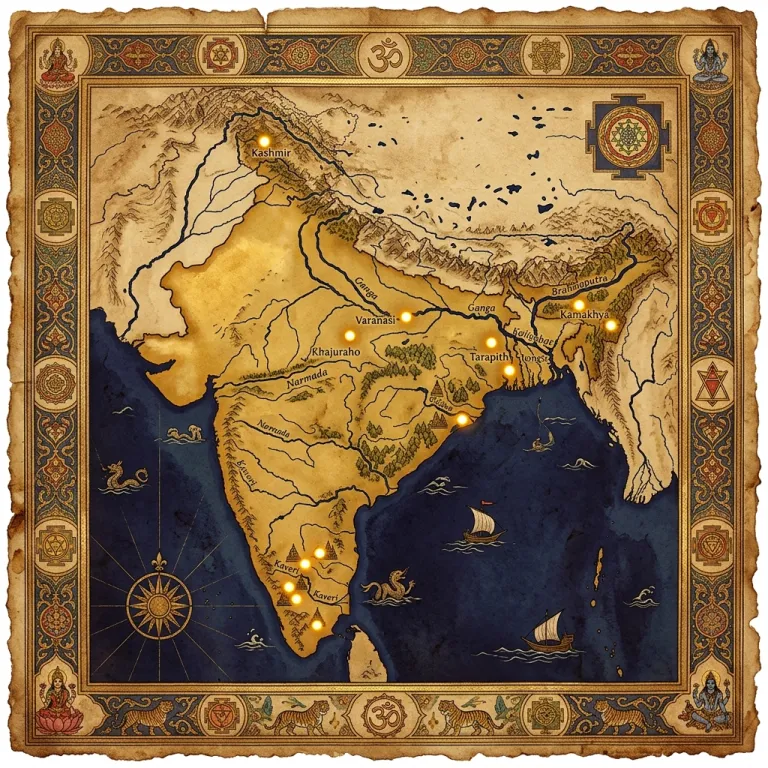
It is one of the few major Hindu shrines with nothing in the sanctum to look at except fire. That single fact shapes everything else about the place: its theology, its legends, the long argument over whether the flames are miraculous or geological, and the particular atmosphere of the darshan queue. This guide sets out what is known, what is tradition, and what is simply repeated online — and places Jwala Ji within the wider network of Shakti Peethas and sacred sites and the cluster of Shakti Peethas in Himachal Pradesh.
Where Is Jwala Ji Temple?
Jwala Ji (ज्वाला जी), also written Jwalamukhi or Jawalamukhi, stands in the small town of the same name in Kangra district, Himachal Pradesh. The town lies in the lower, warmer part of the Kangra valley, south-west of the high Dhauladhar range that forms the skyline above Dharamshala. This is not a high-altitude shrine: the temple sits on a low hillside inside a working bazaar town, and the walk from the road to the gate is short.
The name is descriptive. Jwala means flame, and mukhi means mouthed or faced, so Jwalamukhi is "the flame-mouthed one" — a name given to the Goddess and then to the town that grew around her. Many search queries for jwala ji kahan per hai assume the temple is somewhere in the high Himalaya; in practice it belongs to the accessible foothill belt that also holds Brajeshwari Devi at Kangra, Chintpurni and Chamunda Devi.
Why There Is No Idol: Worship of a Living Flame
The single thing every visitor notices is that the sanctum holds no murti. There is no carved stone goddess, no painted face, no dressed image lifted out for festival processions. What the pilgrim sees, through a low silver-plated recess, is a flame burning from a fissure in the rock — small, steady, and quite unlike a lamp. That flame is the deity. Offerings of flowers, rabri and red cloth are made to it, and arati is performed before it in the same way arati would be performed before an image elsewhere.
This makes Jwala Ji one of India's important aniconic shrines: places where the object of devotion is a feature of the living earth rather than a crafted form. The best-known parallel is Kamakhya in Assam, where the worshipped object is a moist cleft in the rock, not a statue. In both cases the theology is the same in outline — the Goddess is not represented here, she is present here — and in both cases the absence of an image is precisely what makes the site feel unusual to first-time visitors.
The Nine Flames and Their Traditional Names
Tradition counts nine flames at Jwalamukhi rather than one: a principal flame in the sanctum and a set of smaller ones burning at points around the complex, each enclosed and each identified with a goddess. Visitors are often told that seven or nine are alight at any given time, and reports of how many are actually visible differ from account to account.
The names, too, vary. Popular lists commonly give the nine as below, but temple publications, older gazetteer notices and guidebooks do not agree on either the order or the full set — one name in particular, the ninth, is written differently in different sources. The table is therefore offered as the most commonly repeated naming, not as an authoritative one.
| Flame | Goddess most often named | Note |
|---|---|---|
| Principal flame | Mahakali | The flame in the sanctum, the focus of the main darshan |
| Second | Annapurna | Goddess of food and sustenance |
| Third | Chandi | The martial form of the Goddess |
| Fourth | Hinglaj | Named for the shrine in Balochistan, itself a famous Peetha |
| Fifth | Vindhyavasini | Named for the goddess of the Vindhya hills |
| Sixth | Mahalakshmi | Goddess of abundance |
| Seventh | Saraswati | Goddess of learning and speech |
| Eighth | Ambika | A general name of the Mother Goddess |
| Ninth | Anjana or Anji Devi | Spelling and identification vary most here |
Two cautions are worth stating plainly. The nine names are a devotional scheme, drawing in famous goddesses from across the subcontinent so that the site becomes a compressed pilgrimage in itself; they are not a list preserved in any single early text that can be checked. And because the flames depend on a natural seep, their visible behaviour changes, so treating a particular count on a particular day as significant is a modern habit rather than a traditional one.
Jwala Ji Shakti Peeth: The Tongue of Sati
Jwala Ji is widely counted a Shakti Peetha, and it appears in most popular versions of the 51-Peetha list. The framing legend is the Puranic story of Sati and Daksha: Sati gave up her body after her father insulted Shiva; Shiva carried her corpse across the world in grief; the body was cut apart, and wherever a part fell a seat of the Goddess arose. Tradition holds that Sati's tongue fell at Jwalamukhi, and the flame is understood as that tongue, still speaking.
The fit between the attribution and the site is unusually neat — fire is called the tongue of the sacrifice throughout Indian ritual literature, and a flame is naturally described as a tongue. Whether the attribution produced the site's fame or the site's fame produced the attribution is not something the sources allow us to settle. As explained in our overview of the Shakti Peetha network, the lists themselves disagree: different texts count four, eighteen, fifty-one, fifty-two or one hundred and eight Peethas, and several shrines claim the same limb. No body-part attribution anywhere in this tradition should be read as a settled historical fact. It is a devotional map, and it works as one.
Popular Peetha lists also assign each site a goddess-name and a guardian Bhairava. For Jwalamukhi the goddess is usually named Siddhida or Ambika and the Bhairava Unmatta, though here too the lists are not consistent with one another.
Natural Gas or Divine Fire? Holding Both Accounts
Geologists explain the flames straightforwardly: combustible natural gas rises through fissures in the rock and burns where it meets the air. Seeps of this kind are known in several parts of the world, including other sites where a continuously burning vent has attracted religious attention. Nothing about the Jwalamukhi flames requires an exception to ordinary geology, and serious writers on the temple have said so for a long time. Abul Fazl, writing in the sixteenth-century Mughal court, already recorded a naturalistic explanation of the fire, attributing it to a mineral source in the ground.
It is worth being careful about what that does and does not settle. A physical account of how the fire burns is not an account of what it means, and the tradition has never claimed that the flames violate nature. In Shakta theology the Goddess is the natural world in its active aspect; a fire that the earth itself produces and sustains is, on that reading, a particularly apt sign rather than an embarrassing one. Pilgrims who know perfectly well what a gas seep is continue to come, and many will tell you both things in the same breath.
The unhelpful versions are at either extreme: the debunking tone that treats worshippers as dupes, and the online material that treats the flames as scientifically inexplicable and cites investigations that are never named. Neither is accurate. We take the same approach in our page on Tantra and science: describe the mechanism honestly, describe the meaning honestly, and do not pretend that one dissolves the other.
The Gilded Dome: Mughal and Sikh-Era Patronage
The building most visitors photograph is not ancient. The present structure, with its gilded dome and pinnacles and its folding silver-plated doors, belongs to the modern history of the shrine rather than to its origins, and it reflects layers of patronage from two very different states.
The documented layer is the earlier one. A fourteenth-century Persian chronicler, Shams-i Siraj Afif, records the visit of Sultan Firuz Shah Tughlaq to the Nagarkot region and his interest in the shrine, including an episode in which Sanskrit manuscripts held there were taken for translation into Persian. Two centuries later Abul Fazl, Akbar's court historian, describes the burning flame in his account of the empire's provinces. These are near-contemporary notices by named writers, and they establish that the site was already famous and already visited by rulers well before the Mughal period ended. Local accounts name the Katoch rajas of Kangra as the shrine's older patrons, though the dates within that tradition are not verifiable.
The gilding belongs to the Sikh period. It is commonly stated that Maharaja Ranjit Singh, whose empire absorbed the Kangra hills in the early nineteenth century, gave gold for the dome, and that his son Kharak Singh gave the silver for the doors. Ranjit Singh's patronage of hill shrines is well attested in general, and the attribution of the doors to Kharak Singh is recorded in standard reference accounts of the temple. The more colourful details — how much gold, from which campaign, and what vow prompted it — belong to popular history, and the figures given in travel writing should not be treated as documented.
The Akbar Story: Legend and Record
The most-told Jwala Ji story concerns Akbar. In the popular version, a devotee — usually named Dhyanu Bhagat — was challenged at court to prove the Goddess's power; the emperor then marched on the shrine and attempted to extinguish the flames, first by covering them with an iron disc and then by diverting a water channel over them. The flames burned on. Humbled, Akbar is said to have offered a parasol of gold, which turned on the spot into an unknown base metal because the offering was made in pride rather than devotion.
This is tradition, not record. It is worth separating the strands carefully:
- Documented: that the shrine was known at the Mughal court and described in court literature; Abul Fazl's notice of the flame is a real sixteenth-century source.
- Plausible but undated: that the temple received Mughal-era endowments, as many prominent shrines did.
- Legend: the attempt to quench the flames, the beheaded and restored horse in some versions of the Dhyanu Bhagat story, and the parasol that changed metal. These belong to devotional literature and oral retelling.
The legend is not thereby worthless. It dramatises the encounter between imperial power and local sacred power, and lets a small hill shrine claim the attention of the greatest ruler of the age — a real fact about how communities remember, even when the episode cannot be verified.
Gorakh Dibbi and the Nath Connection
Within the complex, a short walk from the main sanctum, is Gorakh Dibbi — a small shrine with a tank of water associated with Gorakhnath, the organising teacher of the Nath Sampradaya. The water in it appears to bubble as though boiling, while remaining cool to the touch; the same gas seep that feeds the flames is the ordinary explanation. Tradition holds that Gorakhnath performed austerities here, and one popular story has him ask the Goddess to heat water for his food and then never return, leaving the water perpetually waiting.
The Nath association is worth taking seriously as a historical pattern even where the individual legend cannot be dated. Nath yogis were for centuries present at exactly this kind of site: places of natural power at the edge of settled territory, often Shakta in devotion, on the routes wandering ascetics travelled between the Punjab hills, Nepal and the Deccan. Gorakhnath himself is usually placed between the eleventh and thirteenth centuries, but no inscription fixes him, and legends attaching him to particular shrines are generally later than the shrines. Gorakh Dibbi is evidence of a durable relationship between the Nath order and the Kangra hills, not of a specific visit.
Navratri at Jwalamukhi: What the Crowds Are Like
Jwalamukhi is busy all year and extremely busy during Navratri, which in the Himachal hills is the occasion for large fairs at all the major Devi shrines. Two Navratri seasons matter here: the spring Navratri of Chaitra and the autumn Navratri of Ashvin, with fairs held at the temple during both. The Gregorian dates move every year with the lunar calendar, so the rule rather than the date is what to remember — and pilgrims planning a visit should check a current panchang rather than a fixed figure. The same logic applies to the lesser-known Gupt Navratri, the two "hidden" Navratris of Magha and Ashadha, which are observed by practitioners more than by crowds.
During the fairs the town fills with pilgrim buses and the darshan itself becomes very short; visitors who want a quieter experience come on an ordinary weekday instead, when it is possible to sit in the courtyard for as long as one likes. Crowd arrangements and queue routing are set by the temple administration and change from year to year, so follow current official notices rather than older accounts, including this one.
Visiting Jwala Ji Temple: General Guidance
Jwala Ji is among the easier major Shakta shrines to reach, because the Kangra valley is well connected and the temple is in a town rather than on a summit. The guidance below is deliberately general: timings, fares and transport services change, and we do not publish figures we cannot keep current.
| Question | General guidance |
|---|---|
| Where it is | Jwalamukhi town, Kangra district, Himachal Pradesh, in the lower Kangra valley. |
| Nearest large towns | Kangra and Dharamshala in the same district; Una and Hoshiarpur lie to the south-west. |
| Rail | Pathankot is the main broad-gauge railhead for the Kangra valley; the narrow-gauge Kangra Valley Railway also serves stations in the district. |
| Air | The nearest airport is Kangra Airport at Gaggal, near Dharamshala; Amritsar and Chandigarh are the larger alternatives. |
| Road | State and private buses serve Jwalamukhi from towns across Himachal and neighbouring Punjab; most pilgrims arrive by road. |
| Season | Spring and autumn are generally the most comfortable. Summers in the lower valley are hot and the monsoon brings heavy rain. |
| Busiest times | Both Navratris, other Devi festivals, and weekends. Expect long queues at those times. |
| Dress and conduct | Modest clothing covering shoulders and knees. Footwear is left outside; heads are often covered. Leather items are usually left with footwear. |
| Inside the sanctum | Photography is restricted in and near the sanctum. Follow the staff and signage on the day, and do not photograph other worshippers without asking. |
| Offerings | Flowers, red cloth, coconut and sweets are the usual offerings, sold at stalls outside. There is no obligation to buy expensive packages. |
One practical caution applies at every popular Indian shrine and is worth repeating here. Self-appointed guides and intermediaries sometimes approach visitors offering special darshan, private puja or remedies for personal troubles, with fees that rise as the conversation continues. Politely declining is entirely acceptable. Paying for the removal of a curse is not a traditional practice, and we discuss why that framing is misleading in our page on fear of black magic.
Most visitors combine Jwala Ji with the other foothill shrines rather than travelling for it alone; the practicalities of that route are covered in our guide to the Himachal Devi darshan circuit.
Frequently Asked Questions
Where is Jwala Ji temple?
Jwala Ji, also written Jwalamukhi, stands in the small town of Jwalamukhi in Kangra district, Himachal Pradesh, in the lower Kangra valley in north India. Dharamshala and Kangra town are the nearest well-known places, and the shrine sits on a low hillside within the town rather than on a remote peak.
Why is there no idol at Jwala Ji temple?
Because the object of worship is the flame itself. Natural fire issues from fissures in the rock inside the sanctum, and the tradition treats that fire as the direct presence of the Goddess, so no carved or painted image was ever installed. Offerings and arati are made to the flame, which is enclosed behind a silver-plated recess.
How many flames burn at Jwalamukhi temple?
Nine flames are traditionally counted, one central and eight around the complex, and each is identified with a goddess. Reports of how many are visible at any time vary, and the names given to the nine are not fixed: different temple publications and guidebooks list them in different orders and sometimes with different names.
Which part of Sati fell at Jwala Ji?
Tradition holds that the tongue of Sati fell here, which is why the Goddess is worshipped as flame, the tongue of fire. This is a devotional attribution rather than a historical claim, and the Shakti Peetha lists disagree with one another about which site holds which part of the body.
Is the Jwala Ji flame natural gas?
Geologists generally explain the flames as combustible natural gas seeping upward through fissures in the rock and burning where it reaches the air. Similar seeps are known elsewhere in the world. Knowing the mechanism does not settle the religious question, and most pilgrims are untroubled by it: the tradition venerates the fire, not an explanation of it.
Did Akbar try to put out the flame at Jwala Ji?
That story is popular tradition rather than documented history. It is told that Akbar tried to smother the flames with water and then offered a golden parasol that turned to base metal. Contemporary Mughal writing does discuss the site, but the parasol episode appears in later devotional retellings, so it should be treated as legend.
What is Gorakh Dibbi at Jwala Ji?
Gorakh Dibbi is a small shrine and water tank within the Jwala Ji complex, linked by tradition to Gorakhnath, the great teacher of the Nath Sampradaya. Its water appears to bubble as though boiling while remaining cool to the touch. The association is a matter of living tradition, not dated record.
Sources & Further Reading
- D. C. Sircar, The Śākta Pīṭhas, Motilal Banarsidass, Delhi (revised edition) — the standard study of the Peetha lists and their disagreements.
- David Kinsley, Hindu Goddesses: Visions of the Divine Feminine in the Hindu Religious Tradition, University of California Press, 1986.
- Hugh B. Urban, Tantra: Sex, Secrecy, Politics, and Power in the Study of Religion, University of California Press, 2003.
- George Weston Briggs, Gorakhnāth and the Kānphaṭa Yogīs, Motilal Banarsidass, Delhi (reprint of the 1938 edition) — for the Nath presence at hill shrines.
- Abu'l-Fazl, Ain-i-Akbari (English translations by H. Blochmann and H. S. Jarrett) — the sixteenth-century Mughal notice of the burning flame.
- Shams-i Siraj Afif, Tarikh-i Firuz Shahi — the fourteenth-century account of Firuz Shah Tughlaq in the Nagarkot region.
- Published district gazetteer and archaeological survey material for Kangra district, which records the temple's patronage history and later repairs.