Guide
Sri Yantra at Home: Placement, Direction & Worship
श्री यन्त्र · गृह स्थापना
Yes — in the Hindu traditions that permit it, a householder may keep a Sri Yantra at home, provided it is treated as a sacred object rather than as décor. Custom places it in a clean shrine, commonly on an east or north-facing wall or in the north-east corner, raised off the floor, and asks for simple regular worship rather than mere display.
Beyond that, most of what circulates online about “where to place a Sri Yantra” and “which direction is correct” comes from popular ritual handbooks and Vastu practice rather than from the older Tantric texts. This guide sets out those customs honestly, labels them as customs, and explains the parts that the tradition itself treats as serious: consecration, initiation and respectful care. For the meaning of the diagram itself — the nine interlocking triangles, the bindu and the nine avaranas — see our full explanation of the Sri Yantra’s structure and symbolism.
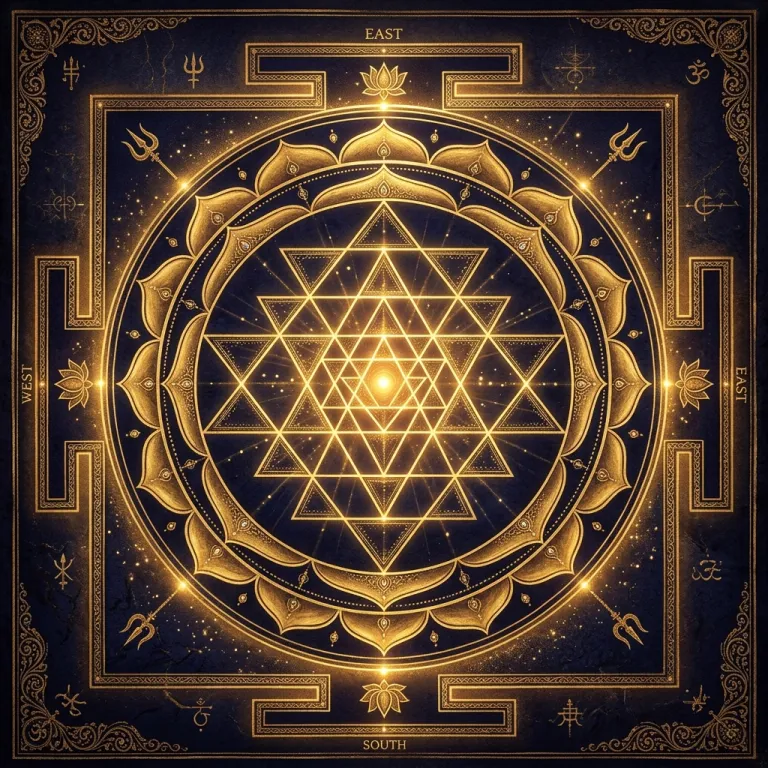
Can You Keep a Sri Yantra at Home?
In ordinary Hindu practice, yes. Yantras of many deities are kept in domestic shrines across India, and in South India a small Sri Chakra plate in the home puja room is entirely commonplace. Nothing in mainstream practice forbids a householder from owning, honouring or meditating before one. Sri Vidya has in fact long been a householder tradition rather than a renunciate one, which is part of why its emblem travelled so easily into family shrines.
The real distinction the tradition draws is not between temple and home, but between veneration and upasana. Keeping a yantra, keeping it clean, lighting a lamp before it, reciting widely published hymns and meditating on its form are open to anyone. Formal Sri Vidya worship — the root mantras, the full nyasa sequences and the nine-stage Navavarana Puja — is held by the lineages to require diksha, initiation from a qualified teacher. This is why reputable teachers rarely publish those mantras, and why a page like this one cannot substitute for a guru.
A second caution is heard often from traditional priests: a consecrated yantra carries obligations. Once the deity has been formally invited into it, the manuals expect regular worship, not a shelf. Several teachers therefore advise householders who are unsure of their routine to keep an unconsecrated image or plate as a contemplative object, which carries no such liability, and to seek consecration only when they are ready to maintain it.
Sri Yantra vs Sri Chakra: Is There a Difference?
They are two names for the same diagram. Yantra (“instrument”) is the general word for a ritual diagram; chakra (“wheel”) is preferred in Sri Vidya ritual language, partly because each of the nine enclosures is itself called a chakra. Sellers sometimes present “Sri Chakra” as a superior product; there is no such distinction in the texts. What genuinely differs is the form in which the same figure is made — flat, raised or pyramidal — which the next section describes.
Where to Place a Sri Yantra at Home: Customary Guidance
The following is the advice most consistently repeated in popular ritual handbooks and by Vastu practitioners. It is presented here as a record of custom.
| Question | Customary guidance | Reasoning given |
|---|---|---|
| Which room? | The home shrine or puja room; failing that, a clean, quiet corner of a living room or study | Cleanliness and freedom from disturbance are the requirements the ritual texts themselves stress |
| Which corner? | The north-east (ishana) is the corner Vastu assigns to worship | A Vastu convention for shrines generally, not a rule specific to the Sri Yantra |
| Which direction should it face? | Placed against a north or east wall, so the yantra faces south or west and the worshipper sits facing north or east | East and north are treated as auspicious directions to face during worship in most Hindu ritual |
| At what height? | On a raised seat, low table or shrine step — at or slightly above eye level when seated; never on the bare floor | A deity’s seat (pitha) should be elevated and distinct from the ground |
| How should it sit? | A flat plate usually lies horizontally on its seat or is tilted on a stand; a Meru stands upright with the bindu at the top | The yantra is read from the outside inward, so its centre should be clearly accessible |
| What goes under it? | A clean cloth, often red or silk, or a small metal plate | Red is associated with the Goddess in Shakta worship |
| Where should it not go? | Bedrooms used for sleeping with the yantra exposed, bathrooms, kitchens, storerooms, under a staircase, on the floor, or among ornaments and clutter | All are variations on a single principle: the object should not be casually handled or placed below eye level |
It is worth noting how little of this appears in the older Tantric literature. The Vamakeshvara Tantra, the Yoginihridaya and the ritual digests are concerned overwhelmingly with the yantra’s construction, the deities of its enclosures and the order of worship — not with the compass bearing of a living room. The consistent traditional demand is simpler: a clean place, a raised seat, a respectful attitude and regularity.
Flat Yantra, Meru or Pendant: Which Form?
Sri Vidya recognises the same figure in several projections. The flat drawing is called bhu-prastara; the partially raised form, in which the enclosures rise in shallow steps like a tortoise shell, is kurma-prastara; and the fully three-dimensional pyramid, in which each enclosure becomes a tier climbing to the bindu at the summit, is the meru-prastara or Meru, named after the mythic world-mountain.
| Form | What it is | Typical use | Points to know |
|---|---|---|---|
| Flat plate (bhu-prastara) | The figure engraved on a metal plate, usually copper | The standard object of daily home and temple worship | The easiest form to check for accuracy, since every line is visible |
| Ardha-meru / kurma-prastara | Enclosures raised in low steps | Used in some lineages and shrines | Sold under many trade names; the terminology is not standardised in the market |
| Meru (meru-prastara) | A solid pyramid of nine ascending tiers | Temple and shrine centrepieces; larger home shrines | Heavier and much costlier; the temple at Devipuram in Andhra Pradesh is itself built in the shape of a Meru |
| Pendant or locket | A miniature plate worn on the body | A personal devotional emblem | Views differ: some teachers permit it freely, others hold that a worshipped yantra should not be carried into contexts where purity rules cannot be kept |
| Printed image or drawing | Paper, cloth or a screen image | Study, teaching and simple gazing meditation | Entirely acceptable for contemplation; manuals do not treat it as a substitute for a consecrated plate in formal rites |
No form is “more powerful” than another in the texts. A Meru is a more complete rendering of the yantra’s vertical symbolism — the ascent from the outer world to the point of unity — and a pendant is the most compressed. Which one suits a home depends on space, budget and how it will actually be used.
Materials: Copper, Crystal, Panchaloha and Paper
| Material | What tradition says | Practical notes |
|---|---|---|
| Copper (tamra) | By far the most common metal for yantras in ritual manuals | Tarnishes; needs gentle periodic cleaning. Inexpensive, and easy to inspect for line accuracy |
| Silver and gold | Mentioned as auspicious for yantras and used where means allow | Price tracks metal weight; ask for weight and purity in writing |
| Panchaloha (five-metal alloy) | The classical alloy for cast temple icons, used for Merus | Composition varies by foundry and is rarely verifiable by a buyer |
| Sphatik (rock crystal / quartz) | Crystal has a genuine place in Shaiva and Shakta worship — crystal lingams and crystal rosaries are long attested | Popular and heavily marketed. Much of what is sold as “sphatik” is glass or resin. Claims about crystal “energy” are modern and unproven |
| Paper, cloth or print | Accepted for study and meditation | Fragile; should be kept clean and disposed of respectfully rather than binned casually |
| Drawn in kumkum, turmeric or rice flour | A genuinely traditional practice — yantras are often drawn fresh for a rite and dissolved afterwards | Free, impermanent and arguably the most orthodox option of all |
The texts care much more about whether the geometry is correct than about what it is made of. A well-cut copper plate whose nine triangles actually meet at their proper points is, in traditional terms, a better yantra than an expensive crystal one whose lines are approximate.
What Does “Activating” a Sri Yantra Mean?
The word used online is “activation”. The traditional term is prana pratishtha (प्राण प्रतिष्ठा), “the establishing of life-breath” — the consecration by which an image or yantra stops being an artefact and becomes, for the worshipper, the seat of the deity. For images the rite includes an eye-opening ceremony; for a yantra it centres on purification, nyasa, the recitation of the deity’s mantra and a formal invitation (avahana) of the deity into the diagram.
Most lineages hold that this cannot be improvised, for a straightforward reason: the core of the rite is the deity’s own mantra, and in Sri Vidya that mantra is transmitted only at initiation. Someone who has not received it cannot perform the invocation as the manuals define it. In practice, householders who want a consecrated Sri Yantra ask a temple priest or an initiated teacher within their own tradition to perform the rite, often on an auspicious day.
This also explains why “pre-energised” products should be read sceptically. Consecration in the tradition is a specific act performed by a specific qualified person for a specific shrine — not a factory process, and not something a certificate can evidence. A yantra sold as already energised is, from the tradition’s side, simply an unverifiable claim.
If you are not seeking consecration, nothing is lost. An unconsecrated Sri Yantra remains a legitimate object of study and contemplation, which is how most people outside initiated lineages use it.
How to Worship a Sri Yantra at Home: A Simple Respectful Pattern
What follows describes, at an explanatory level, the shape of simple domestic veneration as it is commonly practised. It is not a substitute for instruction, and it deliberately omits the mantras that the lineages reserve for initiates.
- Prepare the place. The shrine is cleaned, the yantra wiped, a fresh cloth laid and a lamp lit.
- Settle yourself. A few quiet breaths, a moment of intention (sankalpa), and remembrance of one’s teachers.
- Offer simply. The five basic offerings (panchopachara) are scent, flowers, incense, lamp and food. Water and a flower are enough on an ordinary day.
- Recite what is public. The Lalita Sahasranama and the Saundarya Lahari are published, widely recited and require no initiation. Many households simply read a portion.
- Gaze and meditate. Let the attention move slowly from the outer square inward through the lotus rings and triangles to the central bindu, and rest there. This mirrors the direction of formal worship.
- Close respectfully. A short arati, a bow, and the lamp extinguished or left to burn out.
The full Navavarana Puja, which honours the deities of each of the nine enclosures in turn, is a long and technical rite learned from a teacher; it is outlined in our page on the nine avaranas and in the wider survey of Tantric ritual practice. Consistency matters more in the tradition than elaboration: a minute a day is regarded as better than an hour once a season.
Caring for a Sri Yantra: Cleaning and Common Mistakes
- Handle with clean hands, and lift a plate by its edges rather than sliding it across a surface.
- Clean copper gently. Traditional households use a paste of tamarind, lemon and salt, or ash, then rinse and dry thoroughly. Harsh abrasives wear the engraved lines away, which is the one part of the object the tradition actually cares about.
- Clean crystal with plain water and a soft cloth. Avoid chemical cleaners.
- Keep it dust-free and uncrowded. A yantra buried among ornaments is being displayed, not honoured.
- Do not place it on the floor, step over it, use it as a stand or coaster, or move it around the house casually.
- Household purity customs vary. Some families observe restrictions during menstruation, mourning or illness; others do not. Follow the custom of your own household or teacher rather than internet instruction.
- If it is damaged or must be retired, the traditional course is immersion in a river or burial. Today, a temple or a priest will usually accept it, which avoids adding metal to a waterway.
Sri Yantra Benefits at Home: Claims and Evidence
Searches for “Sri Yantra benefits” return confident promises of wealth, promotion, business growth and family harmony. It helps to sort such statements into three groups.
| Claim | What kind of claim it is | How to read it |
|---|---|---|
| Brings Sri — prosperity and auspiciousness — into the house | Traditional religious belief | Rooted in the yantra’s link with the goddess of auspiciousness. Not a guaranteed or measurable outcome |
| Corrects “Vastu dosha” or negative energy in a home | Modern popular belief, largely Vastu-derived | Not found in the classical Sri Vidya texts, and not demonstrable |
| Fixes a business or brings a specific sum of money | Marketing claim | Treat as advertising. Nothing in the tradition promises a financial result |
| Gives a household a focal point for shared devotion and routine | Observable social fact | Reasonable: a shrine structures attention and family habit, as any regular practice does |
| Steadies attention when used for gazing meditation | Experience-based and plausible | Sustained visual focus is a recognised concentration aid; the yantra is designed for exactly this use |
| Leads to spiritual realisation | The central religious claim of Sri Vidya | A matter of faith and sustained practice within the tradition, under a teacher |
The tradition’s own position is more modest than the marketing: the yantra supports worship and meditation. It is not a charm, and the Sri Yantra page sets out the same distinction in more detail alongside the popular claims about golden ratios and scientific validation, which our review of Tantra and science finds unsupported.
How to Spot Overpriced or Fake “Energised” Yantras
The Sri Yantra is one of the most heavily marketed objects in the Indian devotional trade, and the online market is largely unregulated. This site sells nothing and recommends no seller; the points below are simply what to look at.
| Warning sign | Why it matters |
|---|---|
| “Energised by 108 priests”, “Siddha”, “charged”, with a certificate | Consecration is a rite performed for a particular worshipper and shrine. A mass-produced certificate evidences nothing, and no authority issues such certification |
| Guaranteed outcomes — wealth, marriage, a court case, a cure | A promise of a specific result is a commercial claim, not a religious one, and in many jurisdictions a legally risky one |
| Heavy “discount” from an invented list price, or countdown urgency | Standard price anchoring. Compare against the plain metal value and the workmanship |
| “Sphatik crystal” with no weight, origin or return policy | Glass and resin are routinely sold as crystal. Ask for weight in grams and a returns option in writing |
| “Panchaloha” or “pure silver” without hallmark or weight | Alloy composition is not visually verifiable. For silver, ask for hallmarking |
| Blurred product photos, or a stock image instead of the actual item | You cannot check the geometry from a stylised render |
| Astrological upsell — a “dosha” found first, a product offered second | A well-known sales pattern and a common vector for fraud |
Two practical tests. First, look at the lines: in a correctly drawn Sri Yantra the nine triangles intersect to form forty-three smaller triangles, and the lines meet exactly at shared points. Mass-produced plates frequently have triangles that miss their intersections — visible under a close photograph. Second, price the metal: a copper plate is a modest object, and a large gap between the metal-plus-craft value and the asking price is usually being justified by unverifiable spiritual claims. Keep invoices, prefer sellers with a returns policy, and remember that consumer-protection law in India covers misleading advertising of goods like any other product.
What Not to Expect
- Not a financial instrument. No yantra substitutes for income, savings or advice from a qualified professional.
- Not a treatment. It is not a remedy for illness of any kind, and should never delay medical or mental-health care.
- Not a fix for relationships or legal matters. Claims to influence other people’s behaviour belong to the sales literature, not to Sri Vidya.
- Not a shortcut past practice. The tradition’s promise, such as it is, attaches to sustained worship and study under a teacher, not to ownership.
- Not a timetable. Any seller who tells you when results will arrive is inventing it.
Frequently Asked Questions
Can we keep a Sri Yantra at home?
Yes. In the traditions that permit it, a householder may keep and honour a Sri Yantra, and a small Sri Chakra plate in the home shrine is common in South India. What the lineages restrict is formal Sri Vidya worship with its root mantras and the Navavarana Puja, which are held to require initiation from a qualified teacher.
Which direction should a Sri Yantra face at home?
Popular ritual handbooks and Vastu practice favour placing it against a north or east wall, often in the north-east corner, so the worshipper sits facing north or east. It should be raised off the floor in a clean shrine. These are customary conventions rather than textual rules, and they have not been empirically demonstrated.
How do you activate a Sri Yantra?
What is popularly called activation is prana pratishtha, a consecration rite that purifies the yantra and formally invites the deity into it using her mantra. Because that mantra is transmitted at initiation, most lineages hold that the rite needs a qualified priest or an initiate. Householders normally ask a temple priest or their own teacher.
What is the difference between a Sri Yantra and a Meru Sri Yantra?
They are the same figure in different projections. The flat plate is called bhu-prastara; the Meru, or meru-prastara, is the three-dimensional pyramid in which each of the nine enclosures becomes a rising tier with the bindu at the summit. A partially raised form is also made. No form is treated in the texts as more powerful than another.
Is a crystal Sri Yantra better than a copper one?
Not according to the tradition. Copper is the metal the ritual manuals mention most often, and what the texts actually emphasise is accurate geometry rather than material. Sphatik or crystal is popular and heavily marketed, much of what is sold as crystal is glass or resin, and claims about crystal energy are modern and unproven.
Can I wear a Sri Yantra locket or pendant?
Many people do, and teachers differ. Some permit it freely as a personal devotional emblem. Others hold that a yantra which has been formally consecrated should not be carried into contexts where the usual purity customs cannot be observed. If you follow a particular lineage or family custom, ask there first.
What are the benefits of keeping a Sri Yantra at home?
Tradition associates the Sri Yantra with auspiciousness, harmony and protection, and Sri Vidya regards it as a support for realisation. These are religious claims, not proven effects, and no yantra guarantees wealth or health. What can fairly be said is that a shrine gives a household a focus for regular practice and that the diagram is designed to steady attention.
Sources & Further Reading
- Douglas Renfrew Brooks, The Secret of the Three Cities: An Introduction to Hindu Śākta Tantrism. University of Chicago Press, 1990.
- Douglas Renfrew Brooks, Auspicious Wisdom: The Texts and Traditions of Śrīvidyā Śākta Tantrism in South India. SUNY Press, 1992.
- Madhu Khanna, Yantra: The Tantric Symbol of Cosmic Unity. Thames & Hudson, 1979.
- Gudrun Bühnemann, Maṇḍalas and Yantras in the Hindu Traditions. Brill, 2003.
- W. Norman Brown (trans.), The Saundaryalaharī, or Flood of Beauty. Harvard Oriental Series, Harvard University Press, 1958.
- Primary texts referred to: Vamakeshvara Tantra (Nityashodashikarnava), Yoginihridaya, Saundarya Lahari, Lalita Sahasranama. See our reading list for accessible translations.