Temple Guide
Kamakhya Temple: Story, Ambubachi Mela and Tantric Significance
कामाख्या मन्दिर
Kamakhya Temple is a Shakta and Tantric shrine on Nilachal Hill in Guwahati, Assam, where the Goddess is worshipped not as a statue but as a natural cleft in the rock, revered as her yoni. Tradition counts it the foremost of the Shakti Peethas, and its annual Ambubachi Mela draws hundreds of thousands of pilgrims.
Few Indian temples attract as much curiosity, or as much misinformation. This guide sets out the Sati and Kamadeva stories, what historians can say about the building, what pilgrims actually see inside, how Ambubachi works, the ten Mahavidya shrines on the hill, and Kamakhya's place in Kaula and Shakta Tantra. For the wider network it heads, see our guide to the Shakti Peethas.
Where Is Kamakhya Temple and Why Does It Matter?
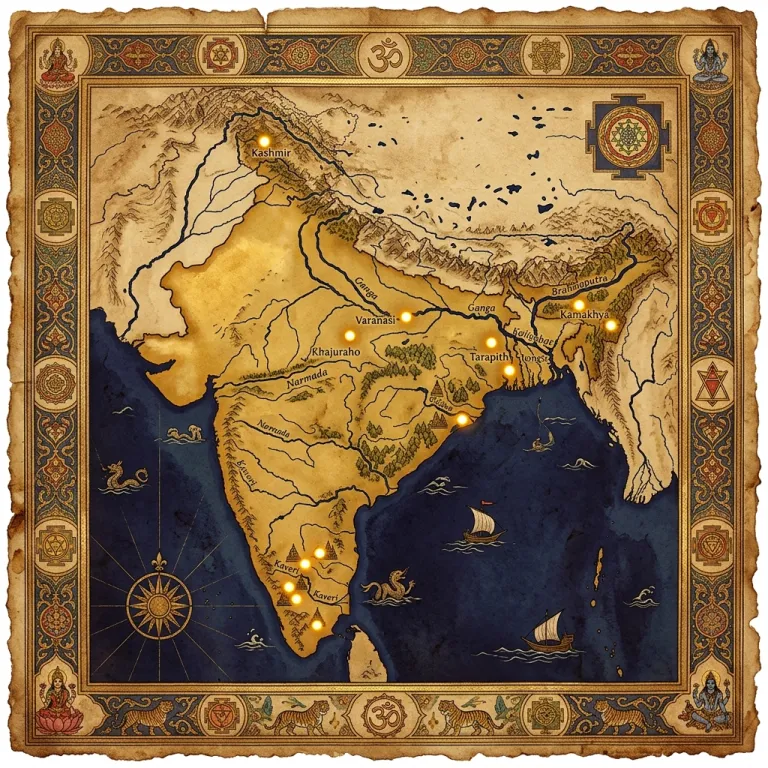
Kamakhya Temple (कामाख्या मन्दिर) stands on Nilachal Hill — also written Neelachal — on the southern bank of the Brahmaputra in Guwahati, Assam. The hill rises directly above the city, and the temple complex spreads across its upper slopes rather than occupying a single building.
Its importance is threefold. In the Shakta tradition Kamakhya is the yoni Peetha, the seat of the Goddess's generative power, and is usually ranked first among the Shakti Peethas in Tantric texts. The surrounding region, ancient Kamarupa, appears in Tantric literature as one of the classical pithas, the great power-places of the Kaula traditions. And the temple has been a working centre of goddess worship, royal patronage and esoteric practice for centuries.
The Kamakhya Temple Story: Sati, Daksha and the Yoni Peetha
The best-known Kamakhya story is the Puranic legend of Sati and Daksha. Sati married Shiva against her father's wishes; when Daksha held a great sacrifice and pointedly excluded Shiva, Sati attended, was insulted, and gave up her body. Shiva carried her corpse across the world in grief until Vishnu's discus cut it apart, and wherever a part fell, a Shakti Peetha arose.
In this scheme the yoni — the womb and genitals — is said to have fallen on Nilachal Hill. That one detail shapes everything about Kamakhya: the absence of an anthropomorphic image, the symbolism of the spring, the menstruation festival, and the temple's standing as the most potent of the Peethas. The same legend is retold across the Puranas and Tantras, with the number of Peethas varying from four to more than a hundred.
The Kamadeva Story Behind the Name
A second narrative, prominent in the Kalika Purana, links the name to Kama, the god of desire. After Shiva burnt Kama to ashes, Kama is said to have recovered his form (rupa) in this region — hence Kamarupa, "the form of desire" — and to have raised a shrine here in gratitude. Kamakhya is usually read as "she who is called by desire". Tradition treats the two accounts as complementary rather than rival.
A third strand is local. Scholars have long argued that Kamakhya's worship absorbed indigenous goddess cults of the Assam region, and that several names and rites point to pre-Brahmanical layers. Banikanta Kakati's study of the Mother Goddess Kamakhya remains the standard reference for that argument.
Kamakhya Temple History: From Kamarupa to the Koch Rebuilding
The honest summary is that the site is much older than the building. Copper-plate grants and sculptural remains from the Kamarupa period show organised religious activity on Nilachal Hill long before the surviving structure was raised, but no foundation date can be assigned to the original shrine.
What is reasonably well attested is that an earlier temple stood here and was ruined — accounts differ on when and by whom — and that the temple standing today was rebuilt in the 16th century under the Koch king Naranarayana, with his brother and general Chilarai associated with the work. Later Ahom rulers endowed and extended the complex, and repairs have continued since.
| Phase | What happened | Basis |
|---|---|---|
| Kamarupa period | Goddess worship established on Nilachal Hill | Inscriptions and sculptural remains; no firm date for the first shrine |
| Early medieval | Kamakhya celebrated as a Tantric centre in the Kalika Purana | Textual; scholars date that text to roughly the 10th–11th century |
| Pre-16th century | The earlier temple is destroyed | Later chronicle and tradition rather than contemporary record |
| 16th century | Rebuilt under Naranarayana; the temple takes its present form | Inscription and chronicle; the 16th-century dating is standard |
| Ahom period onward | Endowments, further shrines, tanks, stairways, repairs | Ahom records and the fabric of the complex |
Architecturally Kamakhya is a hybrid: a beehive-shaped shikhara on a cruciform, many-angled base, with older carved stone reused in the lower courses. Art historians often call this the "Nilachal type", a form found in Assam that does not match the standard North Indian temple styles.
What Is Inside Kamakhya Temple? The Sanctum Explained
This is the question behind most searches for Kamakhya mandir ka rahasya, and the answer is simple rather than sensational. The sanctum contains no statue or painted image of a goddess. From the main hall, steps lead down into a small, dark, cave-like chamber below ground level. In its rock floor is a natural cleft, kept permanently moist by an underground spring. The cleft is treated as the yoni of the Goddess, covered with silk cloth, vermilion and flowers; worshippers touch the water and receive it as prasad.
The chamber is small and the queue moves continuously, so most visitors are inside only briefly. What makes Kamakhya theologically distinctive is exactly this aniconic worship: the object of devotion is a feature of the living earth, not a crafted image — a point that connects the temple to the older stratum of goddess religion discussed in our page on the origins of Tantra.
Ambubachi Mela: The Goddess's Menstruation Festival
Ambubachi Mela (also Ambubasi or Ameti) is Kamakhya's largest annual gathering. It marks the belief that the Goddess, identified with the earth itself, undergoes her yearly menstruation. During the observance the temple doors are closed for three days and reopened on the fourth, after ritual purification.
The festival falls in the Assamese month of Ahaar (Sanskrit Ashadha), which generally corresponds to the second half of June; the exact days follow the Assamese calendar and shift each year, so pilgrims check the temple administration's announcement rather than a fixed Gregorian date. During the closure ordinary worship stops across the region, and traditionally ploughing is paused, because the earth is held to be resting.
When the doors reopen, devotees receive angodak (water from the spring) and angabastra, pieces of the red cloth said to have covered the rock during the closure. Both are treated as highly auspicious. The mela is also the one time of year when large numbers of ascetics, Tantric practitioners, Aghoris and Naga sadhus are visible on the hill.
How the Menstruation Symbolism Is Understood
It is worth stating plainly what the symbolism means within the tradition, because it is often reported crudely. In Shakta theology, menstruation is treated here not as pollution but as evidence of fertile, creative power — the same power that makes the soil productive after the first rains. The festival dramatises the identification of the Goddess with the earth. Scholars of Assamese religion, notably Hugh Urban, read Ambubachi as a rare public reversal of the wider Indian tendency to treat menstruation as impure.
The Ten Mahavidya Temples on Nilachal Hill
Kamakhya is not one temple but a complex, and one of its most striking features is that all ten Mahavidyas are enshrined on the hill. Most sites honour one or two of them; this is a major reason Kamakhya works as a pilgrimage circuit rather than a single darshan. The arrangement is usually described as follows, though local usage varies.
| Mahavidya | Where she is commonly described as residing |
|---|---|
| Tripurasundari | Within the main Kamakhya temple itself |
| Matangi | Within the main Kamakhya temple itself |
| Kamala | Within the main Kamakhya temple itself |
| Kali | A separate shrine on Nilachal Hill |
| Tara | A separate shrine on Nilachal Hill |
| Bhuvaneshwari | A separate shrine near the summit |
| Bhairavi | A separate shrine on the hill |
| Chhinnamasta | A separate shrine on the hill |
| Dhumavati | A separate shrine on the hill |
| Bagalamukhi | A separate shrine on the hill |
The complex also holds shrines to forms of Shiva and Bhairava and several sacred tanks. A full circuit takes far longer than the main darshan, and the smaller shrines stay quiet even when the principal temple is busy.
Tantra at Kamakhya: Kaula, the Kalika Purana and the Yogini Tantra
Kamakhya's reputation as a Tantric capital rests on both text and practice. In the Kaula traditions, Kamarupa is one of the four great pithas, listed with Purnagiri, Jalandhara and Oddiyana. These four are cosmic as well as geographic: they are mapped onto the practitioner's body and the centres described in our page on the subtle body, so that pilgrimage and inner practice mirror each other. The same Kaula milieu produced the circular 64 Yogini temples of Odisha and central India.
Two Sanskrit works matter most for the temple itself:
- Kalika Purana — a Shakta Purana that scholars generally date to around the 10th–11th century and associate with the Assam region. It describes Kamakhya, the Kamarupa landscape and the worship of the Goddess in detail, including ritual prescriptions still reflected there.
- Yogini Tantra — usually dated by scholars to about the 16th century and also connected with Assam. It glorifies Kamakhya and Kamarupa and reflects the temple's standing at the time of the rebuilding.
In practice Kamakhya has long hosted both mainstream devotional worship and vamachara (left-hand) Kaula practice. These coexist rather than compete: most of what happens at the temple is ordinary puja, while esoteric rites are performed privately by initiated practitioners. Claims that the temple is a centre for "black magic" belong to rumour rather than tradition — a theme we take up in myths and misconceptions about Tantra.
Animal Sacrifice at Kamakhya
Animal sacrifice (bali) is still offered at Kamakhya, chiefly of goats, and is prescribed in texts such as the Kalika Purana. By long-standing rule, female animals are not offered. It takes place in a designated area away from the sanctum, and it is legally and ethically contested in contemporary India. Visitors who would rather not encounter it can avoid that part of the complex.
The Kamakhya Mantra and How the Goddess Is Worshipped
The most widely published Kamakhya mantras are the invocation Om Kamakhya Devyai Namah and the Kamakhya Gayatri, Om Kamakhyayai cha vidmahe Kamarupayai dhimahi tanno Devi prachodayat. Both circulate freely in printed stotra collections and are chanted publicly at the temple.
Tradition nonetheless holds that Tantric mantra practice proper begins with initiation (diksha) from a qualified guru, who gives the mantra with its method and restrictions; a mantra repeated outside that framework is regarded as devotional rather than Tantric practice. No mantra should be treated as a guaranteed remedy for illness, money trouble or any other outcome.
Visiting Kamakhya Temple: When to Go and How to Reach
Kamakhya is among the easier major Tantric sites to reach, since it sits inside a state capital. The table gives general guidance only; timings, queue arrangements and fees change, so check current notices before travelling.
| Question | General guidance |
|---|---|
| Nearest city | Guwahati, Assam. The temple is on Nilachal Hill within the city, reached by a hill road and also by a long flight of steps. |
| How to reach | Guwahati has an international airport, and both Guwahati and Kamakhya railway stations serve the city. Taxis and shared vehicles run up the hill. |
| Best season | The cooler, drier months from roughly October to March are generally most comfortable; the monsoon brings heavy rain to Assam. |
| Busiest times | Ambubachi Mela (month of Ahaar, usually the second half of June), Durga Puja and Navratri, and weekends. |
| Queue and darshan | The temple runs managed queue systems, with separate arrangements for faster entry at times. Details change; rely on official signage and staff on the day. |
| Dress and conduct | Modest clothing covering shoulders and knees. Footwear, and commonly leather items, are left outside. |
| Photography | Not permitted inside the sanctum. Ask before photographing sadhus, rituals or other worshippers. |
| Accessibility | The descent into the sanctum is by steep, narrow, often wet steps. Anyone with limited mobility should plan accordingly. |
Nilachal Hill rewards more than the main darshan: the Mahavidya shrines, the tanks and the views over the Brahmaputra are part of what has made it a place of practice.
Frequently Asked Questions
What is the story behind Kamakhya Temple?
Kamakhya is linked to the legend of Sati, who gave up her body after her father Daksha insulted Shiva. As Shiva carried her corpse, Vishnu's discus cut it apart, and each part that fell created a Shakti Peetha. Tradition holds that Sati's yoni fell on Nilachal Hill, making Kamakhya the foremost Peetha for Tantric worshippers.
What is inside Kamakhya Temple?
There is no image of a goddess in the sanctum. Steps lead down into a small cave-like chamber where a natural cleft in the rock, kept moist by an underground spring, is worshipped as the yoni of the Goddess. It is covered with cloth, vermilion and flowers, and the spring water is given to devotees as prasad.
Why is Kamakhya famous in Tantra?
Kamakhya is the classical yoni Peetha and lies in Kamarupa, one of the four great pithas of the Kaula tradition. The Kalika Purana and Yogini Tantra glorify it, all ten Mahavidyas are enshrined on Nilachal Hill, and both mainstream Shakta worship and left-hand Kaula practice have continued there for centuries.
When is Ambubachi Mela held and what happens?
Ambubachi falls in the Assamese month of Ahaar, usually the second half of June, with the exact days set by the Assamese calendar. The Goddess is believed to menstruate, the temple closes for three days, and on the fourth it reopens. Devotees then receive angodak, water from the spring, and angabastra, pieces of red cloth.
How old is Kamakhya Temple?
The site is far older than the building. Inscriptions and sculptural remains show goddess worship in the Kamarupa region long before the present structure, but no firm foundation date exists. The temple standing today was rebuilt in the 16th century under the Koch king Naranarayana after an earlier shrine was ruined.
Which Mahavidya temples are at Kamakhya?
All ten Mahavidyas are represented on Nilachal Hill. Tripurasundari, Matangi and Kamala are commonly described as residing within the main temple, while Kali, Tara, Bhuvaneshwari, Bhairavi, Chhinnamasta, Dhumavati and Bagalamukhi have their own shrines on the hill, making the site a complete Mahavidya circuit.
What is the best time to visit Kamakhya Temple?
The cooler months from about October to March are generally most comfortable, since Assam's monsoon brings heavy rain. Ambubachi Mela in June and the Durga Puja season are significant but extremely crowded. Timings and queue arrangements change, so check the temple administration's current notices before travelling.
Sources & Further Reading
- D. C. Sircar, The Śākta Pīṭhas, Motilal Banarsidass, Delhi (revised edition).
- Hugh B. Urban, The Power of Tantra: Religion, Sexuality and the Politics of South Asian Studies, I.B. Tauris, 2010.
- Banikanta Kakati, The Mother Goddess Kāmākhyā, Gauhati, 1948.
- K. R. van Kooij, Worship of the Goddess according to the Kālikāpurāṇa, E. J. Brill, Leiden, 1972.
- B. N. Shastri (trans.), The Kālikāpurāṇa, Nag Publishers, Delhi, 1991.
- David Kinsley, Tantric Visions of the Divine Feminine: The Ten Mahāvidyās, University of California Press, 1997.
- André Padoux, The Hindu Tantric World: An Overview, University of Chicago Press, 2017.
- Primary texts referred to: Kalika Purana and Yogini Tantra (see our reading list for translations).