Mahavidya 5 of 10
Bhairavi — Tripura Bhairavi, Goddess of Tapas and Inner Fire
भैरवी
Bhairavi (भैरवी) is the fifth of the ten Mahavidyas. She is a fierce goddess whose name means “the formidable one” and who is the female counterpart of Bhairava, Shiva’s fierce form. Worshipped especially as Tripura Bhairavi, she stands for tapas, the burning energy of spiritual discipline that destroys impurity and ignorance.
Bhairavi is less widely known than Kali or Tara, but she has an important place in Tantric thought, where her fire is linked with transformation, speech and the awakened kundalini. The word bhairavi is also used as a title for a female Tantric adept, and it is the name of a well-known raga in Hindustani music. This guide explains the goddess’s meaning, iconography, myths, philosophy and worship.
Bhairavi Meaning
Bhairavi is the feminine form of Bhairava, a name traditionally connected with bhīru, “fearful,” and so meaning “the fearsome one.” Bhairava is the terrifying form of Shiva, lord of the cremation ground and guardian of sacred places. Bhairavi is his consort and, in Shakta terms, the power that makes his fierce activity possible. Kashmir Shaiva interpretations also read the syllables of “Bhairava” as the cosmic functions of sustaining, withdrawing and projecting the world, so the pair stands for the whole cosmic cycle rather than destruction alone.
The name Tripura Bhairavi links her to the “three cities” or triads that also define Tripura Sundari. In many Tantric sources, Tripura Bhairavi is treated as the fierce counterpart of Tripura Sundari. They are two faces of one goddess, one beautiful and one formidable.
Bhairavi Iconography and Symbolism
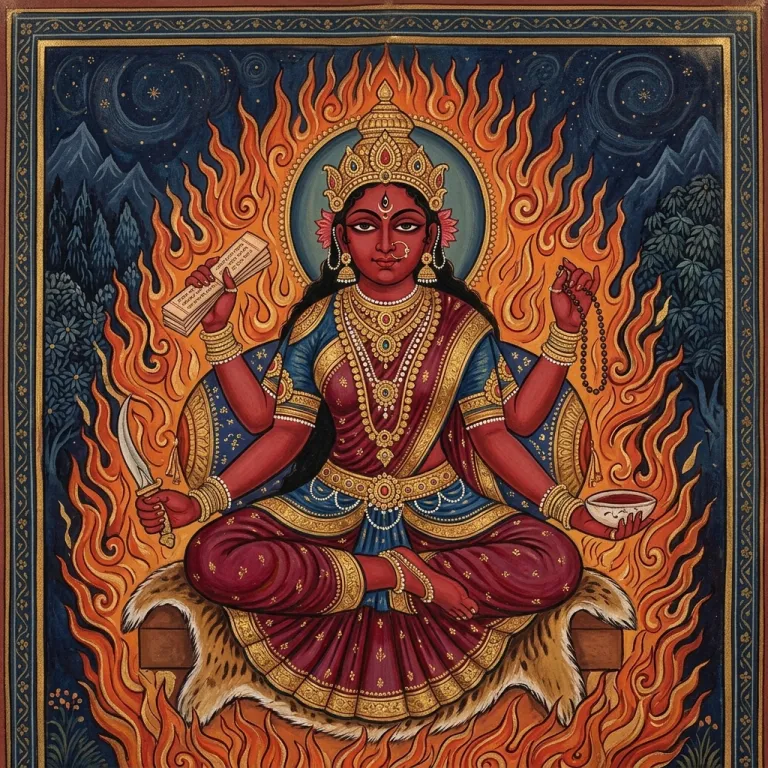
Her most widely cited meditation verse, summarised by scholars such as David Kinsley, describes her as radiant like a thousand rising suns. She wears red silk and a garland of heads, has three eyes and a crescent moon in her crown, and holds a rosary and a book while making the gestures of fearlessness and blessing. Other forms show her with a sword and a cup, seated on a corpse or a lotus.
| Feature | Traditional meaning |
|---|---|
| Red, sun-like radiance | Fire, heat and energy: tapas and the blazing power of awareness |
| Red garments | Passion transformed into spiritual intensity; the colour of Shakti |
| Rosary (japamala) | Disciplined mantra practice as the means of transformation |
| Book (pustaka) | Sacred knowledge (vidya) and the power of speech |
| Abhaya and varada mudras | Protection and grace: her fierceness serves the devotee |
| Garland of heads | The ego and its identifications burned away; also read as the letters of the alphabet |
| Three eyes and crescent moon | Vision beyond the ordinary, and the cooling nectar that balances her heat |
The combination is telling. The objects in her hands, rosary and book, belong to the ascetic and the scholar, while her garland and setting belong to the cremation ground. Bhairavi joins disciplined study and practice with fearless confrontation of death and change.
Bhairavi Mythology and Sources
Among the ten forms of Sati
As with the other Mahavidyas, the best-known account of Bhairavi’s appearance is in the Shakta Mahabhagavata Purana. Forbidden by Shiva to attend her father Daksha’s sacrifice, Sati reveals her power by appearing in ten forms around him, Bhairavi among them. The order and placement of the ten differ between texts.
Consort of Bhairava
Much of Bhairavi’s identity comes from her pairing with Bhairava. In Shaiva and Shakta Tantra, Bhairava is not merely a frightening deity but a name for the supreme consciousness, as in the Vijnana Bhairava Tantra, a text of 112 meditation methods framed as a dialogue between Bhairava and Bhairavi. In that text Bhairavi is the questioning goddess who draws out the teaching. The Kashmir Shaiva traditions built much of their philosophy on this Bhairava–Bhairavi framework.
Forms of Bhairavi
Tantric compendia describe several forms of the goddess, among them Tripura Bhairavi, Chaitanya Bhairavi (Bhairavi as awakened consciousness) and Sampatprada Bhairavi (the bestower of prosperity). The lists and details vary between sources. The variety shows that Bhairavi is less a single figure than a type of fierce, transforming Shakti.
Philosophical Meaning: Tapas, Dissolution and Kundalini
Bhairavi’s central idea is tapas, literally “heat,” the energy generated by austerity, concentration and self-discipline. In Indian thought tapas is a creative and purifying force: ascetics generate it, and gods create worlds through it. Bhairavi is this heat personified. She burns away what is impure, lazy or false, and she refuses to let the practitioner settle into complacency.
She is also associated with dissolution (pralaya). Scholarly accounts, including Kinsley’s, link Bhairavi with destruction in the cosmic cycle, understood not as a random force but as the necessary end of every created thing. Coming after Bhuvaneshwari, who is space and the manifest world, Bhairavi shows that everything within that space is subject to transformation.
Many teachers connect Bhairavi with the fiery awakening of kundalini, the coiled energy that yoga traditions locate at the base of the spine, and with vak, the power of speech rising from its subtle source. In this reading she is the inner fire that climbs through the chakras and transforms the practitioner.
A caution about intensive practice
Traditions describe kundalini practices and intensive austerities as demanding and potentially destabilising. They should be undertaken only under an experienced, qualified teacher. Spiritual practice is not a substitute for medical or mental-health care; anyone with health concerns should consult a qualified professional.
Bhairavi Worship: Mantra, Yantra and Practice
Bhairavi is worshipped mainly in initiated Tantric sadhana rather than in large public temples. Published sources commonly give the mantra of Tripura Bhairavi as a three-part formula built from complex seed syllables (often transliterated hsraim hsklrim hsrauh), structurally related to the three-part mantras of the Sri Vidya family. Tradition treats such mantras as esoteric and to be received only from a guru.
Her yantra is generally described as a central point within a downward-pointing triangle or set of triangles, surrounded by lotus petals and a square enclosure with four gates. As with the Sri Yantra, worship proceeds from the outer enclosure inward. Offerings of red flowers and red cloth are commonly associated with her, reflecting her colour.
A note on practice
Shakta traditions hold that Mahavidya mantras require initiation (diksha) and proper guidance. They are spiritual disciplines, not guaranteed ways to gain power, wealth or other outcomes.
Bhairavi as a Title: Female Tantric Adepts
Beyond the goddess, “bhairavi” is used for an accomplished female Tantric practitioner, regarded as an embodiment of the goddess. The best-known example is the Bhairavi Brahmani, a woman adept who arrived at Dakshineswar in the 1860s and guided Sri Ramakrishna through a wide range of Tantric disciplines, according to his biographers. Her story is a reminder that Tantra has recognised women as teachers and spiritual authorities.
Temples and Festivals
Compared with Kali or Tara, Bhairavi has relatively few prominent temples dedicated to her alone. She is most often worshipped within Mahavidya shrines and in private practice. The Kamakhya temple complex on Nilachal Hill, Guwahati, which honours the ten Mahavidyas, is the best-known pilgrimage centre for the group as a whole. Bhairavi is also honoured during Navaratri and in the private worship of Shakta practitioners.
Bhairavi vs Kali and Bhairavi vs Bhairava
| Compared with | Similarity | Difference |
|---|---|---|
| Kali | Both fierce, both wear garlands of heads and are linked with dissolution | Kali is dark and stands for time; Bhairavi is red and stands for fire and tapas, and often holds a rosary and book |
| Bhairava | Same name root; a divine couple | Bhairava is the fierce form of Shiva (consciousness); Bhairavi is his Shakti (power) |
| Tripura Sundari | Share the name Tripura and related three-part mantras | Sundari is the beautiful, blissful face of the goddess; Bhairavi is her formidable face |
| Raga Bhairavi | Same name | A Hindustani musical raga, not a deity; the goddess and the raga should not be confused |
Frequently Asked Questions
What is the meaning of Bhairavi?
Bhairavi means “the formidable” or “fearsome one” and is the feminine of Bhairava, the fierce form of Shiva. As the fifth Mahavidya, she is the goddess of tapas, the fiery energy of spiritual discipline that burns away impurity and ignorance. The word is also a title for accomplished female Tantric practitioners.
Who is Tripura Bhairavi?
Tripura Bhairavi is the best-known form of the Mahavidya Bhairavi. She is described as radiant like a thousand rising suns, dressed in red, with three eyes and a crescent moon, holding a rosary and a book and making gestures of fearlessness and blessing. Many sources treat her as the fierce counterpart of Tripura Sundari.
What does goddess Bhairavi represent?
Bhairavi represents tapas (spiritual heat), transformation and the dissolution of everything created. Tantric teachers also connect her with the awakening of kundalini and with the power of speech. Her fierceness is understood as protective: it burns away ego and complacency so that the practitioner can grow.
Is Bhairavi the wife of Bhairava?
Yes. In Shaiva and Shakta Tantra, Bhairavi is the consort and Shakti of Bhairava, the fierce form of Shiva. The Vijnana Bhairava Tantra is framed as a dialogue between them, with Bhairavi asking the questions that draw out Bhairava’s teaching on meditation.
What is the mantra of Bhairavi?
Published sources commonly give Tripura Bhairavi’s mantra as a three-part formula of complex seed syllables, often transliterated “hsraim hsklrim hsrauh,” related to the Sri Vidya family of mantras. Tantric tradition treats it as esoteric and holds that it should be received only through initiation from a qualified guru.
Is raga Bhairavi related to the goddess?
Raga Bhairavi is a well-known raga of Hindustani classical music, often performed at the end of a concert. It shares the goddess’s name, but it is a musical form, not a deity or a ritual. Information about the goddess Bhairavi should not be confused with the raga.
Sources & Further Reading
- David Kinsley, Tantric Visions of the Divine Feminine: The Ten Mahāvidyās (University of California Press, 1997)
- Jaideva Singh (trans.), Vijñānabhairava or Divine Consciousness (Motilal Banarsidass, 1979)
- Swami Saradananda, Sri Ramakrishna, the Great Master, trans. Swami Jagadananda (Sri Ramakrishna Math, Madras)
- Hugh B. Urban, The Power of Tantra: Religion, Sexuality and the Politics of South Asian Studies (I.B. Tauris, 2010)
- Madhu Khanna, Yantra: The Tantric Symbol of Cosmic Unity (Thames & Hudson, 1979)
- S. Shankaranarayanan, The Ten Great Cosmic Powers: Daśa Mahāvidyās (1972)