Mahavidya 3 of 10
Tripura Sundari — Lalita, Shodashi and the Goddess of Sri Vidya
त्रिपुरसुन्दरी
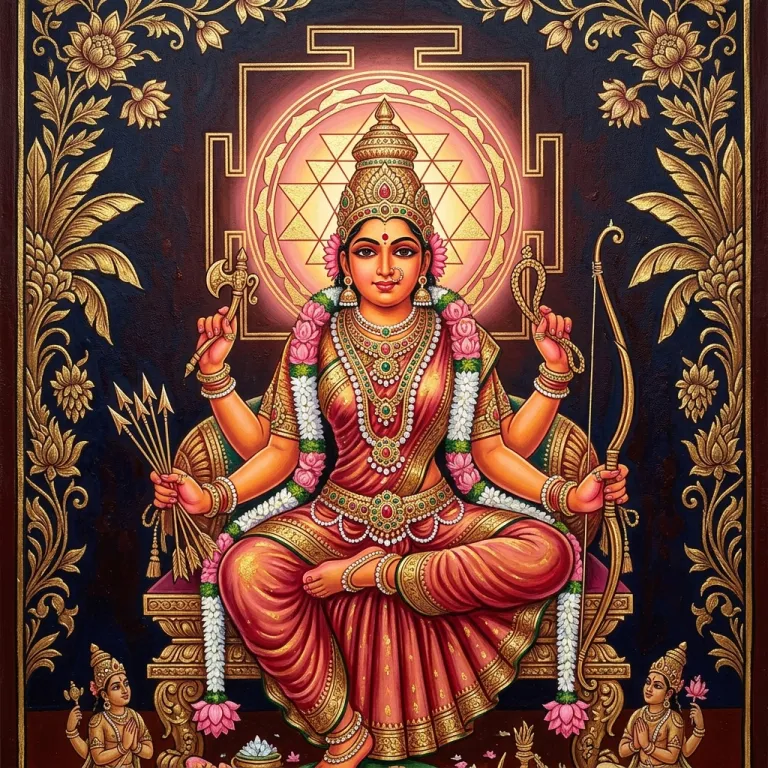
Tripura Sundari (त्रिपुरसुन्दरी), “the beautiful one of the three worlds,” is the third of the ten Mahavidyas and the supreme goddess of the Sri Vidya tradition. She is also called Lalita (“she who plays”), Shodashi (“the sixteen-year-old”) and Rajarajeshwari, and she is worshipped above all through the Sri Yantra.
Kali and Tara teach through fierce imagery. Tripura Sundari teaches through beauty, delight and royal majesty. For her followers, the world is not something to escape but the joyful play (lila) of consciousness. This guide explains her names, her symbols, the main myths, the philosophy of Sri Vidya, and how she is worshipped through mantra and yantra.
What Does Tripura Sundari Mean?
Sundari means “beautiful woman.” Tripura, literally “three cities,” is read in many ways within Sri Vidya, as Douglas Renfrew Brooks describes in Auspicious Wisdom. It can mean the three worlds (earth, atmosphere and heaven), the three states of waking, dreaming and deep sleep, or the three powers of will, knowledge and action. It can also mean the triad of knower, act of knowing and object known. She is the beauty that underlies and goes beyond each of these triads.
Lalita, Shodashi and her other names
- Lalita, “she who plays”: creation is her effortless play.
- Shodashi, “she who is sixteen”: she has the perfect beauty of a sixteen-year-old. The name also links her to the sixteen-syllable mantra and the sixteen phases (kalas) of the moon.
- Rajarajeshwari, “queen of kings”: she is the sovereign ruler of the cosmos.
- Kameshvari, “goddess of desire”: she is the consort of Kameshvara, a form of Shiva.
- Bala Tripurasundari: her form as a young girl, often worshipped as an entry point to Sri Vidya.
Tripura Sundari Iconography and Symbolism
Sri Vidya meditation verses describe her as rosy or red like the rising sun. She has three eyes and a crescent moon in her crown. She is seated on a throne whose legs are the gods Brahma, Vishnu, Rudra and Ishvara, with Sadashiva forming the seat. Each object she holds carries a teaching.
| Feature | Traditional meaning |
|---|---|
| Red or rosy complexion | Compassion, passion and the dawn of awareness |
| Noose (pasha) | Attachment or desire, which she both binds with and controls |
| Goad (ankusha) | Restraint and the power to guide, including the checking of aversion |
| Sugarcane bow | The mind, whose sweetness draws experience toward it |
| Five flower arrows | The five senses and their objects |
| Throne of five gods | Her supremacy. The gods who create, preserve, dissolve, conceal and reveal all serve her. |
| Crescent moon | Nectar, time and the phases of consciousness |
| Youthful beauty | Consciousness that never ages and is always fresh |
The point of the image is that the goddess does not reject desire, the mind or the senses. She holds them as her own instruments. Sri Vidya treats refined desire (iccha) as a form of divine will rather than as something to suppress.
Mythology: Lalita and Bhandasura
Lalita’s main myth is told in the Lalitopakhyana, a section of the Brahmanda Purana. After Shiva burned Kama, the god of love, to ashes, a demon named Bhandasura arose from those ashes and oppressed the three worlds. The gods performed a great sacrifice, offering even themselves into the fire. From the fire of consciousness (chidagni) the goddess Lalita appeared, radiant and fully armed.
She rode out with her powers, the goddesses Shyamala (Mantrini) and Varahi (Dandanatha) among them, and destroyed Bhandasura and his armies. She then married Kameshvara and restored Kama to life. The story is read symbolically as well. Bhandasura is the ego that arises when desire is cut off from consciousness, and Lalita’s victory restores desire to its divine source.
Among the ten forms of Sati
In the Mahabhagavata Purana’s origin story for the Mahavidyas, Sundari or Shodashi is one of the ten forms Sati takes to show Shiva her full power before going to Daksha’s sacrifice. The lists of the ten vary between texts. Some treat Shodashi and Tripura Sundari as one goddess, and others list related forms separately.
Sri Vidya: The Tradition of Tripura Sundari
Sri Vidya (“auspicious wisdom”) is a Shakta Tantric tradition with Tripura Sundari at its centre. It belongs to the Srikula, the “family of Sri,” as distinct from the Kali-centred Kalikula. Its core ideas share much with Kashmir Shaiva non-dualism. Consciousness is the only reality, and the goddess is that consciousness in its dynamic, self-aware, blissful aspect.
Important texts include the Vamakeshvara Tantra (with the Nityashodashikarnava and Yogini Hridaya), the Tantraraja Tantra, and the Lalita Sahasranama, a thousand-name hymn found in the Brahmanda Purana. The Saundarya Lahari, a hymn traditionally attributed to Adi Shankaracharya, is also central. The 18th-century scholar Bhaskararaya wrote influential commentaries on the Lalita Sahasranama and on Sri Vidya ritual. For the wider textual history, see Sacred Texts.
In South India, Sri Vidya has long been linked with the Shankaracharya monasteries (mathas) and with Smarta Brahmin households. That gives it a more “right-handed,” mainstream character than many other Tantric lineages. Brooks’ studies trace this history in detail.
Worship: The Panchadashi Mantra and the Sri Yantra
The mantra
Tripura Sundari’s root mantra is the Panchadashi (“fifteen-syllable”) mantra. It is made of three sections (kutas), each ending in the seed syllable hrim, and the three are linked to speech, desire and power. There are two main versions, the Kadi and Hadi forms, named after their opening letters. Adding the seed syllable shrim gives the sixteen-syllable Shodashi mantra. Although the mantra appears in books, Sri Vidya is one of the most strictly initiation-based Tantric traditions. Students usually receive the mantra step by step from a guru, often starting with the Bala mantra.
A note on practice
Sri Vidya teachers stress that its mantras and Navavarana worship are to be learned through initiation (diksha) and proper guidance. Devotional recitation of the Lalita Sahasranama is widely practised by lay devotees. No mantra or yantra should be treated as a guaranteed means to wealth, health or other outcomes.
The Sri Yantra
The goddess is worshipped above all in the Sri Yantra (Sri Chakra), which Sri Vidya treats as her subtle body. It is built from nine interlocking triangles, four pointing up (Shiva) and five pointing down (Shakti), around a central point (bindu). These are surrounded by lotuses of eight and sixteen petals, circles, and a square enclosure with four gates. The yantra is divided into nine enclosures (avaranas), each holding its own group of goddesses.
In Navavarana puja, the practitioner worships these nine enclosures one by one, from the outer square to the bindu. The bindu is where the goddess is united with Shiva. The rite is understood as an inner journey from outer experience to the source of consciousness. For a full explanation of the geometry, see our Sri Yantra guide. The practices page covers yantra worship in general.
Tripura Sundari vs Lalita: Are They the Same?
Yes. In Sri Vidya, Lalita, Tripura Sundari, Shodashi and Rajarajeshwari are names of one goddess. Different names come to the fore in different contexts. “Lalita” dominates in the Puranic myth and the Sahasranama. “Tripura Sundari” is common in Tantric texts. “Shodashi” is the usual name in Mahavidya lists. The table sums up how she relates to goddesses she is often compared with.
| Compared with | Relationship |
|---|---|
| Lalita / Shodashi / Rajarajeshwari | The same goddess under different names |
| Bala Tripurasundari | Her young-girl form, with its own mantra |
| Bhuvaneshwari | A separate Mahavidya with very similar iconography (red, noose and goad), closely allied in Srikula worship |
| Kali | The other pole of Shakta Tantra: Kalikula versus Srikula, the fierce versus the beautiful |
| Kamakshi | The presiding goddess of Kanchipuram, widely identified with Lalita in the Sri Vidya tradition |
Tripura Sundari Temples and Festivals
- Kamakshi Amman Temple, Kanchipuram (Tamil Nadu): A major Sri Vidya centre, where tradition holds that Adi Shankaracharya installed a Sri Chakra.
- Tripura Sundari Temple, Udaipur (Tripura): Known locally as Matabari and counted among the Shakti Peethas. It is widely believed to be the origin of the state’s name.
- Kamakhya temple complex, Guwahati: Tradition places Tripura Sundari among the Mahavidyas honoured on Nilachal Hill.
Devotees honour her especially during Navaratri. Many Sri Vidya households also observe Lalita Panchami, the fifth day of the bright half of Ashvin, and recite the Lalita Sahasranama on Fridays and full-moon days.
Frequently Asked Questions
Who is Tripura Sundari?
Tripura Sundari is the third of the ten Mahavidyas and the supreme goddess of the Sri Vidya tradition. Her name means “the beautiful one of the three worlds.” She is also called Lalita, Shodashi and Rajarajeshwari. She is shown with a rosy complexion, holding a noose, goad, sugarcane bow and flower arrows, and is worshipped through the Sri Yantra.
Are Lalita and Tripura Sundari the same goddess?
Yes. In Sri Vidya, Lalita, Tripura Sundari, Shodashi and Rajarajeshwari are names of one goddess. “Lalita” is most common in the Lalitopakhyana and the Lalita Sahasranama, “Tripura Sundari” in Tantric texts, and “Shodashi” in lists of the ten Mahavidyas.
Why is she called Shodashi?
Shodashi means “she who is sixteen.” The name describes her as eternally youthful, with the perfect beauty of a sixteen-year-old. It also links her to the sixteen-syllable Shodashi mantra and to the sixteen phases (kalas) of the moon, which symbolise completeness in Tantric thought.
What is Sri Vidya?
Sri Vidya, “auspicious wisdom,” is a Shakta Tantric tradition centred on the goddess Tripura Sundari. It is known for its non-dual philosophy, the Panchadashi mantra and worship of the Sri Yantra. Its key texts include the Vamakeshvara Tantra, the Lalita Sahasranama and the Saundarya Lahari. It traditionally requires initiation from a guru.
What is the relationship between Tripura Sundari and the Sri Yantra?
The Sri Yantra, or Sri Chakra, is considered the geometric form of Tripura Sundari. Its nine interlocking triangles, lotuses and square enclosure form nine enclosures filled with her attendant powers. In Navavarana puja, practitioners worship these enclosures from the outside in, ending at the central bindu, where the goddess is united with Shiva.
What is the mantra of Tripura Sundari?
Her root mantra is the fifteen-syllable Panchadashi, which has three sections, each ending in the seed syllable hrim. Adding shrim gives the sixteen-syllable Shodashi mantra. Sri Vidya tradition holds that these are given only through initiation, often after the Bala mantra. Lay devotees commonly recite the Lalita Sahasranama instead.
Where is the Tripura Sundari temple?
Well-known centres include the Tripura Sundari (Matabari) temple at Udaipur in Tripura, counted among the Shakti Peethas, and the Kamakshi Amman temple in Kanchipuram, a major Sri Vidya centre. The Kamakhya complex in Assam also honours her among the ten Mahavidyas.
Sources & Further Reading
- Douglas Renfrew Brooks, Auspicious Wisdom: The Texts and Traditions of Śrīvidyā Śākta Tantrism in South India (SUNY Press, 1992)
- Douglas Renfrew Brooks, The Secret of the Three Cities: An Introduction to Hindu Śākta Tantrism (University of Chicago Press, 1990)
- David Kinsley, Tantric Visions of the Divine Feminine: The Ten Mahāvidyās (University of California Press, 1997)
- Madhu Khanna, Yantra: The Tantric Symbol of Cosmic Unity (Thames & Hudson, 1979)
- W. Norman Brown (trans.), The Saundaryalaharī, or Flood of Beauty (Harvard University Press, 1958)
- S. Shankaranarayanan, The Ten Great Cosmic Powers: Daśa Mahāvidyās (1972)