Mahavidya 1 of 10
Goddess Kali — Meaning, Symbolism and the First Mahavidya
काली
Kali (काली) is the Hindu goddess of time, change and liberation, and the first of the ten Mahavidyas, or “great wisdom” goddesses. Her name means “the black one” and is linked to kala, time. She destroys ignorance and ego, and devotees also worship her as a loving mother.
Kali is one of the most widely worshipped and most misunderstood deities in India. Her fierce appearance shocks many newcomers. Within Shakta and Tantric traditions, though, it is read as a set of teachings, not as a celebration of violence. This guide covers her name, her symbols, the main myths, her place in Tantric philosophy, how she is worshipped and where her best-known temples are.
What Does the Name Kali Mean?
“Kali” is the feminine form of kala, a Sanskrit word that means both “black” and “time.” Tradition uses both meanings. She is dark because she existed before light and form, and she is Time, which eventually swallows everything that exists. In the Mahanirvana Tantra, the goddess is praised as the power that takes back even Time itself (Mahakala) at the end of the cosmic cycle.
The word turns up early. The Mundaka Upanishad names Kali as one of the seven flickering tongues of the sacrificial fire. As a goddess with her own myths, Kali becomes prominent in the Devi Mahatmya (part of the Markandeya Purana, generally dated to around the 5th–6th century CE). Later Tantric and devotional literature, especially from Bengal, made her a supreme deity. For the wider history, see the origins of Tantra.
Kali Iconography and Symbolism
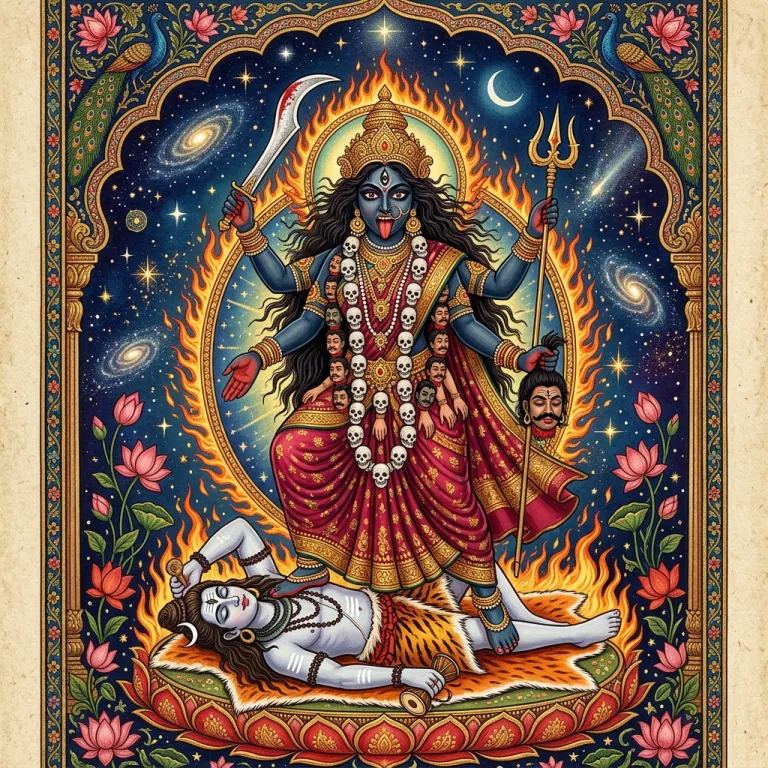
Kali’s appearance differs from region to region. The most common form in eastern India is Dakshina Kali. She is dark-skinned and four-armed, with loose hair, three eyes and a red tongue, and she stands on Shiva. The table gives the usual Tantric readings of each feature. These are interpretations handed down in the tradition, not literal descriptions.
| Feature | Traditional meaning |
|---|---|
| Black or dark blue skin | The formless void before creation. All colours disappear into black, as all things disappear into her. |
| Nakedness (digambara, “clothed in space”) | Freedom from all limitation. Nothing can cover or contain her. |
| Sword | Knowledge that cuts through ignorance and attachment |
| Severed head held in one hand | The ego, which must be given up for liberation |
| Right hands in abhaya and varada mudras | “Do not fear” and “I grant boons.” She protects her devotees. |
| Garland of heads | Often counted as fifty and read as the fifty letters of the Sanskrit alphabet: sound and language, from which the world takes shape |
| Girdle of arms | Action (karma). Arms are the instruments of deeds, and she frees the devotee from their consequences. |
| Protruding red tongue | Read in different ways: her appetite for all that is transient, the energy of rajas, or, in a popular story, embarrassment (see below) |
| Cremation ground setting | The place where attachments end. In Tantric symbolism it is also the devotee’s heart, emptied of ego. |
Other forms include Shmashana Kali, the Kali of the cremation ground, and Bhadrakali, an auspicious form widely worshipped in Kerala.
Why Is Kali Standing on Shiva?
This is one of the most searched questions about Kali. Tradition gives several answers, and they sit side by side rather than cancelling each other out.
The popular story
A widely told folk story, especially common in Bengal, runs like this. After defeating the demons, Kali kept dancing in a battle frenzy that threatened the world. To calm her, Shiva lay down in her path. When she stepped on her husband she realised what she had done, and she stuck out her tongue in shame. The story is well loved, but it is a later popular explanation rather than a canonical scripture.
The Tantric interpretation
In Tantric thought the image is a diagram of reality. Shiva is pure, unchanging consciousness and Kali is the dynamic power (Shakti) that brings everything into being. A well-known play on words holds that Shiva without the letter “i”, which stands for Shakti, becomes shava, a corpse. Consciousness and power cannot be separated. Kali standing on the still Shiva shows that manifestation happens only when the two are together. In some images Shiva lies under her like a corpse. In others he gazes up at her, and the pair are shown in union.
Bengali devotional poets such as Ramprasad Sen (18th century) offer a third reading: Shiva lies at her feet as the ideal devotee, completely surrendered to the Mother.
Kali Mythology and Origin Stories
Kali in the Devi Mahatmya
In the Devi Mahatmya, the goddess Ambika (Durga) grows dark with anger while fighting the demon generals Chanda and Munda, and Kali springs from her brow. Kali defeats both generals and is given the name Chamunda. In the later battle with Raktabija, a demon whose every drop of blood produces a copy of himself, Kali stops the copies from multiplying by consuming the blood before it can touch the ground. This lets the goddess win. In this text Kali is a power that comes out of the great goddess, not a separate deity.
Kali as the first Mahavidya
The best-known origin story for the ten Mahavidyas comes from the Shakta Mahabhagavata Purana. Sati wanted to attend her father Daksha’s sacrifice, but Shiva forbade it. In her anger Sati took on a terrifying dark form, the form of Kali. When Shiva tried to leave, she appeared as ten goddesses who blocked every direction. Shiva recognised her supreme power and let her go. Kali is the first and chief of these forms. Other texts tell the story differently, and the order of the goddesses varies.
Kali in the Tantras
Tantras of the Kali family, such as the Kali Tantra, Todala Tantra and Mahanirvana Tantra, treat her as the highest reality. She is Adya Shakti, the primordial power, and all other deities are her forms. See our guide to Tantric texts for how these works are dated and classified.
Kali’s Place Among the Mahavidyas
Kali heads the list of the ten Mahavidyas. Many teachers treat her as the source from which the other nine emerge. The Todala Tantra pairs each Mahavidya with a form of Shiva, and pairs Kali with Mahakala, “Great Time.” Some later writers also link the ten goddesses to Vishnu’s ten avatars, with Kali matched to Krishna, though these links vary from text to text.
Many modern interpreters see the sequence as a path, beginning with Kali’s radical letting go and ending with Kamala’s abundance.
Kali Worship: Mantra, Yantra and Practice
Kali is worshipped in two main ways: in public temple rituals and in private Tantric practice (sadhana). Temple worship involves hymns, lamps, sweets and flowers, especially red hibiscus. Householders commonly recite hymns such as the Kali Kavacham.
Kali mantra
Kali’s seed syllable (bija) is Krim (क्रीं). A widely published devotional form is Om Krim Kalikayai Namah (“Om, salutations to Kalika”). Longer Tantric mantras of Dakshina Kali, built around krim, hum and hrim, appear in printed manuals. Tradition, however, holds that these belong to initiated practice.
A note on practice
Shakta traditions hold that Tantric mantras should be received through initiation (diksha) from a qualified guru, who also teaches the correct method and conduct. Mantras are spiritual disciplines, not guaranteed ways to get results. Anyone dealing with health, legal or emotional problems should consult the relevant professionals.
Kali yantra
The Kali yantra is usually drawn as a central point (bindu) inside a set of downward-pointing triangles, a symbol of Shakti. These are surrounded by an eight-petalled lotus and a square outer enclosure with four gates. As with every yantra, the practitioner moves in meditation from the outer square to the centre. Madhu Khanna’s Yantra explains the principles behind these diagrams.
Famous Kali Temples and Festivals
- Kalighat Kali Temple, Kolkata: One of the best-known Kali temples in India, and counted among the Shakti Peethas. Tradition holds that part of Sati’s body fell here.
- Dakshineswar Kali Temple, Kolkata: Founded by Rani Rashmoni in the mid-19th century on the bank of the Hooghly. It is famous as the place where Sri Ramakrishna served as priest and worshipped Kali as Bhavatarini.
- Kamakhya temple complex, Guwahati: The Nilachal Hill complex has shrines associated with the ten Mahavidyas, including Kali.
Kali Puja is held on the new-moon night (amavasya) of the month of Kartika, usually the same night as Diwali. It is a major festival in West Bengal, Assam, Odisha and Tripura, and many worshippers observe it with night-long rites. Kali is also honoured during Navaratri and Durga Puja.
Kali vs Durga: What Is the Difference?
Kali and Durga are closely linked but not the same. In the Devi Mahatmya, Durga (Ambika) is the radiant warrior goddess who rides a lion, and Kali is a fierce power that comes out of her in battle. Durga appears adorned and many-armed, protecting the cosmic order. Kali is dark and unadorned, and stands for dissolution and freedom beyond that order. In Shakta theology the two are ultimately forms of one goddess, called Devi or Mahadevi. For how Kali relates to the second Mahavidya, see Kali vs Tara.
Frequently Asked Questions
What is the meaning of goddess Kali?
Kali means “the black one” and is linked to kala, meaning time. She is the goddess of time, change and liberation. She destroys ignorance and ego, and her devotees also worship her as a loving, protective mother. In Tantra she is the first of the ten Mahavidyas and is often treated as the supreme reality.
Why is Kali standing on Shiva?
A popular story says Shiva lay in her path to calm her battle frenzy, and she stuck out her tongue in embarrassment when she stepped on him. Tantric teachers read the image symbolically: Shiva is still, pure consciousness and Kali is the active power, and nothing appears in the world unless the two act together.
Is Kali a good or evil goddess?
Hindu tradition does not regard Kali as evil. She is fierce because she destroys what harms her devotees, such as demons, ignorance and fear. Her followers call her Ma, Mother, and saints such as Ramakrishna and Ramprasad Sen described her as endlessly loving. Her frightening appearance is read as a teaching about letting go and fearlessness.
What is the mantra of Kali?
Kali’s seed syllable is Krim. A widely published devotional mantra is “Om Krim Kalikayai Namah.” Longer Tantric mantras of Dakshina Kali also exist, but tradition holds that these should be received through initiation from a qualified teacher. Mantras are treated as spiritual practice, not as guaranteed ways to get results.
Why is Kali the first Mahavidya?
Kali comes first because she stands for the dissolution of all limited identity, which clears the way for the wisdom the other goddesses represent. In the Mahabhagavata Purana, Sati first takes Kali’s dark form before appearing as all ten. Many Tantric teachers treat Kali as the source from which the other Mahavidyas arise.
When is Kali Puja celebrated?
Kali Puja falls on the new-moon night of the Hindu month of Kartika, usually October or November, and generally coincides with Diwali. It is especially important in West Bengal, Assam, Odisha and Tripura, where temples and community groups hold night-time worship of the goddess.
Sources & Further Reading
- David Kinsley, Tantric Visions of the Divine Feminine: The Ten Mahāvidyās (University of California Press, 1997)
- David Kinsley, Hindu Goddesses: Visions of the Divine Feminine in the Hindu Religious Tradition (University of California Press, 1986)
- Rachel Fell McDermott & Jeffrey J. Kripal (eds.), Encountering Kālī: In the Margins, at the Center, in the West (University of California Press, 2003)
- Rachel Fell McDermott, Mother of My Heart, Daughter of My Dreams: Kali and Uma in the Devotional Poetry of Bengal (Oxford University Press, 2001)
- Thomas B. Coburn, Encountering the Goddess: A Translation of the Devī-Māhātmya and a Study of Its Interpretation (SUNY Press, 1991)
- Madhu Khanna, Yantra: The Tantric Symbol of Cosmic Unity (Thames & Hudson, 1979)
- S. Shankaranarayanan, The Ten Great Cosmic Powers: Daśa Mahāvidyās (1972)