Mahavidya 6 of 10
Chhinnamasta — The Goddess Who Offers Her Own Head
छिन्नमस्ता
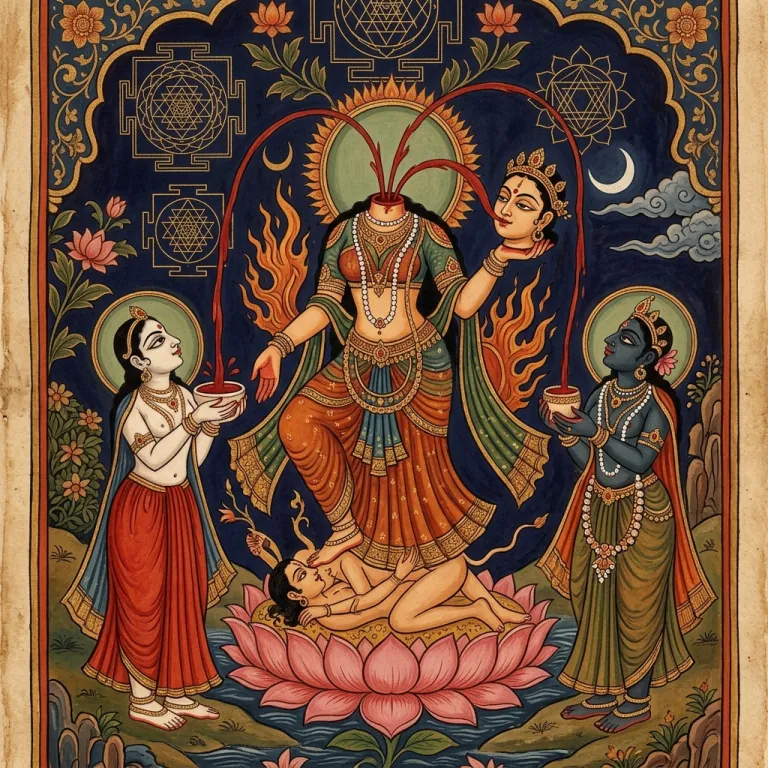
Chhinnamasta (छिन्नमस्ता, "she whose head is severed") is the sixth of the ten Mahavidyas, the wisdom goddesses of Hindu Tantra. She is shown holding her own head, which she has cut off herself. Streams of life-force flow from her neck to feed two attendants and her own mouth. The image stands for self-sacrifice, the life-giving power of Shakti, and going beyond the ego.
Scholars such as David Kinsley and Elisabeth Anne Benard read this startling image as a teaching, not a literal act: life and death, giving and receiving, form one cycle. This page covers her symbolism, myths, worship, temples and link with the Buddhist goddess Vajrayogini.
What Does Chhinnamasta Mean?
The name joins chhinna ("cut, severed") and masta ("head"). She is also called Chhinnamastika (the name used at Rajrappa), is identified with Prachanda Chandika, and is praised as Vajravairochani, a name pointing to Buddhist Tantra.
She belongs with the fierce (ugra) Mahavidyas such as Kali and Tara, yet her defining act is giving, not destroying.
Chhinnamasta Iconography and Symbolism
Paintings and temple images follow her meditation verses (dhyana) closely. Details vary by region, but the core elements are consistent.
| Feature | Traditional meaning |
|---|---|
| Her own severed head, held in one hand | The ego given up; the head stays alive and serene, so the offering is transformation, not ending |
| Blade (kartri) in the other hand | Discriminating wisdom that cuts through attachment and false identity |
| Three streams from the neck | Life-force (prana) shared with her attendants and herself; yogic readings link them to the three main subtle channels |
| Two attendants, Dakini and Varnini | Called Jaya and Vijaya in some texts; they stand for the devotees or beings sustained by her sacrifice |
| Kama and Rati beneath her, on a lotus | The god of desire and his consort in union; read either as desire mastered or as the creative energy that powers her |
| Red complexion, youthful form | Vital energy and the heat of transformation; texts describe her as sixteen, the age of full vitality |
| Serpent sacred thread, garland of heads, loose hair | Kundalini energy, the powers of creation, freedom from convention |
She is never shown in pain, but calm, even joyful.
Why Did Chhinnamasta Cut Off Her Head? The Myths
Several stories exist, and they do not always agree.
The Hungry Attendants
In the best-known story, summarised by Kinsley from the Pranatoshini Tantra, Parvati bathes in the Mandakini river with two companions. They grow hungry and keep begging for food, and out of compassion she cuts off her own head. Three streams rise from her neck. Two feed her companions and she drinks the third, and all are satisfied. The act is maternal compassion taken to its limit.
The Ten Forms of Sati
In the Mahabhagavata Purana, she is one of the ten forms Sati shows Shiva when he forbids her to attend Daksha's sacrifice (see the Dasha Mahavidya overview).
Other Accounts
Other versions set the act after a battle with demons, or tie her to Prachanda Chandika, and Rajrappa has local legends. Because the stories vary so much, the image is best treated as more stable than any single narrative.
Philosophical Meaning: Life, Death and the Ego
Kinsley notes that the image joins sex (Kama and Rati), death (the severed head) and nourishment (the streams). Together they say that life feeds on life: creation and destruction are one continuous process, and Shakti runs through all of it.
A more inward reading, common among practitioners, treats the head as the self-centred thinking mind. Cutting it off means passing beyond thought into direct awareness, which some teachers compare to kundalini rising through the central channel.
A third reading stresses self-giving that leaves the giver more alive, not less. In the sequence she follows Bhairavi's fire of discipline and precedes Dhumavati's emptiness.
Chhinnamasta and Vajrayogini: The Buddhist Connection
A headless goddess also appears in Vajrayana Buddhism as Chinnamunda ("severed head"), a form of Vajravarahi, herself a form of Vajrayogini. Benard's study, Chinnamastā: The Aweful Buddhist and Hindu Tantric Goddess, compares the two in detail. She argues that the Buddhist form is attested earlier and that the Hindu goddess developed in contact with it. The Hindu epithet "Vajravairochani" supports that link. In the legends of the eighty-four Mahasiddhas, the sisters Mekhala and Kanakhala are said to have offered their own heads.
| Aspect | Chhinnamasta (Hindu) | Chinnamunda Vajrayogini (Buddhist) |
|---|---|---|
| Tradition | Shakta Tantra; one of the ten Mahavidyas | Vajrayana; a form of Vajravarahi / Vajrayogini |
| Colour | Usually red | Usually yellow in the principal textual descriptions |
| Beneath her | Kama and Rati in union, on a lotus | Typically no copulating couple |
| Attendants | Dakini and Varnini (Jaya and Vijaya) | Two yoginis, often named Vajravairochani and Vajravarnani |
| Main meaning | Shakti's self-giving; life and death as one; ego transcended | Emptiness and the cutting of self-grasping in tantric meditation |
The two belong to different systems and should not simply be merged; see Buddhist Tantra.
How Is Chhinnamasta Worshipped?
Chhinnamasta is generally regarded as a goddess for advanced practitioners. Traditional manuals describe a sadhana of purification, nyasa, meditation on her form, mantra repetition and worship of her yantra, a diagram of triangles and petals treated, like other yantras, as the goddess herself.
A widely published mantra for her is श्रीं ह्रीं क्लीं ऐं वज्रवैरोचनीये हूं हूं फट् स्वाहा (shrim hrim klim aim vajravairochaniye hum hum phat svaha). It is given for information only; tradition holds that it should be received through initiation (diksha) from a qualified teacher.
A note on practice
This page is educational, not ritual instruction. No mantra or ritual is presented as guaranteeing any result, and spiritual practice is no substitute for medical or mental-health care.
Chhinnamastika Temple, Rajrappa and Other Sacred Sites
The Chhinnamastika temple at Rajrappa, in Ramgarh district of Jharkhand, is the most famous shrine of the goddess. It stands where the Bhairavi (Bhera) river meets the Damodar and draws large crowds, especially during Navaratri. It is one of the most important Shakta centres of eastern India.
The Chintpurni temple in Una district, Himachal Pradesh, is also dedicated to the goddess as Chhinnamastika, and many devotees regard it as a Shakti Peetha. At the Kamakhya temple complex in Assam, the ten Mahavidyas are honoured, and Chhinnamasta has her own shrine there.
Many Hindu calendars mark Chhinnamasta Jayanti on the fourteenth day of the bright fortnight of Vaishakha (April–May). The Gupta Navaratris are also popular seasons for Mahavidya worship.
Frequently Asked Questions
What is the meaning of Chhinnamasta?
Chhinnamasta means "she whose head is severed". She is the sixth of the ten Mahavidyas, shown holding her own head while streams of life-force feed two attendants and herself. The image symbolises self-sacrifice, Shakti's life-giving power, the unity of life and death, and transcending the ego.
Why did Chhinnamasta cut her own head?
In the best-known story, from the Pranatoshini Tantra, her two attendants grew hungry after bathing and begged for food. Out of compassion she cut off her own head so that its streams could nourish them and herself. Symbolically, the act represents selfless giving and cutting away the ego.
Where is the Chhinnamastika temple?
Her most famous temple is at Rajrappa in Ramgarh district, Jharkhand, where the Bhairavi (Bhera) river meets the Damodar. The Chintpurni temple in Himachal Pradesh is also dedicated to her, and she has a shrine in the Kamakhya temple complex in Assam.
Are Chhinnamasta and Vajrayogini the same goddess?
They are related but not identical. Vajrayana Buddhism has a headless form, Chinnamunda Vajravarahi, which is a form of Vajrayogini. Elisabeth Anne Benard argues the Buddhist form is attested earlier and influenced Chhinnamasta. The two differ in colour, attendants, iconography and doctrinal meaning.
Who are the two attendants of Chhinnamasta?
Her attendants are usually named Dakini and Varnini, and some texts call them Jaya and Vijaya. They stand on either side of her and drink from the streams flowing from her neck, representing the devotees, or all beings, sustained by her self-giving power.
Is it safe to worship Chhinnamasta at home?
Simple prayer and devotion to Chhinnamasta are common, as with any form of the Goddess. Her full Tantric sadhana, however, is traditionally considered advanced and is meant to be learned through initiation from a qualified guru, not attempted from books alone.
Sources & Further Reading
- Benard, Elisabeth Anne. Chinnamastā: The Aweful Buddhist and Hindu Tantric Goddess. Delhi: Motilal Banarsidass, 1994.
- Kinsley, David. Tantric Visions of the Divine Feminine: The Ten Mahāvidyās. Berkeley: University of California Press, 1997.
- English, Elizabeth. Vajrayoginī: Her Visualizations, Rituals, and Forms. Boston: Wisdom Publications, 2002.
- Dowman, Keith. Masters of Mahamudra: Songs and Histories of the Eighty-Four Buddhist Siddhas. Albany: SUNY Press, 1985.
- Urban, Hugh B. The Power of Tantra: Religion, Sexuality and the Politics of South Asian Studies. London: I.B. Tauris, 2010.
- Shankaranarayanan, S. The Ten Great Cosmic Powers. 1972.
- Mahabhagavata Purana (Shakta Upapurana), the account of Sati and the ten Mahavidyas.