Mahavidya 7 of 10
Dhumavati — The Smoky Widow Goddess
धूमावती
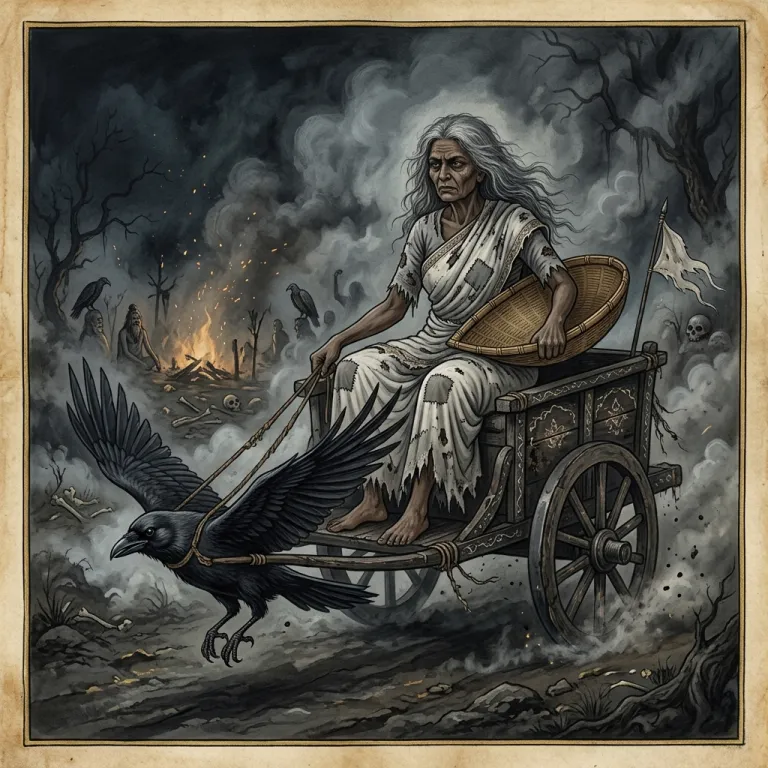
Dhumavati (धूमावती, "the smoky one") is the seventh of the ten Mahavidyas. She appears as an elderly widow with a pale, smoky complexion, often riding a crow or seated on a chariot with a crow banner. She represents loss, emptiness and disappointment, and the wisdom that can be found in facing them.
No other major Hindu goddess is described this way. She is unmarried or widowed, ageing, hungry and unadorned, the opposite of the auspicious wife-goddess. David Kinsley called her one of the most puzzling Mahavidyas. Yet devotees and Tantric practitioners hold that she grants detachment, insight and protection from misfortune. This page explains her image, stories, meaning, worship, temples and her festival, Dhumavati Jayanti.
Dhumavati Iconography and Symbolism
Her meditation verses, discussed by Kinsley, paint a deliberately unsettling portrait. Every detail reverses the usual signs of a blessed, prosperous goddess.
| Feature | Traditional meaning |
|---|---|
| Smoky, pale complexion | Smoke hides and blurs; it is what remains after the fire. She stands for obscurity, ignorance and the aftermath of destruction |
| Old age, thin body, missing teeth | Time and decay, which no one escapes |
| Widow's pale or soiled clothing, no jewellery | Absence of a consort; freedom from social roles and worldly attachments |
| Winnowing basket (shurpa) | Separating grain from husk: discernment between the essential and the non-essential |
| Crow as vehicle or banner | A bird linked with death and ancestors in Indian ritual; also a scavenger that thrives on what others discard |
| Hunger and thirst | Unsatisfied desire, and the restlessness that cannot be filled from outside |
| Hand in a boon or knowledge gesture | Despite her looks, she can grant wisdom and blessings to those who approach her |
Why Is Dhumavati Called the Widow Goddess?
Several stories explain her widowhood. Like the other Mahavidyas, she is best understood through all of them together.
Sati Swallows Shiva
The story most often retold, summarised by Kinsley from the Pranatoshini Tantra, tells how Sati, living with Shiva in the Himalayas, became extremely hungry and asked him for food. When he did not give it to her, her hunger drove her to swallow Shiva himself. Smoke poured from her body. Shiva asked to be released, and when she let him out, he declared that she would be worshipped in this form as a widow, Dhumavati. The story links her to insatiable hunger and to a power that can consume even the Absolute.
Born from the Smoke of Sati
Another account says Dhumavati arose from the smoke of Sati's body when she gave up her life in the fire at Daksha's sacrifice. In this version she is what remains of the goddess after the flames: grief and absence in visible form. This version ties her to the Sati story behind the Shakti Peethas.
One of the Ten Forms
In the Mahabhagavata Purana, she is simply one of the ten forms Sati takes to overwhelm Shiva before the sacrifice. Kinsley also notes her resemblance to older inauspicious goddesses such as Jyeshtha, Alakshmi and Nirriti. These goddesses of misfortune were traditionally kept at a distance, and Dhumavati may have taken on some of their features.
Philosophical Meaning of Dhumavati
Dhumavati brings the spiritual path face to face with what people most avoid: old age, loneliness, poverty, hunger and grief. In Tantric thought these are not outside the divine. If Shakti is everything, as the non-dual philosophy of Tantra holds, she must also be present in loss.
Practitioners describe her as the teacher of vairagya, the dispassion that comes when worldly supports fall away. The smoke that hides the fire can stand for ignorance. It can also stand for the quiet after a great blaze, when the seeker has nothing left to cling to. In the Mahavidya sequence she follows Chhinnamasta's self-sacrifice and precedes Bagalamukhi's power of stillness.
Her widowhood also invites reflection on a social reality. In traditional Indian society widows were often pushed to the margins. A widow worshipped as a goddess gives dignity to the experience of being alone. It also suggests that a woman's spiritual power does not depend on a husband. Kinsley notes that she is described as a form of Shakti existing without Shiva, an unusual idea in a tradition that usually pairs the two.
Dhumavati Worship, Mantra and Yantra
Tradition regards Dhumavati as a goddess approached with care. Many Shakta teachers say that married householders should not install her image at home. Her worship has often been associated with ascetics, the unmarried and Tantric specialists. Devotees pray to her to remove poverty, illness and misfortune, on the logic that the goddess of misfortune can also take it away. These are devotional beliefs, not promises.
A widely published mantra is धूं धूं धूमावती स्वाहा (dhum dhum dhumavati svaha), with small variations between sources; dhum is her seed syllable (bija). Her yantra, like other Mahavidya yantras, combines triangles, a circle, lotus petals and a square enclosure. Traditional manuals mention offerings of smoke, dark or simple foods, and worship at quiet times and places. As with every Tantric sadhana, lineages hold that her mantra should be received through initiation (diksha).
A note on practice
This page is educational, not ritual instruction. No mantra or ritual is presented as guaranteeing any result. Fasting or intensive practice should be undertaken only with a qualified teacher, and spiritual practice is no substitute for medical or mental-health care.
Dhumavati Temples and Dhumavati Jayanti
Temples dedicated mainly to Dhumavati are rare. The best known is the Dhumavati shrine within the Pitambara Peeth complex at Datia, Madhya Pradesh, which is otherwise famous for Bagalamukhi. Varanasi also has a Dhumavati temple, which Kinsley describes in his study. At the Kamakhya temple complex in Assam she is honoured among the ten Mahavidyas.
Dhumavati Jayanti, her appearance day, is observed on the eighth day of the bright fortnight of Jyeshtha (usually May–June). Devotees hold special worship at her shrines that day. The Gupta Navaratris are also popular times for Mahavidya worship.
Dhumavati vs Alakshmi and Jyeshtha
Dhumavati is sometimes simply equated with older goddesses of misfortune. The resemblance is real, but her role is different.
| Aspect | Dhumavati | Alakshmi / Jyeshtha |
|---|---|---|
| Status | A Mahavidya, a form of the supreme Goddess | Goddesses of misfortune, often opposed to Lakshmi |
| Attitude of devotees | Worshipped for wisdom, detachment and protection | Mainly kept away or appeased |
| Symbols | Crow, winnowing basket, smoke | Crow and broom are associated with Jyeshtha |
| Spiritual meaning | The void as a doorway to liberation | Inauspiciousness to be removed from the home |
Frequently Asked Questions
Who is Dhumavati in Hinduism?
Dhumavati is the seventh of the ten Mahavidyas, the wisdom goddesses of Hindu Tantra. Her name means "the smoky one". She is pictured as an elderly widow in pale clothes, holding a winnowing basket, with a crow. She represents loss, emptiness and disappointment, and the detachment that can grow from them.
Why is Dhumavati a widow?
In a story retold from the Pranatoshini Tantra, Sati grew so hungry that she swallowed Shiva. When she released him, he declared she would be worshipped as a widow, Dhumavati. Another account says she arose from the smoke of Sati's body at Daksha's sacrifice.
When is Dhumavati Jayanti?
Dhumavati Jayanti is observed on the eighth day (Ashtami) of the bright fortnight of the Hindu month of Jyeshtha, which usually falls in May or June. Devotees hold special worship at her shrines, especially the Dhumavati shrine in the Pitambara Peeth complex at Datia.
Where is the Dhumavati temple?
The best-known Dhumavati shrine is in the Pitambara Peeth complex at Datia, Madhya Pradesh. Varanasi also has a Dhumavati temple, described by scholar David Kinsley, and she is honoured among the ten Mahavidyas at the Kamakhya temple complex in Assam.
Can married people worship Dhumavati?
Many Shakta teachers advise married householders not to install Dhumavati's image at home or perform her Tantric rites, as her worship is traditionally linked with ascetics and specialists. Visiting her temples and praying there is common among lay devotees. For formal practice, tradition recommends guidance from a qualified guru.
What is the Dhumavati mantra?
A widely published mantra is "Dhum Dhum Dhumavati Svaha", with minor variations; "dhum" is her seed syllable. Tantric tradition holds that such mantras should be received through initiation from a qualified teacher, and no mantra should be treated as a guaranteed remedy for any problem.
Sources & Further Reading
- Kinsley, David. Tantric Visions of the Divine Feminine: The Ten Mahāvidyās. Berkeley: University of California Press, 1997.
- Kinsley, David. Hindu Goddesses: Visions of the Divine Feminine in the Hindu Religious Tradition. Berkeley: University of California Press, 1986.
- Shankaranarayanan, S. The Ten Great Cosmic Powers. 1972.
- Urban, Hugh B. The Power of Tantra: Religion, Sexuality and the Politics of South Asian Studies. London: I.B. Tauris, 2010.
- Mahabhagavata Purana (Shakta Upapurana), the account of Sati and the ten Mahavidyas.