Mahavidya 8 of 10
Bagalamukhi — The Yellow Goddess Who Stills All Motion
बगलामुखी
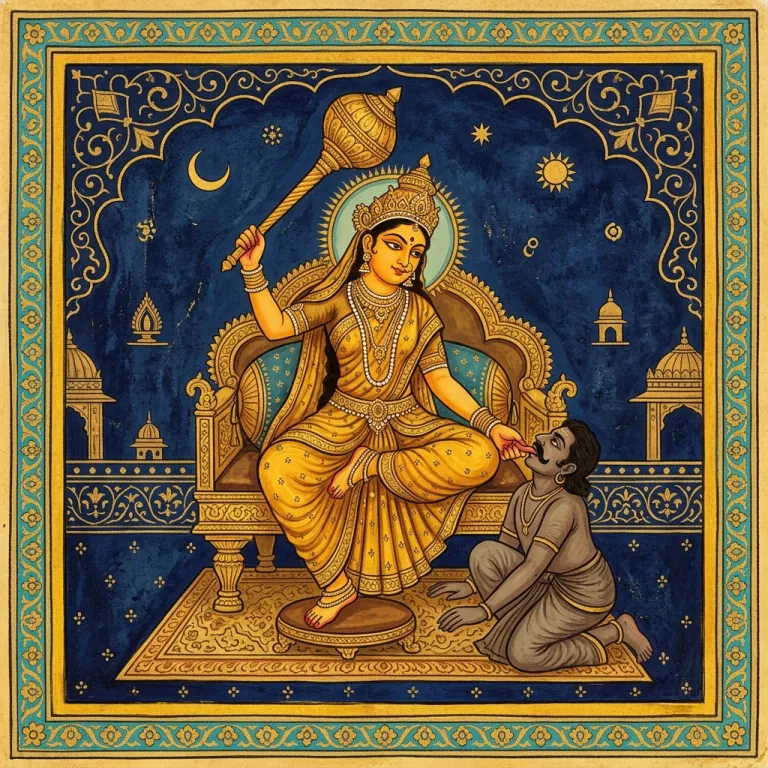
Bagalamukhi (बगलामुखी), also called Pitambara ("clad in yellow"), is the eighth of the ten Mahavidyas. She is the goddess of stambhana, the power to stop or paralyse. She is shown in yellow, holding a club and seizing a demon by the tongue. Devotees see her as stilling hostile speech, harmful forces and the restless mind.
In popular devotion, Bagalamukhi Mata is widely approached for help in disputes, legal cases and contests. Her temple at Datia in Madhya Pradesh is one of the busiest Mahavidya shrines in India. This page explains who she is, what her image means, the traditional claims made about her powers, how she is worshipped, and where her main temples are. The claims are presented as beliefs, not promises.
What Does Bagalamukhi Mean?
The popular reading takes baka or bagula to mean "crane", so Bagalamukhi would be "the crane-faced one". Some images do show a crane beside her or give her a crane's head. The crane standing perfectly still while it waits for a fish is a familiar picture of total concentration. Some scholars, Kinsley among them, note an alternative derivation from valga, "bridle" or "rein". In that reading, valgamukhi became bagalamukhi, "she whose face has the power to control", which fits her role as the goddess who restrains.
Her other name, Pitambara, comes from her yellow clothes. Yellow runs through her worship: yellow flowers, yellow garments, turmeric, and a rosary of turmeric beads.
Bagalamukhi Iconography and Symbolism
| Feature | Traditional meaning |
|---|---|
| Golden-yellow complexion and clothing | Yellow suggests turmeric, gold and the earth element, linked with steadiness and immobility; also royalty and auspiciousness |
| Seizing a demon's tongue | Stopping false, harmful or boastful speech at its source |
| Club (mudgara or gada) raised | Decisive force against obstacles and hostility |
| Jewelled throne amid an ocean, or a yellow lotus | Sovereign calm in the middle of turbulence |
| Crane (in some images) | One-pointed concentration and stillness |
| Two or four arms | The two-armed form stresses restraint; four-armed forms add a noose and other weapons |
The demon she holds is often named Madan in popular accounts. He is shown small and helpless, and in some images he looks toward her in devotion rather than anger.
Bagalamukhi Stories and Origin
The Cosmic Storm
A widely told story says that in an earlier age a great storm threatened to destroy creation. Vishnu did austerities near a lake of turmeric-coloured water, Haridra Sarovar, which popular accounts place in Saurashtra (Gujarat). The goddess rose from the lake as Bagalamukhi and stilled the storm with her power of stambhana. The story explains both her yellow colour and her power to stop.
The Demon Madan
In another popular account, the demon Madan gained vak siddhi, the power that whatever he said would come true, and began to misuse it. Bagalamukhi seized his tongue to stop him. Subdued, he asked to be worshipped with her, and she granted his wish. This is said to be why he appears at her side.
One of Sati's Ten Forms
In the Mahabhagavata Purana, she is one of the ten forms Sati shows Shiva before Daksha's sacrifice. Like the other stories, this is best read alongside the others. The lake and demon stories come mainly from later devotional and local tradition rather than early Sanskrit texts.
Stambhana: Traditional Claims About Bagalamukhi's Power
Medieval Tantric manuals classify ritual aims into six groups (shat karmani): pacifying, attracting, immobilising (stambhana), causing dissension, driving away, and killing. Historians of Tantra, including Hugh Urban, note that such worldly goals were a real part of pre-modern practice alongside liberation, as the Tantric texts show. Bagalamukhi became the goddess most closely linked with stambhana.
In modern devotion this becomes a set of popular beliefs. Devotees pray to her for protection from enemies, success in debates and examinations, and favourable outcomes in legal cases or elections. Indian media have often reported politicians visiting Datia before elections. These are traditional and popular claims, not established facts. This site does not offer rituals for influencing or harming anyone. Using spiritual practice to control others also conflicts with the ethical teachings of the tradition itself (see myths vs reality).
Many teachers stress an inner reading. The "enemy" whose tongue she seizes is one's own restless mind, gossip and self-deception. Stambhana then means the stilling of thought that meditation aims for. In the Mahavidya sequence, this stillness follows Dhumavati's emptiness and prepares for Matangi's inspired speech.
Bagalamukhi Mantra, Yantra and Worship
Her seed syllable (bija) is widely given as ह्लीं (hlim). Her principal root mantra, published in many devotional books, is a longer formula of about thirty-six syllables. It asks the goddess to still the speech, movement and intellect of "the wicked". Teachers generally treat it as a prayer for protection. It is not reproduced here, because every lineage insists it be received through initiation (diksha) and practised under guidance.
Common devotional practice uses yellow throughout: yellow clothes, yellow flowers, turmeric, yellow sweets, and a turmeric-bead rosary (haridra mala). Some devotees favour Thursdays, a day traditionally linked with yellow. Her yantra, often engraved on metal, has a central triangle with circles and lotus petals inside a square enclosure, in the style of other Tantric yantras. It is worshipped as the goddess herself within a full Tantric puja.
A note on practice
This page is educational, not ritual instruction. No mantra, yantra or ritual is presented as guaranteeing success in a court case, election or any other matter, and none should be used to try to harm or control another person. Legal, medical and personal problems need qualified professional help.
Pitambara Peeth, Datia and Other Bagalamukhi Temples
Pitambara Peeth in Datia, Madhya Pradesh, is the most famous centre of Bagalamukhi worship. It was established in the twentieth century by a renunciate known to devotees as Swamiji Maharaj. It houses Bagalamukhi as Pitambara Devi, a shrine to Dhumavati, and an old Shiva temple, Vankhandeshwar. The complex is especially crowded during Navaratri.
Other well-known temples include the Bagalamukhi temple at Nalkheda in Madhya Pradesh's Malwa region, on the Lakhundar river. There is also the Baglamukhi temple at Bankhandi in Kangra district, Himachal Pradesh. At the Kamakhya complex in Assam she is worshipped among the ten Mahavidyas. For other goddess pilgrimage centres, see sacred geography.
Bagalamukhi Jayanti is commonly observed on the eighth day of the bright fortnight of Vaishakha (April–May). The two Gupta Navaratris are also favoured for her worship.
Frequently Asked Questions
Who is Bagalamukhi Mata?
Bagalamukhi Mata, also called Pitambara, is the eighth of the ten Mahavidyas of Hindu Tantra. Dressed in yellow, she holds a club and grasps a demon's tongue. She is the goddess of stambhana, the power to stop, and devotees see her as silencing hostile speech and the restless mind.
What is the Bagalamukhi mantra?
Her seed syllable is widely given as "hlim", and her longer root mantra of about thirty-six syllables appears in many devotional books. Traditional teachers insist that it be received through initiation from a qualified guru. No mantra should be treated as a guaranteed way to win a dispute or any other outcome.
Where is Pitambara Peeth?
Pitambara Peeth is in Datia, Madhya Pradesh, not far from Gwalior and Jhansi. Established in the twentieth century by a renunciate known as Swamiji Maharaj, it houses Bagalamukhi as Pitambara Devi along with a Dhumavati shrine and the Vankhandeshwar Shiva temple.
Is Bagalamukhi worshipped for court cases?
Popular belief holds that Bagalamukhi helps devotees facing legal disputes, enemies or competition, because of her traditional link with stambhana. These are devotional beliefs, not guaranteed results. Legal matters need qualified legal advice, and the tradition's own ethics oppose using ritual to harm or control others.
Why is Bagalamukhi associated with yellow?
Her name Pitambara means "clad in yellow". Her worship uses yellow clothes, flowers, turmeric and a turmeric rosary. A popular story says she rose from a turmeric-coloured lake, Haridra Sarovar, to calm a cosmic storm. Yellow is also linked with the earth element and steadiness.
Which are the famous Bagalamukhi temples?
The best-known Bagalamukhi temples are Pitambara Peeth in Datia and the temple at Nalkheda, both in Madhya Pradesh, and the Baglamukhi temple at Bankhandi in Kangra district, Himachal Pradesh. She is also worshipped among the ten Mahavidyas at the Kamakhya complex in Assam.
Sources & Further Reading
- Kinsley, David. Tantric Visions of the Divine Feminine: The Ten Mahāvidyās. Berkeley: University of California Press, 1997.
- Urban, Hugh B. The Power of Tantra: Religion, Sexuality and the Politics of South Asian Studies. London: I.B. Tauris, 2010.
- Khanna, Madhu. Yantra: The Tantric Symbol of Cosmic Unity. London: Thames & Hudson, 1979.
- Shankaranarayanan, S. The Ten Great Cosmic Powers. 1972.
- Mahabhagavata Purana (Shakta Upapurana), the account of Sati and the ten Mahavidyas.