Mahavidya 9 of 10
Matangi — The Goddess of Speech, Music and Hidden Knowledge
मातङ्गी
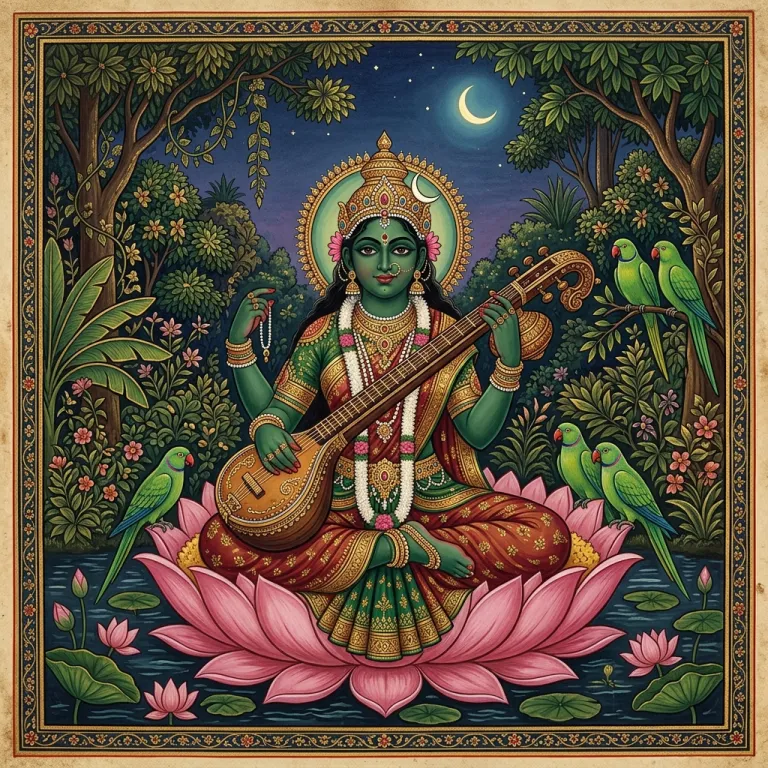
Matangi (मातङ्गी) is the ninth of the ten Mahavidyas. She is the Tantric goddess of speech, music, learning and inner knowledge. She is usually shown dark green, playing the veena, with a parrot. She is often called a Tantric Saraswati, but she is linked with leftovers (ucchishta) and people on the margins of society.
Orthodox ritual keeps leftovers and "polluted" people away from worship; Matangi's worship reverses this, showing that the divine does not stop at lines of purity and caste. In the Sri Vidya tradition, as Raja Matangi or Shyamala, she is also the chief minister of the goddess Lalita Tripurasundari.
Who Is Matangi? Names and Forms
Her name connects her with Matanga, a sage in Hindu legend, and with the Matanga people, a community historically classed as outside the caste order. Kinsley notes that her texts repeatedly tie her to such groups and to things considered impure. Her main forms include:
- Ucchishta Matangi or Ucchishta Chandalini: the form associated with leftover food and with worship in a state that orthodox ritual would call impure.
- Raja Matangi, Raja Shyamala or Mantrini: the royal form honoured in Sri Vidya as Lalita's minister and counsellor.
Matangi Iconography and Symbolism
| Feature | Traditional meaning |
|---|---|
| Dark green or dark blue (shyama) complexion | Fertility, depth and the hidden side of knowledge; the name Shyamala means "the dark one" |
| Veena (lute) | Music, sound and the arts; the creative power of vibration (nada) |
| Parrot | Speech and learning, since a parrot repeats words; also sweetness and eloquence |
| Crescent moon on the head, three eyes | Her kinship with Shiva and the power of inner vision |
| Youthful form, often sixteen years old | Freshness and full creative energy |
| Noose, goad, sword or shield (in some forms) | Control of the mind and the power to cut through ignorance |
| Offerings of leftovers | Nothing is outside the sacred; purity rules are transcended in her worship |
What Does Ucchishta Matangi Mean?
Ucchishta means "left over", especially food remaining after a meal, which has touched someone's mouth or hands. In orthodox Brahmanical rules such food is polluting and must never be offered to a deity. Ucchishta Matangi is worshipped with precisely such offerings. Some texts, discussed by Kinsley, prescribe that the worshipper approach her after eating, without first purifying themselves.
Kinsley reads this as a deliberate reversal. By accepting what society throws away, Matangi shows that divine reality is not limited by human ideas of purity. The practitioner learns to drop the habit of dividing the world into clean and unclean, itself a form of bondage. This is one reason Matangi is often discussed in studies of Tantric traditions that challenge social norms. Honouring an "outcaste" goddess did not, of course, end real caste discrimination.
Matangi Mythology and Origin Stories
Born from the Leftovers of the Gods
A story retold by Kinsley tells of Vishnu and Lakshmi visiting Shiva and Parvati and sharing a meal. From food that fell to the ground arose a dark maiden who asked for their leftovers. They were given to her, and it was declared that her worship would be connected with leftovers. She became known as Ucchishta Matangi.
Parvati as an Outcaste Woman
Another story, told in some traditions, says Parvati took the form of a low-caste huntress or outcaste woman and approached Shiva, who was drawn to her despite her status. When he realised who she was, he granted that this form would be worshipped as Ucchishta Chandalini, or Matangi. The story links her with love, attraction and the crossing of social boundaries.
Daughter of Sage Matanga and One of Sati's Forms
Other traditions say the goddess was born as the daughter of the sage Matanga after his austerities, which gives her the name Matangi. In the Mahabhagavata Purana, she is one of the ten forms Sati shows Shiva. As with other Mahavidyas, these accounts are parallel, not a single story.
Matangi's Place Among the Mahavidyas
Matangi rules speech in all its levels. Tantric philosophy of sound describes speech emerging from silent potential into spoken words (see Tantric philosophy). Some teachers link her to the throat centre, the chakra of expression (see chakras). In the Mahavidya sequence she follows Bagalamukhi, who stills speech, and comes before Kamala, who brings abundance. Silence gives way to inspired expression, which then flowers as prosperity.
In Sri Vidya, Raja Shyamala is Lalita's chief minister and leads part of her forces in the battle with the demon Bhanda. That battle is narrated in the Lalitopakhyana of the Brahmanda Purana. The Sanskrit hymn Shyamala Dandakam, traditionally attributed to the poet Kalidasa, praises her. Douglas Renfrew Brooks's studies of Sri Vidya describe how such subsidiary goddesses fit around the central worship of the Sri Yantra.
Matangi Worship, Mantra and Temples
Matangi is traditionally invoked for eloquence, learning, music and the arts. Her seed syllable is often given as ऐं (aim), the same syllable used for Saraswati. Several of her longer published mantras include attraction (vashya) formulas, so they are not reproduced here. Every lineage holds that her mantras should be received through initiation (diksha) and practised within a full Tantric sadhana.
Independent Matangi temples are uncommon. At the Kamakhya temple in Assam, Matangi is worshipped inside the main shrine along with Tripurasundari and Kamala, while the other Mahavidyas have separate temples in the complex. In South India, Raja Shyamala is honoured widely in Sri Vidya circles. Some communities observe the Magha Gupta Navaratri as Shyamala Navaratri in her honour.
A note on practice
This page is educational, not ritual instruction. No mantra or ritual is presented as guaranteeing learning, success or any other result, and none should be used to try to influence another person.
Matangi vs Saraswati: Key Differences
Matangi is often called the Tantric Saraswati, and both are goddesses of speech, music and learning. The differences are real, though.
| Aspect | Matangi | Saraswati |
|---|---|---|
| Tradition | Tantric; one of the ten Mahavidyas; Sri Vidya minister | Vedic and Puranic; worshipped across Hinduism, also in Jainism and Buddhism |
| Colour | Dark green or dark blue | White |
| Symbols | Veena, parrot, sometimes weapons | Veena, book, rosary, swan, white lotus |
| Purity | Accepts leftovers; linked with marginal groups | Associated with purity, the river and Vedic learning |
| Domain | Inner and "forbidden" knowledge, speech, arts, attraction | Learning, scripture, eloquence, music |
| Main festival | Gupta Navaratris, in some communities | Vasant Panchami |
Frequently Asked Questions
Who is the goddess Matangi?
Matangi is the ninth of the ten Mahavidyas, the Tantric goddess of speech, music, learning and inner knowledge. She is usually shown dark green, playing a veena, with a parrot. She is linked with leftover food and marginal communities, and in Sri Vidya she is Raja Shyamala, the minister of Lalita.
What is the meaning of Ucchishta Matangi?
Ucchishta means "leftover", especially food remaining after eating, which orthodox ritual treats as impure. Ucchishta Matangi is the form of the goddess worshipped with such leftovers. Scholars such as David Kinsley read this as a deliberate reversal showing that the divine is not bound by human rules of purity.
What is the difference between Matangi and Saraswati?
Both rule speech, music and learning. Saraswati is a white, Vedic goddess associated with purity, scripture and Vasant Panchami. Matangi is a dark green Tantric Mahavidya who accepts leftovers, is linked with marginal groups, and governs hidden knowledge. Many devotees see her as a Tantric form of Saraswati.
Is Matangi the same as Raja Shyamala?
Yes, in the Sri Vidya tradition Raja Matangi is also called Raja Shyamala or Mantrini, the chief minister of Lalita Tripurasundari. The hymn Shyamala Dandakam, traditionally attributed to Kalidasa, praises her. Tantric texts also describe other forms, such as Ucchishta Matangi, with different images and mantras.
Why does Matangi hold a parrot?
The parrot repeats words, so it symbolises speech, learning and eloquence, the goddess's main domains. It is also linked with sweetness and love. Together with the veena she plays, the parrot marks Matangi as the goddess of expression in both words and music.
Where is Matangi worshipped?
At the Kamakhya temple in Assam, Matangi is worshipped inside the main shrine along with Tripurasundari and Kamala. In South India, Raja Shyamala is honoured in Sri Vidya communities, some of which observe the Magha Gupta Navaratri as Shyamala Navaratri.
Sources & Further Reading
- Kinsley, David. Tantric Visions of the Divine Feminine: The Ten Mahāvidyās. Berkeley: University of California Press, 1997.
- Brooks, Douglas Renfrew. Auspicious Wisdom: The Texts and Traditions of Śrīvidyā Śākta Tantrism in South India. Albany: SUNY Press, 1992.
- Brooks, Douglas Renfrew. The Secret of the Three Cities: An Introduction to Hindu Śākta Tantrism. Chicago: University of Chicago Press, 1990.
- Kinsley, David. Hindu Goddesses: Visions of the Divine Feminine in the Hindu Religious Tradition. Berkeley: University of California Press, 1986.
- Shankaranarayanan, S. The Ten Great Cosmic Powers. 1972.
- Brahmanda Purana, Lalitopakhyana section; Mahabhagavata Purana (Shakta Upapurana).