Mahavidya 10 of 10
Kamala — Kamalatmika, the Lotus Goddess of Abundance
कमला / कमलात्मिका
Kamala (कमला, "she of the lotus"), also called Kamalatmika, is the tenth and last of the ten Mahavidyas. She is the Tantric form of Lakshmi, goddess of wealth, fertility, beauty and good fortune. She is shown golden, seated on a lotus, holding lotuses, while elephants pour water over her.
After the fierce forms of Kali, Chhinnamasta and Dhumavati, the sequence ends with the gentlest and most auspicious goddess. Kamala is often read as the point where the path, having passed through dissolution and emptiness, returns to the world and finds it full of grace.
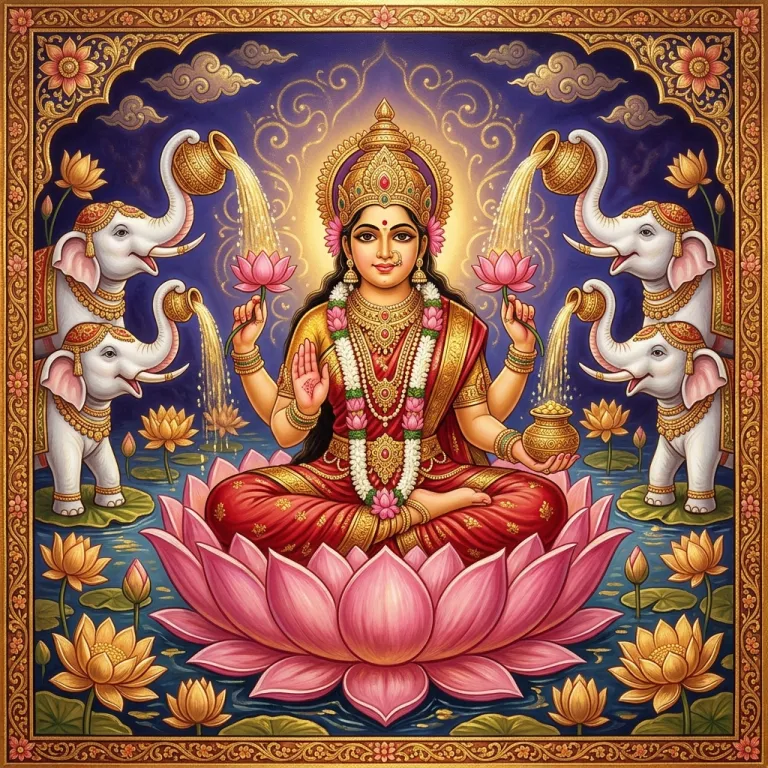
What Does Kamala Mean? Kamala and Kamalatmika
Kamala means "lotus", and as a name, "she who is of the lotus". Kamalatmika adds atman, "self", giving "she whose essence is the lotus". Growing from mud yet staying clean, the lotus is one of the oldest Indian symbols of purity, beauty, fertility and spiritual unfolding.
Lakshmi has been called Kamala and Padma ("lotus") since early Hindu literature. The Shri Sukta, a hymn appended to the Rigveda, already praises the goddess Shri as lotus-born, lotus-coloured and standing on a lotus. The Mahavidya Kamala inherits this long history.
Kamala Iconography and Symbolism
| Feature | Traditional meaning |
|---|---|
| Golden complexion | Wealth, radiance and the light of consciousness |
| Seated or standing on a lotus | Purity amid the world; spiritual unfolding rooted in ordinary life |
| Two hands holding lotuses | Beauty, fertility and the flowering of the heart |
| Two hands in boon (varada) and fearlessness (abhaya) gestures | Generosity and protection offered to devotees |
| Elephants pouring water from pots | Rain, fertility and royal consecration; the abundance of the earth |
| Rich garments and jewellery | Sovereignty and the sacredness of worldly prosperity |
The image of a goddess on a lotus bathed by elephants, known as Gaja-Lakshmi, is among the oldest goddess images in Indian art. It appears on early Buddhist monuments such as the gateways at Sanchi and on ancient coins. Kamala's Mahavidya image continues this ancient pattern.
Kamala Mythology and Origin Stories
Rising from the Churning of the Ocean
The best-known story of Lakshmi, told in the Vishnu Purana, the Bhagavata Purana and the Mahabharata, is the churning of the ocean of milk (samudra manthana). Gods and demons churned the ocean for the nectar of immortality. Among the treasures that emerged was the goddess Shri-Lakshmi, seated on a lotus. The elephants of the directions bathed her, and she chose Vishnu as her consort. This story explains the elephants in Kamala's image.
One of Sati's Ten Forms
In the Mahabhagavata Purana, Kamala is one of the ten forms Sati reveals to Shiva before Daksha's sacrifice. In that setting she is not Vishnu's consort but an aspect of the one Great Goddess. In most Mahavidya depictions she appears alone, without Vishnu, which matches the Shakta view that the Goddess is supreme in her own right.
A Note on Order
The list and order of the ten Mahavidyas vary between texts. Kamala does not always come last. This site follows the order most common in modern sources, in which Kamala closes the sequence.
Kamala's Meaning in Tantra
Kamala's place at the end of the modern sequence carries a clear message. The fierce goddesses teach letting go: of the ego with Kali, of the head itself with Chhinnamasta, of every support with Dhumavati. Kamala shows what returns once that letting go is complete. The world is received back as a gift, and prosperity, beauty and pleasure become forms of the Goddess rather than distractions from her.
This fits Tantra's general refusal to split spiritual and worldly goals. Many Tantric texts name both bhukti (enjoyment) and mukti (liberation) as aims of practice (see Tantric philosophy). Kamala represents bhukti made sacred. Practitioners also read her inwardly, as the unfolding "lotus" of the heart and of the chakras in the subtle body. The rings of lotus petals in the Sri Yantra echo the same symbol.
Kamala is also the most conventional of the ten, the most clearly a "householder" goddess. Her place in the group shows that the Mahavidyas cover the full range of the divine, from the terrifying to the benign.
Kamala Mantra, Yantra and Worship
Kamala's seed syllable (bija) is श्रीं (shrim), which is also Lakshmi's. A widely published mantra addressed to her as Kamala is ॐ श्रीं ह्रीं श्रीं कमले कमलालये प्रसीद प्रसीद श्रीं ह्रीं श्रीं ॐ महालक्ष्म्यै नमः (om shrim hrim shrim kamale kamalalaye prasida prasida shrim hrim shrim om mahalakshmyai namah). It asks "Kamala, who dwells in the lotus" to be gracious. Many devotees recite Lakshmi prayers openly. For Tantric practice, however, lineages hold that the mantra should be received through initiation (diksha).
Her yantra has a central triangle surrounded by circles, rings of lotus petals and a square enclosure, the usual layout of Tantric yantras. Offerings typically include lotuses, red or pink flowers, sweets, lamps and fragrance. Fridays, Diwali and the Gupta Navaratris are popular times for her worship. Some calendars mark Kamala Jayanti on the new-moon night of Kartika, the night of Diwali.
A note on practice
This page is educational, not ritual instruction. No mantra or ritual is presented as a guaranteed way to gain wealth or any other result, and spiritual practice is no substitute for sound financial, medical or professional advice.
Where Is Kamala Worshipped?
At the Kamakhya temple in Assam, Kamala is worshipped inside the main shrine together with Tripurasundari and Matangi, while the other Mahavidyas have separate temples in the complex (see sacred geography). Beyond Kamakhya, Kamala is mostly worshipped through Lakshmi's many temples and through Mahavidya shrines that house all ten goddesses. In Bengal, Diwali night is also the night of Kali Puja, so the first and last Mahavidyas are honoured on the same new moon.
Kamala vs Lakshmi: Key Differences
Kamala and Lakshmi are the same goddess in essence, but they are approached in different ways.
| Aspect | Kamala (Mahavidya) | Lakshmi (Puranic / Vaishnava) |
|---|---|---|
| Setting | Shakta Tantra; one of the ten Mahavidyas | Vedic hymns, Puranas and Vaishnava devotion |
| Consort | Usually shown alone; an aspect of the supreme Goddess | Wife of Vishnu, often shown at his side or feet |
| Worship | Tantric sadhana with yantra, nyasa and initiated mantra | Household puja, especially on Diwali and Fridays |
| Meaning | Completion of the Mahavidya path; worldly life seen as sacred | Wealth, fortune, fertility and royal prosperity |
| Shared features | Lotus seat, golden colour, elephants, the seed syllable shrim | |
Frequently Asked Questions
Who is Kamala Mahavidya?
Kamala, also called Kamalatmika, is the tenth of the ten Mahavidyas. She is the Tantric form of Lakshmi, goddess of wealth, fertility and good fortune. She is shown golden, seated on a lotus and bathed by elephants. She represents abundance and grace as expressions of the divine.
What does Kamalatmika mean?
Kamalatmika means "she whose very self is the lotus", from kamala (lotus) and atman (self). The lotus grows from mud yet stays clean, so it symbolises purity, beauty and spiritual unfolding. The name stresses that the goddess is identical with what the lotus represents.
Are Kamala and Lakshmi the same?
In essence, yes: Kamala is Lakshmi as worshipped within the Tantric Mahavidya system. The difference is in emphasis. Lakshmi is usually honoured as Vishnu's consort in household and temple worship, while Kamala is shown alone as an aspect of the supreme Goddess and approached through Tantric sadhana.
Why is Kamala the last Mahavidya?
In the most common modern order, Kamala closes the sequence. After the fierce goddesses teach letting go of ego and attachments, Kamala shows the world returning as grace, with prosperity and beauty seen as divine. The order of the Mahavidyas does, however, vary between texts.
What is the Kamala mantra?
Kamala's seed syllable is "shrim". A widely published mantra addresses her as "Kamale Kamalalaye", Kamala who dwells in the lotus, asking her to be gracious. Tantric lineages hold that such mantras should be received through initiation, and no mantra should be seen as a guaranteed source of wealth.
Why do elephants pour water on Kamala?
The image, called Gaja-Lakshmi, is among the oldest in Indian art. The elephants represent rain, fertility and royal consecration. In the story of the churning of the ocean, the elephants of the directions bathed Lakshmi when she emerged, and Kamala's image continues this tradition.
Sources & Further Reading
- Kinsley, David. Tantric Visions of the Divine Feminine: The Ten Mahāvidyās. Berkeley: University of California Press, 1997.
- Kinsley, David. Hindu Goddesses: Visions of the Divine Feminine in the Hindu Religious Tradition. Berkeley: University of California Press, 1986.
- Khanna, Madhu. Yantra: The Tantric Symbol of Cosmic Unity. London: Thames & Hudson, 1979.
- Brooks, Douglas Renfrew. Auspicious Wisdom: The Texts and Traditions of Śrīvidyā Śākta Tantrism in South India. Albany: SUNY Press, 1992.
- Shankaranarayanan, S. The Ten Great Cosmic Powers. 1972.
- Shri Sukta (Rigveda Khila); Vishnu Purana, the churning of the ocean; Mahabhagavata Purana (Shakta Upapurana).