Mahavidya 2 of 10
Goddess Tara — The Second Mahavidya, Who Carries Devotees Across
तारा
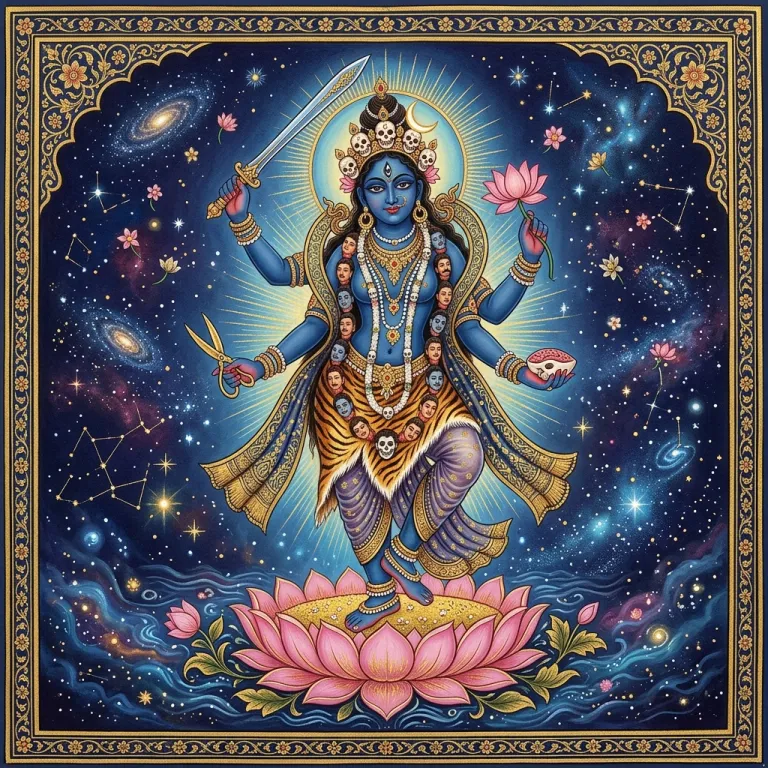
Tara (तारा) is the second of the ten Mahavidyas, a fierce, blue-skinned Tantric goddess whose name means “she who carries across” or “star.” Devotees worship her as the saviour who carries them across the ocean of worldly suffering, and as the power of speech and guiding wisdom.
Tara looks so much like Kali that the two are often confused. She also shares her name with one of the most beloved figures of Buddhist Tantra. This guide covers Tara’s symbols, her myths, the famous shrine of Tarapith in Bengal, and the differences between Tara and Kali and between the Hindu and Buddhist Taras.
What Does Tara Mean?
“Tara” comes from the Sanskrit verb root tṛ, “to cross over.” The goddess is Tarini, “she who saves by carrying across.” Worldly life (samsara) is often pictured as a dangerous ocean, and Tara is the boat or the pilot. The same word also means “star.” Commentators link this to her role as a guiding light, like the stars sailors steer by.
A second strand links Tara with speech (vak). Her form Nila Saraswati, the “blue Saraswati,” is invoked for eloquence and learning. In the Tantric reading of sound, Tara is the power by which silent consciousness becomes the word. She sits just after Kali in the list: Kali is time dissolving into the void, and Tara is the first stirring of sound and light in that darkness.
Tara Iconography and Symbolism
Tantric meditation verses (dhyana) describe Tara in a form scholars such as David Kinsley have summarised. She is dark blue, short and pot-bellied. She stands in the pratyalidha posture, left foot forward, on a corpse or on Shiva, often in a cremation ground or on a burning pyre.
| Feature | Traditional meaning |
|---|---|
| Blue complexion | Endless space and depth, like the sky or ocean she carries devotees across |
| Sword (khadga) | Cutting through ignorance |
| Shears or cleaver (kartri) | Severing the bonds of attachment |
| Skull cup (kapala) | Consuming everything that is impermanent |
| Blue lotus (nilotpala) | Purity and awakening that rise out of worldly life |
| Tiger skin around the waist | Mastery over wild, untamed energies |
| Single matted braid (ekajata) | Ascetic power. In some images a small figure of the Buddha Akshobhya sits in her hair, a sign of Buddhist connections. |
| Protruding belly | Her capacity to hold and absorb the whole universe |
| Standing on Shiva or a corpse | As with Kali, consciousness is inert without Shakti, and she acts on it to set it in motion |
Beside this fierce image there is a tender one, found especially at Tarapith. There Tara is shown as a mother nursing Shiva at her breast. The story behind it is told below.
Tara Mythology and Origin Stories
Tara among Sati’s ten forms
In the Mahabhagavata Purana’s account of the Mahavidyas, Sati is angry at being forbidden to attend her father Daksha’s sacrifice, and she appears to Shiva in ten forms that surround him on all sides. Tara is the second of these forms. As with all ten, the story shows that the goddess is present in every direction and that her power surpasses Shiva’s. Different texts give different directions and orders for the goddesses.
Tara nursing Shiva
A well-known legend connected with Tarapith draws on the churning of the ocean. When the deadly halahala poison rose from the waters, Shiva drank it to save the world, and his throat turned blue. The local tradition adds that the poison left him in burning pain. Tara took him on her lap and nursed him, and her milk soothed the burning. The story shows the protective, motherly side of a goddess who looks fierce.
Vasishtha and the “Chinese” method
Some Tantras, including works in the Tara tradition, tell how the sage Vasishtha failed in his worship of Tara. He was then sent to “Mahachina,” a region beyond the Himalaya, to learn the chinachara method of worship. Scholars take this legend as a sign that Tara worship had strong links to regions and practices outside the Brahmanical mainstream, including Buddhist ones. Tradition places Vasishtha’s later success at Tarapith.
Tara’s Place Among the Mahavidyas
Tara stands closest to Kali in the Mahavidya series, and both belong to the Kalikula, the “Kali family” of Tantric lineages. Kinsley notes that many texts describe the two in near-identical terms. The Todala Tantra pairs Tara with Akshobhya, a form of Shiva, and some later lists match her to Vishnu’s Rama avatar. Philosophically, Tara stands for grace in action. Kali strips away every false support, and Tara is the saving hand that follows. For the full series, see the Dasha Mahavidya overview.
Kali vs Tara: Key Differences
The two goddesses share a fierce appearance, a cremation-ground setting and a position on Shiva, but tradition keeps them distinct:
| Aspect | Kali | Tara |
|---|---|---|
| Position | First Mahavidya | Second Mahavidya |
| Name | “The black one”; linked to time (kala) | “She who carries across”; “star” |
| Colour | Black or very dark blue | Blue |
| Build and dress | Tall, slender, naked, with a girdle of arms | Short, pot-bellied, wearing a tiger skin |
| Typical hand objects | Sword and severed head; gestures of protection and blessing | Sword, shears, skull cup and blue lotus |
| Core idea | Time, dissolution, liberation | Salvation, guidance, speech and sound |
| Seed syllable | Krim | Strim (commonly given) |
| Best-known shrines | Kalighat, Dakshineswar | Tarapith |
| Buddhist parallel | None of comparable importance | Yes: the Buddhist Tara |
Tara in Buddhism vs Hinduism
In Mahayana and Vajrayana Buddhism, Tara is a female bodhisattva or Buddha of compassion. She is especially loved in Tibet and Nepal. Tibetan tradition tells that she was born from a tear of Avalokiteshvara, and it describes twenty-one Taras, of whom Green Tara and White Tara are the best known. Her widely chanted mantra is Om Tare Tuttare Ture Soha. Buddhist Tara is generally gentle and youthful, though wrathful forms exist.
Tara is well attested in Buddhist art and texts of India from roughly the 6th–7th centuries CE onward. The Hindu Mahavidya Tara shows clear points of contact, such as Akshobhya in her hair, the name Ekajata (also a Buddhist deity) and the Vasishtha legend. Most scholars see a real historical exchange between the two traditions, but they debate its direction and details. It is best not to treat the two Taras as simply identical. Each belongs to its own framework of practice and doctrine.
| Aspect | Hindu Mahavidya Tara | Buddhist Tara |
|---|---|---|
| Role | A form of the Great Goddess (Shakti) | Bodhisattva or female Buddha of compassion |
| Typical appearance | Fierce, blue, standing on Shiva | Mostly peaceful, seated, green or white |
| Goal of worship | Protection, grace, liberation (moksha) | Protection and progress toward awakening (bodhi) |
| Key centres | Tarapith; Kamakhya complex | Monasteries across Tibet, Nepal and the Himalaya |
Tara Worship: Mantra, Yantra and Practice
Tara is worshipped in temples, in household devotion and in initiated Tantric sadhana. Her seed syllable is commonly given as Strim (स्त्रीं). A widely published mantra is Om Hrim Strim Hum Phat. Practitioners also recite hymns such as the Tara Stotra and her hundred names.
The Tara yantra is generally described as a central point inside a downward-pointing triangle, surrounded by an eight-petalled lotus and a square enclosure with four gates. Worship moves from the outer square toward the centre, as with other yantras.
A note on practice
Tantric traditions hold that mantras like these should be received through initiation (diksha) from a qualified teacher. They are spiritual disciplines with no guaranteed worldly results. Practices associated with cremation grounds belong to specific lineages and are not meant for casual experiment.
Tarapith and Other Tara Temples
Tarapith, near Rampurhat in the Birbhum district of West Bengal, is the most famous Tara shrine in India. Local tradition counts it among the Shakti Peethas, holding that Sati’s eye fell here, though it does not appear in every list. The temple image is a metal mask of the goddess. The deeper image beneath it is traditionally described as Tara nursing Shiva.
Next to the temple lies a cremation ground long used for Tantric practice. It is closely associated with Bamakhepa (Vamakshepa, 19th century), a celebrated Tara devotee remembered for his unconventional, childlike devotion to the Mother. Among Tarapith’s festivals, Kaushiki Amavasya, the new moon of the month of Bhadrapada, draws very large crowds, and Kali Puja night is also important.
The Kamakhya temple complex in Guwahati, Assam, also has a Tara shrine among its Mahavidya temples. Tara is also honoured during Navaratri alongside the other Mahavidyas.
Frequently Asked Questions
Who is Tara in the Mahavidyas?
Tara is the second of the ten Mahavidyas. She is a fierce, blue-skinned goddess whose name means “she who carries across.” She is worshipped as a saviour who ferries devotees across worldly suffering and as a power of speech and wisdom. She is closely related to Kali and belongs to the Kalikula family of Tantric lineages.
What is the difference between Kali and Tara?
Both are fierce goddesses who stand on Shiva, but Kali is black, tall and naked and stands for time and dissolution. Tara is blue, short and pot-bellied, wears a tiger skin and holds shears and a blue lotus, and she stands for salvation, guidance and speech. Kali’s seed syllable is krim; Tara’s is commonly given as strim.
Is Hindu Tara the same as Buddhist Tara?
Not exactly. They share a name and some features, and scholars agree the two traditions influenced each other. Buddhist Tara, however, is a bodhisattva of compassion, usually peaceful and green or white. The Hindu Mahavidya Tara is a fierce form of the Great Goddess. Each belongs to its own system of practice and doctrine.
Why is Tarapith famous?
Tarapith, in Birbhum district of West Bengal, is the best-known shrine of goddess Tara. Local tradition counts it as a Shakti Peetha, links it with the sage Vasishtha, and shows Tara nursing Shiva. Its cremation ground is associated with the saint Bamakhepa, and festivals such as Kaushiki Amavasya attract large numbers of pilgrims.
What is the mantra of goddess Tara?
In Hindu Tantra, Tara’s seed syllable is commonly given as strim, and a widely published mantra is “Om Hrim Strim Hum Phat.” Buddhists chant “Om Tare Tuttare Ture Soha” to their Tara. Hindu Tantric tradition holds that such mantras should be received through initiation and practised under guidance.
Why does Tara stand on Shiva?
As with Kali, the image is usually read symbolically. Shiva stands for pure, still consciousness and Tara for the active power that brings it into expression. Without Shakti, Shiva is said to be like a corpse. The pose also shows her supremacy in Shakta theology, while the Tarapith image of Tara nursing Shiva shows her motherly side.
Sources & Further Reading
- David Kinsley, Tantric Visions of the Divine Feminine: The Ten Mahāvidyās (University of California Press, 1997)
- Stephan Beyer, The Cult of Tārā: Magic and Ritual in Tibet (University of California Press, 1973)
- Miranda Shaw, Buddhist Goddesses of India (Princeton University Press, 2006)
- Hugh B. Urban, The Power of Tantra: Religion, Sexuality and the Politics of South Asian Studies (I.B. Tauris, 2010)
- June McDaniel, Offering Flowers, Feeding Skulls: Popular Goddess Worship in West Bengal (Oxford University Press, 2004)
- S. Shankaranarayanan, The Ten Great Cosmic Powers: Daśa Mahāvidyās (1972)