Temple Guide
Mookambika Temple, Kollur: The Devi, the Golden Line and Vidyarambham
मूकाम्बिका मन्दिर
Mookambika Temple is a goddess shrine at Kollur in the Udupi district of Karnataka, on the southern bank of the Souparnika river at the foot of the Kodachadri hills, where the Devi is worshipped in a self-manifested (swayambhu) linga divided by a fine golden line. Temple tradition reads that line as uniting Shiva and Shakti in a single object of worship.
Kollur is one of the busiest goddess temples on the Karnataka coast, and much of its traffic comes from outside the state: Malayali and Tamil families travel to it in very large numbers, particularly for Vidyarambham, the ceremony in which a small child writes a first letter. This guide sets out where the temple is, what is actually in the sanctum, the Mookasura story that gives the goddess her name, the Adi Shankara association and how much weight it can bear, the Kodachadri pilgrimage above the village, and sober visiting guidance. For the wider regional picture, see our guide to South India's Shakti temples.
Where Is Mookambika Temple and Why Do People Go?
Mookambika Temple (मूकाम्बिका मन्दिर) is at Kollur, a small temple village in the Udupi district of Karnataka, inland from the Arabian Sea coast and at the western foot of the Kodachadri range in the Western Ghats. The Souparnika river runs past the village, and bathing in it before darshan is a normal part of the visit; the temple stands on its southern bank.
Three things explain the crowds. The sanctum holds an unusual object of worship — not an image of a goddess, but a linga read as containing both Shiva and Shakti. Kollur is tied in tradition to Adi Shankara, which gives it weight out of proportion to the village. And the temple is strongly associated with learning: it is a Saraswati shrine in function as much as a Shakta one, and families bring children here to begin their education.
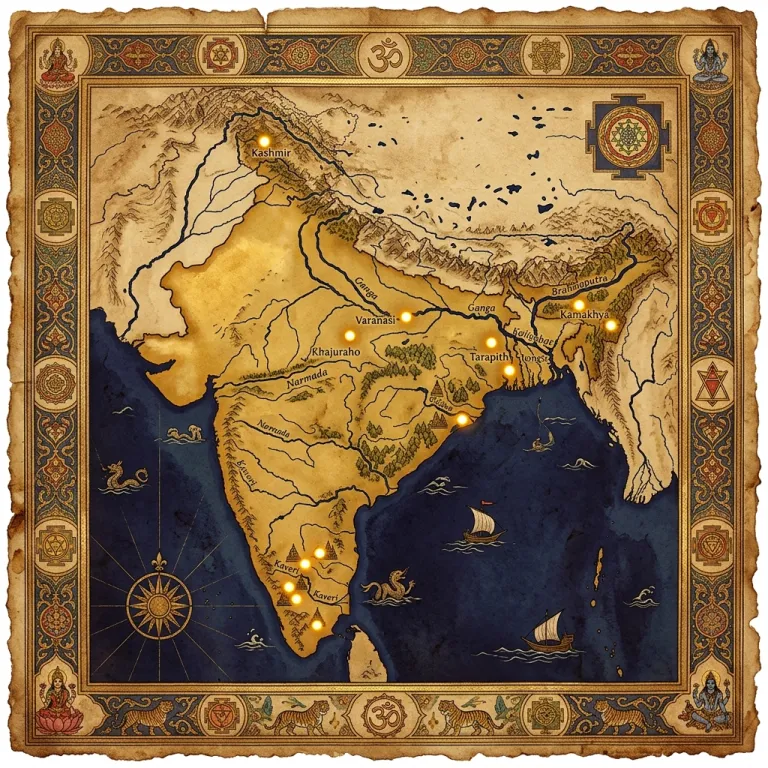
Kollur sits in a different religious landscape from the Shakta sites this encyclopedia has covered most — Bengal's Kalighat and Tarapith, Assam's Kamakhya, the Himachal Peethas. Coastal Karnataka's temple culture is its own, and it carries a heavy traffic of pilgrims coming up from Kerala.
Who Is Mookambika Devi? Shakti and Shiva in One Linga
Mookambika is worshipped as the great Goddess in a form that deliberately refuses to separate her from Shiva. She is addressed as Adi Parashakti and, in Sri Vidya idiom, identified with Lalita Tripurasundari; she is also approached as Saraswati, the goddess of speech and learning, which is why Kollur became a place for beginning study. Devotees commonly describe her as holding the functions of all three goddesses — Saraswati, Lakshmi and Parvati — at different points of the day or in different aspects, though descriptions of this vary from one account to another and we would not state a fixed schedule as fact.
The Golden Line in the Swayambhu Linga
The distinctive feature of the shrine is the object in the sanctum. It is a swayambhu linga — self-manifested, not carved and installed, in the same category of claim made for the jyotirlinga shrines of Shiva, though Kollur is not counted among the twelve jyotirlingas. Running through it is a fine golden line, usually said to be clearly visible during the ablution (abhisheka) rather than at all times.
Temple tradition reads that line as dividing the single form into two halves, one carrying the male triad and the other the female: Brahma, Vishnu and Shiva on one side, Saraswati, Lakshmi and Parvati on the other. Accounts differ on which side is which — a disagreement worth noticing, because it shows the meaning carried is theological rather than topographical. The point is that the masculine and feminine principles, consciousness and power, are not two objects side by side but one reality with a seam in it: the same non-dual claim the Shakta and Shaiva philosophies make in argument, made here in stone.
The golden line is a feature of a worshipped object inside a living temple. No geological or art-historical account of it is available to us: we report what the tradition says about it, not what it is.
The Panchaloha Image Behind the Linga
Behind the linga stands a metal image of the seated Goddess, described in temple accounts as panchaloha — a five-metal alloy — and attributed by tradition to Adi Shankara's own consecration. Most devotees experience the darshan as being of this richly dressed figure, with the linga at its base. The arrangement is itself a statement: the aniconic swayambhu form is primary, the image secondary.
The Mookasura Story Behind the Name
The name Mookambika — "the mother of the mute one", or "she of Mooka" — is explained by a Puranic-style legend that every account of the temple repeats. A demon performed a severe penance to win a boon of invincibility. Seeing what he intended to ask for, the Goddess took away his power of speech at the decisive moment, so that he could not pronounce the request; from then on he was Mooka, the mute, and he became Mookasura. He continued to harass the sages of the region until a rishi — named in most retellings as Kola Maharishi, from whom the village name Kollur is derived — appealed to the Goddess, who took form here and killed him.
Two cautions. The demon's earlier name is spelled differently between retellings, and the site identified as the place of his killing is local tradition rather than any text we can cite. More importantly, this is sthala-purana, the sacred story of a place: an explanation of a name and a licence for worship, not a historical claim, and nobody in the tradition treats it as one.
The narrative shape is familiar from the Durga Saptashati: austerity won, a boon that would make the asura untouchable, and a Goddess who intervenes with intelligence as much as force. What is particular to Kollur is that the thing removed is speech — which sits suggestively alongside the temple's identity as a place where children are given their first letters.
Adi Shankara and Kollur: Tradition Versus Documented History
Almost everything written about Mookambika leads with Adi Shankara, and the association must be reported — but it must be reported honestly.
What tradition holds: that Shankara, the eighth-century Advaita teacher, meditated on Kodachadri above Kollur, received a vision of the Goddess, asked her to come down to a place where everyone could worship her, and consecrated her image at the present site. Some retellings add a condition — that he was not to look back as she followed — and explain the temple's location by his having done so. The Sarvajnapeetha atop Kodachadri is pointed out as his seat.
What can be documented: very little. The historical Shankara is himself a difficult figure to date closely, and the standard traditional biographies (the several Shankara-vijaya texts) are devotional works composed centuries after his lifetime, which disagree with each other on itinerary and incident. There is no inscription or contemporary record known to us that places Shankara at Kollur. This is a traditional attribution, not documented history, in exactly the way that many South Indian temples claim a Shankara foundation — the claim is a statement of alignment with the Advaita and Sri Vidya mainstream, and its religious meaning does not depend on being historically verifiable.
None of that makes the association unimportant: it is old, held firmly, and part of why Kollur functions as a learning shrine. But a reader asking whether Adi Shankara founded this temple deserves the accurate answer — nobody can show that he did, and the tradition that he did is itself a significant religious fact. We take the same approach to the Shankaracharya associations at Kanchi and other southern shrines.
Why Mookambika Matters to Kerala and Tamil Devotees
One of the things a visitor notices at Kollur is how much Malayalam is spoken there. Although the temple is in Karnataka, its devotee base extends well beyond the state, and in Kerala in particular Mookambika is treated as a household deity rather than a distant pilgrimage.
Several threads explain this. Kollur sits at the northern end of a coastal corridor that has carried people, trade and ritual between Kerala and Tulu Nadu for centuries. The Goddess's identification with Saraswati speaks directly to a Kerala religious culture in which initiation into learning is a major family rite. And the arts carry the connection: Kollur has long been a place where Kerala musicians, dancers and writers offer a first performance or seek the Goddess's sanction for their work. Tamil devotees come in large numbers too, drawn by the Saraswati and Sri Vidya associations.
The practical consequence is that Kollur runs on a Kerala calendar as much as a Karnataka one: its busiest season is Navratri and Vijayadashami, when the Vidyarambham rite fills the village with families who have travelled overnight for it.
Vidyarambham at Mookambika: A Child's First Letters
Vidyarambham (विद्यारम्भम्, "the beginning of learning") is the ceremony in which a young child, usually around the age of two or three, is made to write for the first time. An elder — a priest, a teacher, or a respected family member — guides the child's finger to trace the opening syllables of an invocation, traditionally in rice or sand spread on a tray and then on the child's tongue with a gold ring or a grain of rice. In Kerala it is performed on Vijayadashami, the tenth day of the Navratri sequence, and at Kollur it is performed at scale: thousands of children in a single morning.
The rite is conducted in a hall of the temple known as the Saraswati Mandapam, and its logic is straightforward: education begins under the Goddess's authority rather than a teacher's, and the first act of writing is an offering. Adults use the mandapa too — musicians, dancers and students often make a first offering of their art here, or begin a course of study with a formal prayer.
Saraswati Puja and the Navratri Season
Vidyarambham is the final act of a longer sequence. In the Kerala pattern, books and instruments of work are ceremonially laid before the Goddess for Saraswati Puja during the closing days of Navratri — a period called Puja Vaipu, "the placing" — are left untouched while she is held to inhabit them, and are taken up again (Puja Eduppu) on Vijayadashami, at which point learning resumes and new learning begins. The dates move every year with the lunar calendar, so check a panchang or the temple's own announcement rather than any fixed Gregorian date; our Navratri guide explains the underlying rule.
Outside Navratri the temple keeps a full ritual year, including Friday observances and an annual car festival. Because these dates shift with the regional calendar, we give none here.
Kodachadri Hill and the Sarvajnapeetha
Above Kollur rises Kodachadri (also Kudajadri), a peak in the Western Ghats inside a protected wildlife area, and for many pilgrims the visit is incomplete without it. The hill is treated as the Goddess's original seat — the moola sthana — with the Kollur temple as the accessible shrine she was brought down to.
At or near the summit stand two things pilgrims look for: a small shrine often described as the original Mookambika moola sthana, and the Sarvajnapeetha, a modest open stone structure identified in tradition as the seat where Adi Shankara meditated. The name means "the seat of omniscience". As with the wider Shankara association, the identification is traditional; the structure's date is not something we can state.
Sri Chakra and Sri Vidya at Kollur
Mookambika is drawn firmly into the Sri Vidya tradition, the southern Shakta stream centred on the goddess Lalita Tripurasundari and the Sri Chakra. Temple accounts describe a Sri Chakra associated with the shrine and attributed, again, to Adi Shankara's establishment — the same claim made for Kanchi Kamakshi and several other southern goddess temples. Devotees recite the Lalita Sahasranama here, and the identification of Mookambika with Lalita is routine in devotional literature.
How much formal Sri Vidya ritual takes place inside the sanctum is not something an outsider can verify, and we do not assert it. What can be said safely is that Kollur sits inside the Sri Vidya devotional world. Sri Vidya proper is an initiatory tradition whose mantra practice is held to require diksha from a qualified guru; the public worship at Kollur is devotional rather than initiatory.
Visiting Mookambika Temple: General Guidance
The table below is deliberately general: districts, nearest towns and named railheads, and nothing else. Timings, darshan arrangements, seva rates and fares all change, and a page like this one is the wrong place to learn them. Check the temple administration's current notices or ask locally.
| Question | General guidance |
|---|---|
| Where exactly | Kollur village, Byndoor taluk area, Udupi district, Karnataka, on the southern bank of the Souparnika river below Kodachadri. |
| Nearest towns | Byndoor and Kundapura are the closest towns of any size; Udupi and Mangaluru are the nearest large centres, and Shivamogga lies inland. |
| Railheads | Mookambika Road Byndoor and Kundapura, both on the Konkan Railway, are the stations usually used. Buses and taxis connect them to Kollur. |
| Air | Mangaluru is the nearest airport; Bengaluru is the usual long-haul entry point for visitors from outside the region. |
| Timings | The temple keeps the usual South Indian pattern of a long morning session, a midday closure and an evening session. We give no hours: they vary by season and festival, so rely on current notices. |
| Busiest periods | Navratri and Vijayadashami (Vidyarambham), the annual car festival, Fridays, and school holiday weekends. |
| Dress | Traditional, modest dress is expected, and coastal Karnataka temples are conservative about it: men commonly remove upper garments and wear a dhoti or mundu, women a sari or long skirt and blouse. Trousers and shorts may not be accepted. Footwear is left outside. |
| Conduct | No photography inside the shrine. Bathing in the Souparnika before darshan is customary. Queues are long during festivals and the sanctum area is small. |
| Combining the visit | Kodachadri above the village is a full half-day or day; Udupi, Murudeshwara and Kundapura are on the same coastal route. |
A last note: Kollur is a village, and accommodation is limited and heavily oversubscribed during Navratri. Entry policies for people of other faiths are set by each South Indian temple individually and are not uniform, so ask rather than assume — see our South Indian temple etiquette notes.
Frequently Asked Questions
Where is Mookambika Temple located?
Mookambika Temple is at Kollur in the Udupi district of Karnataka, on the southern bank of the Souparnika river at the foot of the Kodachadri hills in the Western Ghats. The nearest towns are Byndoor and Kundapura; Udupi and Mangaluru are the closest large centres, and both Mookambika Road Byndoor and Kundapura stations serve the village.
What is the deity in Mookambika Temple?
The object of worship is a swayambhu linga with a fine golden line through it, which temple tradition reads as uniting the male and female principles in one form, with the three gods on one side and the three goddesses on the other. Accounts differ on which side is which. A metal image of the seated Goddess stands behind the linga.
Why is she called Mookambika?
Tradition explains the name through the demon Mookasura. He performed austerities to win invincibility, but the Goddess removed his power of speech before he could ask for the boon, leaving him mute, or mooka. He troubled the sages of the region until she took form at Kollur and killed him. This is the sacred story of the place rather than history.
Did Adi Shankara establish Mookambika Temple?
Tradition holds that he meditated on Kodachadri, received a vision of the Goddess, and consecrated her worship at Kollur. This is a traditional attribution rather than documented history. No inscription or contemporary record places Shankara at Kollur, and the traditional biographies of him were written centuries later and disagree with each other.
What is Vidyarambham at Mookambika Temple?
Vidyarambham is the ceremony in which a young child writes a first letter, guided by an elder, usually on Vijayadashami at the close of Navratri. At Kollur it is performed on a very large scale in the Saraswati Mandapam, because the Goddess here is also approached as Saraswati. Adults beginning a course of study or an art often make a similar offering.
What are Mookambika Temple timings?
The temple follows the usual South Indian pattern of a long morning session, a midday closure and an evening session, but we do not publish hours. Timings, darshan arrangements and seva schedules change with the season and the festival calendar, so check the temple administration's current notices rather than any third-party page.
Is Kodachadri part of the Mookambika pilgrimage?
Many pilgrims treat it as part of the same visit. Kodachadri hill above Kollur is held in tradition to be the Goddess's original seat, and near the summit stands the Sarvajnapeetha, a small stone structure identified as Adi Shankara's meditation seat. It is a hill climb in a protected forest area with access rules that change, so go with local guidance.
What should I wear at Mookambika Temple?
Traditional and modest dress is expected. Coastal Karnataka temples are conservative: men commonly remove upper garments and wear a dhoti or mundu, and women wear a sari or a long skirt and blouse. Trousers and shorts may not be accepted. Footwear is left outside, and photography inside the shrine is not permitted.
Sources & Further Reading
- Douglas Renfrew Brooks, Auspicious Wisdom: The Texts and Traditions of Srividya Sakta Tantrism in South India, State University of New York Press, 1992.
- Douglas Renfrew Brooks, The Secret of the Three Cities: An Introduction to Hindu Sakta Tantrism, University of Chicago Press, 1990.
- David Kinsley, Hindu Goddesses: Visions of the Divine Feminine in the Hindu Religious Tradition, University of California Press, 1986.
- Diana L. Eck, India: A Sacred Geography, Harmony Books, 2012.
- C. J. Fuller, Servants of the Goddess: The Priests of a South Indian Temple, Cambridge University Press, 1984.
- C. J. Fuller, The Camphor Flame: Popular Hinduism and Society in India, Princeton University Press, 1992.
- Local temple tradition (sthala-purana) for the Mookasura narrative, the golden line and the Adi Shankara account, labelled as tradition throughout.